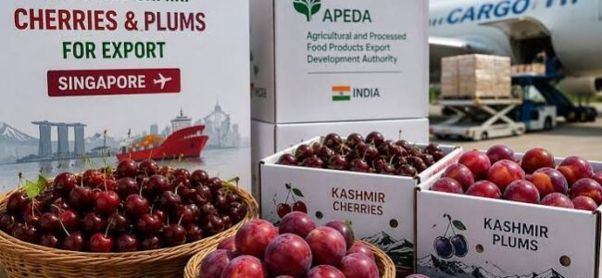
First Export Of Premium Areko Cherries, Scentrose Plums To Singapore Marks A New Milestone For J&K Horticulture
Srinagar: Long celebrated for its apples, walnuts and traditional cherry varieties, Kashmir’s horticulture sector has now taken another significant step towards global diversification. The first export consignment of premium Areko cherries and Scentrose plums from the orchards of Shopian and Pulwama to Singapore has not only opened a new international market for the Valley’s temperate fruits but also highlighted the region’s gradual transformation from volume-driven farming to quality-led, export-oriented horticulture. Facilitated by the Agricultural and Processed Food Products Export Development Authority (APEDA) in collaboration with M/s Osum Food Solutions LLP and M/s Fruit Master Agro Fresh Private Limited, the shipment marks an important milestone in positioning Kashmir’s premium fruits in high-value overseas retail markets. Flagging off the first consignment, APEDA described the initiative as part of its continued efforts to expand global market access for India’s premium horticultural produce while strengthening the export ecosystem in Jammu and Kashmir.
Beyond Apples| Diversifying Kashmir’s Fruit Basket: For decades, apples have dominated Kashmir’s horticulture economy, contributing nearly three-fourths of the region’s fruit production and supporting hundreds of thousands of farming families. While apples remain the backbone of the sector, changing consumer preferences, international demand and evolving cultivation practices are encouraging growers to diversify into premium fruits capable of fetching higher returns. The export of Areko cherries and Scentrose plums reflects this changing landscape. Unlike conventional cherry varieties grown across the Valley, Areko cherries belong to the high-density European sweet cherry category. They are known for their larger size, superior sweetness, vibrant colour, firmness and longer shelf life—qualities highly valued in premium international supermarkets. Similarly, Scentrose plums have gained recognition for their attractive appearance, rich flavour profile and suitability for export due to better storage and transportation characteristics. For Kashmir’s growers, these varieties represent not just agricultural diversification but an opportunity to participate in global value chains where quality often commands significantly better prices than domestic wholesale markets.
Scientific Farming Drives Export Success: The success of the shipment did not begin at the packing station but in the orchards months before harvest. According to APEDA, the exported fruits were cultivated using scientific orchard management practices designed to meet international quality expectations. These included improved pruning methods, canopy management, precision irrigation, nutrient management and integrated pest control measures that enhance fruit quality while reducing crop losses. Equally important was harvesting at optimum maturity—a critical requirement for premium export markets. Unlike domestic markets, where fruits are often harvested based on immediate demand, international exports require precise timing to balance sweetness, firmness, colour development and shelf life. Harvesting either too early or too late can significantly affect market acceptance overseas.
Cold Chain Makes The Difference: Fresh fruit exports depend as much on logistics as on cultivation. Once harvested, the cherries and plums underwent multiple stages of grading, sorting and quality inspection before being packed under strict international standards. Maintaining an uninterrupted cold chain throughout transportation was essential to preserving freshness during the journey to Singapore. Temperature-controlled handling, specialised packaging and rapid logistics ensured that the fruits retained their quality from orchard to overseas retail shelves. Such post-harvest management has increasingly become one of the defining factors determining export competitiveness. For perishable commodities like cherries, where shelf life is measured in days rather than weeks, efficient logistics often determine commercial success.
Singapore Opens A High-Value Market: Singapore may be geographically small, but it is among Asia’s most important premium food markets. With limited domestic agricultural production, the city-state imports the overwhelming majority of its fresh fruits, creating opportunities for exporters capable of meeting stringent quality and food safety standards. Consumers in Singapore increasingly seek premium imported fruits distinguished by freshness, taste, traceability and attractive packaging. For Indian exporters, successful entry into Singapore also serves as a gateway to broader Southeast Asian markets where demand for premium horticultural products continues to grow alongside rising incomes. Establishing a presence in these markets enhances not only export volumes but also international brand recognition for Kashmir’s temperate fruits.
Value Over Volume: The export also reflects a broader shift occurring within India’s horticulture sector. Rather than focusing solely on increasing production, policymakers and exporters are increasingly emphasising value addition and premium market access. For growers, exporting smaller quantities of premium fruits at higher prices often proves more profitable than selling larger volumes in domestic wholesale markets where price fluctuations remain common. Direct access to international buyers also reduces dependence on traditional market intermediaries and offers opportunities for long-term commercial partnerships. This transition towards value-based agriculture aligns with broader efforts to increase farmers’ incomes while improving the competitiveness of Indian horticulture in global markets.
Building An Export Ecosystem: APEDA has played an increasingly active role in developing India’s agricultural export infrastructure through market development, quality certification, capacity building and logistics support. The successful shipment from Kashmir reflects the coordinated efforts of multiple stakeholders, including exporters, growers, logistics providers, quality inspectors and government agencies. Such collaboration is particularly important for fresh produce exports, where every stage—from cultivation and harvesting to transportation and customs clearance—must function efficiently to maintain product quality. The coordinated approach demonstrated during this shipment provides a model for expanding exports of other premium horticultural products from Jammu and Kashmir.
A New Opportunity For Kashmir’s Growers: For orchardists across Shopian and Pulwama, the export represents more than a ceremonial flag-off. It demonstrates that international markets are increasingly accessible to growers willing to adopt scientific cultivation methods and maintain export-quality standards. Premium export markets reward consistency, traceability, food safety and superior quality. This creates incentives for farmers to modernise orchards, invest in improved varieties and adopt advanced production techniques. As more growers observe successful exports generating higher returns, wider adoption of export-oriented horticulture is likely to follow.
High-Density Orchards Change The Landscape: The success of Areko cherries also reflects the growing adoption of high-density orchard systems in Kashmir. Originally popularised in apple cultivation, high-density plantations are increasingly being introduced for other temperate fruits. Compared with conventional orchards, high-density systems offer earlier fruiting, better productivity, improved sunlight penetration and easier orchard management. They also facilitate more uniform fruit quality—an essential requirement for export markets where consistency is often valued as much as taste. Combined with precision irrigation and scientific canopy management, these systems are gradually transforming the economics of horticulture in the Valley.
Challenges Still Remain: Despite the encouraging milestone, several challenges continue to influence the future of horticultural exports from Jammu and Kashmir. Cold-chain infrastructure remains uneven across many producing districts, while air cargo availability during peak harvesting seasons often constrains exports of highly perishable fruits. International markets also demand strict compliance with phytosanitary regulations, traceability protocols and residue standards. Climate variability presents another growing concern. Changing weather patterns, untimely rainfall and rising temperatures increasingly affect flowering, fruit development and harvest quality, making scientific orchard management even more important. Continued investment in logistics, storage, export infrastructure and farmer training will therefore be essential to sustain export growth.
Strengthening India’s Premium Fruit Brand: For India, expanding exports of premium horticultural products represents an important component of agricultural diversification. While the country is among the world’s largest producers of fruits and vegetables, its share in premium global fresh fruit markets remains relatively modest compared with its production potential. Exports such as the Kashmir consignment demonstrate that Indian growers can successfully compete in demanding international markets when supported by modern cultivation techniques, efficient logistics and institutional backing. They also contribute to strengthening India’s reputation as a supplier of premium-quality fresh produce rather than merely a large-volume producer.
A Promising Future For Kashmir’s Horticulture: The first shipment of Areko cherries and Scentrose plums to Singapore may be modest in quantity, but its significance extends well beyond a single export consignment. It reflects the growing confidence of Kashmir’s horticulture sector in meeting international standards, embracing scientific farming and exploring high-value global markets. As demand for premium fruits continues to rise across Asia and other regions, such initiatives could encourage greater diversification within Kashmir’s orchards while improving income opportunities for thousands of farming families. For a region where horticulture remains the backbone of the rural economy, expanding exports offers not only better price realisation but also resilience against domestic market fluctuations. If supported by continued investment in quality infrastructure, cold-chain logistics, research and international market development, Kashmir’s premium fruits could increasingly become ambassadors of the Valley’s agricultural excellence on supermarket shelves around the world. The Singapore-bound cherries and plums therefore represent more than an export—they signal the beginning of a new chapter in Kashmir’s horticultural journey, one where innovation, quality and global competitiveness become as important as tradition itself.