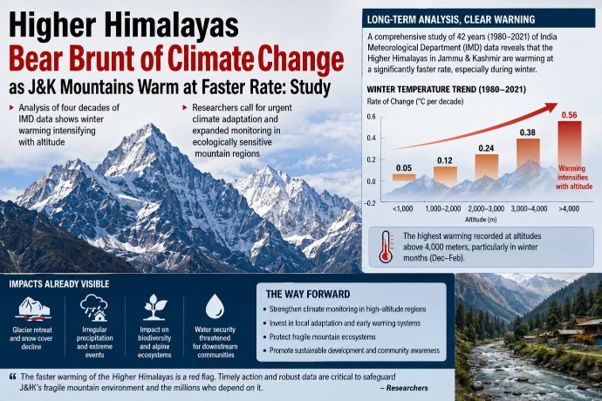
• Analysis of four decades of IMD data shows winter warming intensifying with altitude
• Researchers call for urgent climate adaptation and expanded monitoring in ecologically sensitive mountain region
Srinagar: Jammu and Kashmir’s high-altitude Himalayan regions are warming significantly faster than the plains, particularly during winter, triggering fresh concerns over glacier retreat, water security and the long-term stability of the ecologically fragile Western Himalayas, according to a new scientific study based on more than four decades of climate observations.
The findings have been published in the journal Scientific Reports in a study titled “Warming of the High-Mountainous Climate Sensitive Jammu and Kashmir During the Period 1980–2024,” authored by G.S. Gopikrishnan, Prof. JayanarayananKuttippurath of the Centre for Oceans, Rivers, Atmosphere and Land Sciences (CORAL), Indian Institute of Technology (IIT) Kharagpur, and Chandran Pranav of the India Meteorological Department (IMD).
Based on 44 years of temperature observations from ten IMD stations across Jammu and Kashmir, the research provides robust evidence that higher Himalayan regions are warming significantly faster than lower elevations, particularly during winter, with potentially far-reaching implications for glaciers, water resources and mountain ecosystems
The study, which analysed temperature records from 1980 to 2024 across ten India Meteorological Department (IMD) stations in Jammu and Kashmir, found clear evidence of elevation-dependent warming (EDW)—a phenomenon in which higher mountain regions experience faster warming than lower elevations.
Researchers say the findings underscore how climate change is disproportionately affecting the Himalayan landscape, where rising temperatures can have cascading impacts on glaciers, river systems, agriculture and millions of people dependent on mountain water resources.
The most striking finding is that winter daytime temperatures are increasing by about 0.43°C per kilometre of elevation every decade, while annual average temperatures are rising by 0.18°C per kilometre per decade, indicating that warming intensifies with altitude. The strongest warming signal was recorded during the winter season, when snow-covered landscapes are most vulnerable to climate change.
For a Himalayan region already witnessing erratic snowfall, receding glaciers and changing weather patterns, scientists say the findings provide some of the clearest observational evidence yet that climate change is unfolding unevenly across Jammu and Kashmir.
Unlike global warming trends that describe overall temperature increases, elevation-dependent warming means that mountain ecosystems are heating up faster than nearby lowlands, increasing the vulnerability of glaciers, alpine vegetation and snow-fed rivers.
The researchers found that the warming is especially pronounced in maximum daytime temperatures during winter, suggesting that snow-covered high-altitude landscapes are becoming increasingly efficient at absorbing heat.
According to the study, this is statistically linked to changes in surface albedo the Earth’s ability to reflect sunlight. As snow cover declines, darker land surfaces absorb more solar radiation instead of reflecting it back into the atmosphere, creating a feedback loop that accelerates warming.
While the study identifies a strong statistical association, the authors caution that further research is needed to conclusively establish the underlying physical mechanisms.
The analysis also highlights significant warming in minimum or night-time temperatures, although this warming does not follow the same altitude-dependent pattern.
Instead, researchers found that several stations—including Bhaderwah, Batote, Banihal and Pahalgam—are experiencing pronounced night-time warming, likely linked to increased atmospheric moisture and greater trapping of outgoing long-wave radiation that reduces night-time cooling.
Among all stations, Bhaderwah emerged as one of the fastest-warming locations, recording annual night-time warming of nearly 0.7°C per decade, with even stronger warming during the pre-monsoon and monsoon seasons of around 0.8°C per decade. Other mid- and high-altitude stations also showed statistically significant warming ranging between 0.2°C and 0.4°C per decade.
The researchers note that although these night-time trends are substantial, they are influenced more by local atmospheric conditions than elevation itself.
The findings have significant implications for the Himalayan environment.
Faster warming at higher elevations can accelerate glacier melt, reduce seasonal snow accumulation and alter the timing of snowmelt that feeds rivers across Jammu and Kashmir and downstream regions.
Scientists warn that these changes could affect water availability for agriculture, drinking water supplies and hydropower generation while increasing ecological stress across mountain ecosystems.
The study also notes that warming-driven changes in vegetation, soil moisture and hydrological systems could influence sediment transport, agricultural water stress and the long-term sustainability of fragile Himalayan landscapes.
To ensure the findings were reliable, researchers conducted additional sensitivity tests by repeatedly removing one weather station at a time from the analysis. They found that the strongest warming signals—particularly annual and winter warming in maximum temperatures—remained consistent, reinforcing confidence that the observed trends reflect genuine regional climate patterns rather than anomalies at individual stations.
However, the authors acknowledge important limitations.
The study is based on data from only ten meteorological stations, with relatively few observations from elevations above 3,000 metres, where climate change impacts are expected to be even more pronounced. As a result, the findings primarily represent the available observational range across Jammu and Kashmir rather than the entire Himalayan cryosphere.
Researchers recommend expanding weather monitoring networks in high-altitude regions and maintaining longer-term observations to improve understanding of climate change across the Western Himalayas.
The study concludes that climate change in Jammu and Kashmir cannot be explained by a single warming process. Instead, it is driven by two distinct but overlapping phenomena—rapid altitude-dependent winter warming affecting mountain regions and local atmospheric processes amplifying night-time temperatures in several locations.
Distinguishing between these mechanisms, the researchers say, will be essential for improving climate projections, planning water-resource management and developing adaptation strategies for one of the world’s most climate-sensitive mountain systems.