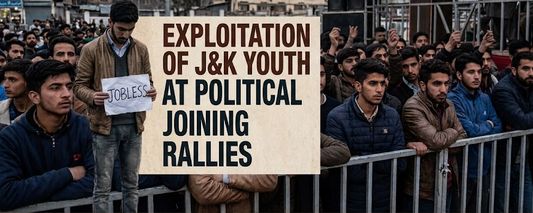
Srinagar: Amid growing political activity in Jammu and Kashmir, a troubling trend is increasingly drawing criticism alleged exploitation of unemployed youth at political joining rallies, where participation is often driven less by ideology and more by economic compulsion.
Political joining rallies, once seen as platforms for public engagement and ideological alignment, are now under scrutiny for becoming stages where vulnerable youth are used as crowd mobilizers.
From garlands and bouquets to loud slogans and staged celebrations, these events project political strength, but behind the spectacle lies a harsh reality: many young participants reportedly attend for money, transport, meals, or the hope of future favors.
Jammu and Kashmir continues to grapple with high unemployment, especially among educated youth. Thousands of graduates and postgraduates remain jobless despite years of preparation for government recruitment exams.
In such an atmosphere of economic distress, even small financial incentives can become enough to attract participation in political events.
Several youth who attend these rallies often find themselves caught in a cycle of dependence. They are called to welcome leaders, fill venues, chant slogans, and create the optics of mass support.
In return, many receive temporary benefits—travel reimbursements, food, or small payments—but little in terms of real empowerment or long-term opportunity.
Political observers say this practice reflects a deeper structural problem. Political parties across the spectrum frequently claim to represent youth aspirations, yet unemployment remains one of the most pressing unresolved issues in the region. Instead of meaningful engagement through policy, skills development, or job creation, symbolic crowd-building appears to be taking precedence.
The contrast is stark. On stage, leaders speak of progress, employment, and development. Off stage, many of the same young faces return home to uncertainty, competitive exams, and shrinking opportunities. The applause ends, but the struggle continues.
Critics argue that this pattern reduces youth participation in democracy to mere optics. Rather than nurturing leadership, innovation, or informed political debate, rallies often reward visibility over substance. This weakens democratic culture by normalizing transactional politics, where support can be mobilized through short-term inducements rather than trust or vision.
The psychological impact is equally significant. Repeated exposure to such political culture can breed cynicism among young people. When rallies become a marketplace of influence instead of a forum for ideas, faith in institutions suffers. Many begin to see politics not as public service, but as performance.
However, the issue cannot be viewed solely through the lens of political blame. It is also a reflection of economic desperation. A youth with stable employment, dignity, and opportunity is less likely to be exploited for symbolic participation. The root challenge therefore remains unemployment and lack of sustainable economic pathways.
As Jammu and Kashmir moves through a politically significant period, the question is becoming harder to ignore: are young people being empowered, or merely being used to create televised narratives of popularity?
Bouquets and applause may dominate headlines for a day, but brickbats of public criticism are growing louder. For J&K’s youth, the demand is no longer for symbolic inclusion—it is for dignity, jobs, and genuine representation.
The real measure of political commitment to youth will not be the size of rally crowds, but the number of meaningful opportunities created beyond the stage.
Srinagar airport lifts operational restrictions ahead of winter schedule
• Late-evening flights expected to improve connectivity from October 25 Srinagar|Oct, 19: Srinagar International Airport has withdrawn restrictions limiting its...
Read moreDetails