Veteran statesman questions infra expansion in fragile mountain zones
Mohammad Irfan
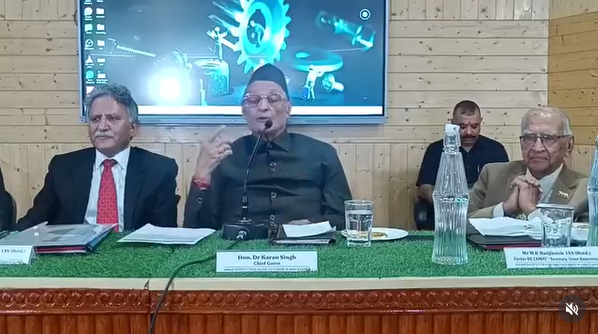
Srinagar : Warning against unchecked infrastructure expansion in the Himalayan region, veteran statesman and former Sadr-e-Riyasat of erstwhile Jammu and Kashmir State Dr Karan Singh has said that unplanned road construction, excessive tunnelling and poorly executed urban development projects were pushing fragile mountain ecosystems towards irreversible damage.
Addressing the valedictory session of a seminar on environmental protection organised by the Group of Concerned Citizens (GCC), Dr Singh said the Himalayas were increasingly bearing the burden of reckless development carried out without adequate ecological assessment. He expressed concern over the rapid expansion of roads and infrastructure in mountainous regions, stating that such interventions were destabilising the natural balance of the
Himalayas.
“Road construction in the Himalayas has disturbed the entire mountain system,” Dr Singh said, cautioning that large-scale blasting, hill cutting and indiscriminate widening of highways were causing long-term environmental consequences. Questioning the necessity of large highways in ecologically sensitive tourist zones, Dr Singh said the development model being followed needed urgent rethinking. “Why should tourists require four-lane roads in such fragile regions? Tourism should not become an excuse for environmental destruction,” he said. Drawing parallels with environmental disasters in Himachal Pradesh and Uttarakhand, he said similar warning signs were now visible in parts of Jammu and Kashmir, including Doda.
Dr Singh also criticised the implementation of so-called smart city projects, saying that while such schemes were promising on paper, poor execution often worsened urban conditions instead of improving them. “These are good schemes in principle, but unless implemented properly, they fail to make any
meaningful impact,” he said.
Turning to Kashmir’s shrinking water bodies, Dr Singh voiced serious concern over the alarming degradation of lakes and wetlands across the Valley. He said iconic water bodies that once defined Kashmir’s ecological identity were rapidly disappearing due to encroachment, pollution and neglect.
Recalling earlier decades, he said Dal Lake had drastically reduced in size.
“When I think of Dal Lake, I remember its full expanse. Today, it has shrunk to nearly one- third of what it once was,” he said. He noted that several other major wetlands, including Wular Lake, Hokersar Wetland, Hygam Wetland and Anchar Lake, had also witnessed severe shrinkage over the years.
Reflecting on the past, Dr Singh remarked that these wetlands once remained ecologically vibrant and served as significant natural habitats, but had gradually deteriorated due to human interference and poor conservation.
Speaking about wildlife conservation, Dr Singh referred to Dachigam National Park and recalled efforts made to protect the endangered Hangul population.
He credited M. K. Ranjitsinh for playing a major role in conservation efforts and said the relocation of villages from Dachigam during his tenure was a difficult but necessary step to create a secure habitat for the Kashmir stag.
“It became a major political issue at the time, but without that relocation, the Hangul could not have survived,” he said. Despite those efforts, Dr Singh said the Hangul population had continued to decline, reflecting the broader ecological stress facing Kashmir’s biodiversity.
Emphasising collective responsibility, he said environmental protection could not be left to governments and departments alone. Local communities, public representatives and civil society must actively participate in conservation efforts. “It is also the responsibility of MLAs and society at large to protect and conserve our environment,” he said.
Prominent cardiologist Upendra Kaul, Lt Gen R. S. Reen (Retd), and M. K. Ranjitsinh also addressed the session, stressing the urgent need for sustainable development and stronger ecological safeguards in Jammu and Kashmir.