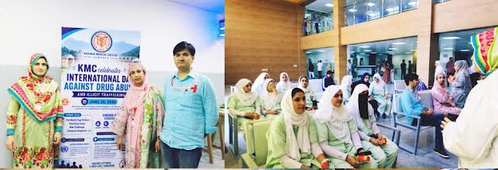
Srinagar : Kashmir Medical College and Hospital (KMCH), Sempora, on Friday observed the International Day Against Drug Abuse and Illicit Trafficking by organizing an awareness programme aimed at educating public and healthcare professionals about the harmful effects of substance abuse and the importance of prevention, treatment, and rehabilitation.
The programme organized by Department of Psychiatry KMC focused on raising awareness about the menace of drug abuse and importance of early intervention, timely treatment, counselling, and rehabilitation. It also highlighted the need for collective efforts by educational establishments, families, and society to prevent substance abuse and promote a healthy, drug-free community.
In her message, Executive Director KMCH, Insha Qazi, reaffirmed the institution’s commitment to supporting initiatives aimed at preventing drug abuse and promoting mental and physical well-being among the youth. She said that awareness, education, and timely medical intervention are key to tackling the growing challenge of substance abuse.
She urged young people to stay away from drugs and adopt healthy lifestyles, while encouraging families and communities to support those struggling with addiction rather than stigmatizing them.
“Drug addiction is a treatable condition, and with timely counselling, medical care, individuals can lead healthy and productive lives. Together, we can build a healthier and drug-free society,” she said.
On the occasion, Principal KMCH, Prof. Nazir Ahmad Khan, said that the institution is committed to building a drug-free society by keeping the youth away from the menace of substance abuse through timely treatment, counselling, and rehabilitation services.
“Drug addiction is a medical and neurobiological condition and should be treated like any other medical illness, without stigma or discrimination,” he said.
Prof. Khan further said that the Lieutenant Governor of Jammu and Kashmir Manoj Sinha has launched a massive 100-day campaign against drug abuse, which is a highly commendable initiative.
He expressed hope that the campaign would create greater public awareness, encourage people to seek treatment at an early stage, and play a role in combating drug addiction across the Union Territory.
Head of the Department of Psychiatry, KMCH, Prof. Maqbool Dar, highlighted the major factors contributing to drug addiction, including unemployment, peer pressure, family conflicts, rapid urbanization, broken families, and a lack of awareness about the harmful effects of substance abuse.
In his address, Prof. Dar said that parents must acknowledge the growing involvement of youth in drug abuse instead of remaining in denial.
He stressed the need for parents to closely monitor their children’s behaviour, maintain open communication with them, and seek professional help whenever necessary.
He emphasized that drug addiction is a medical condition that is treatable through timely counselling, medical intervention, and rehabilitation.
He also appealed to every section of society—including parents, teachers, healthcare professionals, religious leaders, and community members—to play an active role in preventing drug abuse and supporting individuals battling addiction.
Prof. Dar further suggested that the adverse effects of drug addiction should be incorporated into the school curriculum to educate students from an early age.
He also advocated for the appointment of trained counsellors and psychologists in schools to provide guidance, identify vulnerable students, and offer timely psychological support to prevent substance abuse.