

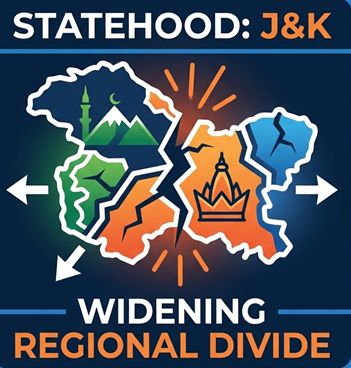
 Five years after the bifurcation of Jammu and Kashmir into two Union Territories — Jammu & Kashmir and Ladakh — the political map may have changed overnight, but the deeper questions of identity, representation, and regional aspirations remain unsettled. What was presented in August 2019 as an administrative and constitutional reorganisation has gradually evolved into something much larger: a redefinition of relationships between Jammu, Kashmir, and Ladakh themselves.
The debate today is no longer confined to restoration of statehood alone. It is increasingly about whether the regions that once constituted the erstwhile state still imagine a common political future. Since 2019, Jammu & Kashmir and Ladakh have followed distinct, and at times divergent, trajectories. In Jammu and Kashmir, political discourse has remained centred on restoration of statehood, democratic agency, and greater devolution of powers following the reduction of legislative authority after reorganisation. In Ladakh, the conversation has taken a different turn — towards constitutional safeguards, protection of land and jobs, ecological concerns, cultural preservation, and demands for greater autonomy.
New Delhi has repeatedly assured Parliament and the judiciary that statehood would be restored at an “appropriate time.” The Assembly elections of 2024 renewed expectations that the promise would soon materialise. Yet the absence of a defined roadmap has transformed hope into uncertainty and political messaging into growing impatience.
Ladakh offers a revealing contrast. A broad-based coalition of political, social, and religious groups has mobilised around demands for constitutional protections and institutional safeguards. The concerns are not merely political; they are existential — linked to ecology, employment, demography, and cultural identity. Discussions around Article 371-type provisions or Sixth Schedule-like protections reflect a region increasingly asserting its distinctiveness within the national framework. But perhaps the most consequential development since 2019 has been the changing political geography of the former state itself.
Jammu, Kashmir, and Ladakh are no longer moving together politically. Ladakh’s institutional separation is already complete. Jammu’s political preferences often diverge sharply from those dominant in Kashmir. Electoral patterns, narratives of governance, and visions of regional identity increasingly operate in parallel rather than in convergence.
These differences are not new. Regional fault lines have existed since the 1950s — around autonomy, representation, resource allocation, and political power-sharing. What has changed is the intensity with which these differences are now expressed and institutionalised.
“Ladakh’s 2019 separation shows that unaddressed regional tension permanently alters governance. If Jammu and Kashmir keep drifting politically, their divide will become structural; restoring statehood is a final test of whether they can still imagine a shared future before becoming permanently estranged.”
Successive governments, irrespective of ideology, must also confront an uncomfortable reality: the institutional architecture needed to preserve inter-regional cohesion remains weak. Student exchanges, business linkages, cultural interactions, and collaborative institutions across Jammu, Srinagar, and Leh remain limited. The result is that physical distances are gradually becoming political distances.
Electoral realities reinforce this divide. The BJP’s political strength in Jammu is shaped by narratives of integration, national security, and development. Kashmir-based political parties continue to foreground statehood, a mild mention of 370 (not necessarily its restoration) and restoration of democratic authority of the elected Government . Consequently, statehood itself increasingly risks being perceived not as a collective regional aspiration but as a geographically concentrated demand.
The geopolitical context further complicates these calculations. Positioned at the intersection of borders with Pakistan and China, both Union Territories remain central to country’s national security architecture. The post-2019 period has coincided with heightened strategic tensions, particularly after developments along the Line of Actual Control in eastern Ladakh. Unsurprisingly, May 2025 – “Operation Sandoor” governance decisions are increasingly viewed through both doctrine of emergency, electoral compulsions, democratic and security lenses. This leaves an important question unanswered: can statehood restoration succeed politically without broader regional ownership?
The answer may depend less on constitutional procedure and more on political bridge-building. Without stronger engagement between Jammu and Kashmir’s political actors — and without rebuilding shared regional platforms — consensus will remain elusive. The real risk is not delay alone. It is drift.
Ladakh’s separation in 2019 demonstrated how regional aspirations, when inadequately addressed, can permanently reshape institutions. If Jammu and Kashmir continue travelling in opposite political directions, the widening distance may eventually become structural rather than temporary. Statehood, therefore, is not merely a constitutional question anymore. It has become a test of whether the regions of the former state still possess the political imagination to think together — before they become accustomed to thinking apart.
(The author is Editor, “Kashmir Horizon”)






