• Bla–Uri, Rajouri–Poonch links under consideration
• Qazigund–Baramulla doubling planned
• 3,000 CCTV cameras, drones, CORAS for security
• Winter tech for sub-zero operations
• 266 km in about 4 hrs 45 mins
Irfan Yattoo
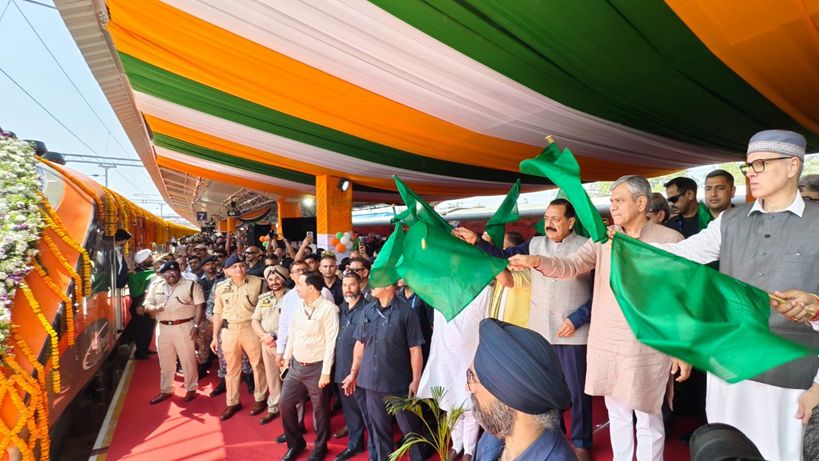
Srinagar: In a major push to rail connectivity in Jammu and Kashmir, Railway Minister Ashwini Vaishnaw on Thursday flagged off the extended Srinagar–KatraVande Bharat Express from Jammu Tawi and also announced its upgrade from 8 to 20 coaches, deployment of winterisation technology, and plans for further expansion of the network.
The extension marks the first time Jammu has been directly linked with the Kashmir Valley by a passenger train, turning a long-standing aspiration into reality. With Jammu Tawi connected to major cities across India, passengers can now access Kashmir with a single interchange, effectively integrating the Valley into the national rail grid.
The train, which earlier operated between Srinagar and Shri Mata Vaishno Devi Katra, will now run up to Jammu Tawi, establishing seamless connectivity across the region. The development follows last year’s inauguration of the Jammu–Srinagar rail line by Prime Minister Narendra Modi.
Calling the launch a “new chapter” in connectivity, Vaishnaw said the expanded service would strengthen integration, ease travel, and boost tourism and trade in the Union Territory. He was joined at the flag-off by Jammu and Kashmir Chief Minister Omar Abdullah and Union Minister Jitendra Singh, along with MPs, MLAs and senior railway officials.
Union Railways Minister Vaishnaw said improved rail connectivity has begun lowering logistics costs in the Valley. Cement prices have dropped by around Rs 50 per bag, he said, while more than 2 crore kilograms of apples have already been transported to markets across the country by rail.
He added that the movement of perishables such as cherries, along with essential commodities like foodgrains, fertilisers, salt and milk, has become more efficient, strengthening supply chains and improving availability of goods in the region.
Officials said the rail link is also facilitating faster movement of local products such as dry fruits, Pashmina, carpets and horticultural produce, boosting livelihoods and integrating the Valley’s economy with national markets.
After the flag-off, the minister reviewed key infrastructure under the Udhampur–Srinagar–Baramulla Rail Link, including inspections of the Anji Khad bridge and the Chenab Bridge, the world’s highest railway bridge, as well as facilities at the Shri Mata Vaishno Devi Katra station.
Vaishnaw said the next phase will focus on expanding capacity and extending connectivity. A proposal to extend the line from Baramulla to Uri is under consideration, while surveys and detailed project work are underway for new rail links to Rajouri and Poonch. Doubling of the Qazigund–Baramulla stretch is also planned to ease congestion and allow more trains to run through the Valley.
He added that broader infrastructure upgrades are underway, including multitracking on key routes such as Delhi–Ambala and Jalandhar–Jammu, aimed at strengthening connectivity between Jammu and the rest of the country.
With demand surging, the Railways has replaced the standard 8-coach rake with a 20-coach configuration, increasing capacity to around 1,400 passengers per trip. Officials said the service has witnessed near full occupancy since its launch, with over 5.5 lakh passengers having travelled so far.
For the first time on this route, the train has been equipped with “winterisation” technology, including heated windshields and specialised heating systems to ensure uninterrupted operations during sub-zero temperatures and heavy snowfall. Designed for temperatures as low as minus 10°C, the system allows the train to maintain speed and reliability in harsh winter conditions.
The 267-km journey between Jammu and Srinagar is now expected to be completed in about four to five hours and will reduce travel time and providing an all-weather alternative to road transport, which is often disrupted by snowfall and landslides.
Railway officials said the trains will cover a distance of about 266.66 km in approximately 4 hours 45 minutes to 4 hours 50 minutes, maintaining an average speed of around 55 to 56 km per hour.
Meanwhile security arrangements along the route have been intensified, with Railway Protection Force deploying CORAS commandos onboard and implementing a “one plus twenty” guard system led by an inspector. Authorities said around 3,000 CCTV cameras have been installed along the route, supported by drone surveillance, perimeter guarding at stations, and guard rooms at regular intervals.
SSP Railways J&K Waseem Qadri said the multi-layered security framework is aimed at ensuring safe travel for passengers, including tourists, and will be strengthened further.
Regular Vande Bharat services will commence from May 2, with two pairs of trains operating six days a week, offering morning and afternoon departures from both Jammu and Srinagar.
Meanwhile, senior Congress leader Ghulam Ahmad Mir has urged the Railway Ministry to provide a halt for the Vande Bharat Express at Anantnag, citing its importance as a commercial and tourism hub. A stop there, he said, would improve accessibility, reduce congestion at nearby stations and support local economic activity.
According to an official notification issued from the Railway headquarters at Baroda House, New Delhi, Train Nos. 26401/26402 (SVDK–Srinagar–SVDK) and 26403/26404 (Srinagar–SVDK–Srinagar) will now operate up to Jammu Tawi, marking a significant expansion of passenger services on the route.
The revised services will run six days a week. Train Nos. 26401/26402 will operate between Jammu Tawi and Srinagar except on Tuesdays, while Train Nos. 26403/26404 will run on the same route except Wednesdays.
Irfan Yattoo