• 20-coach semi-high-speed rake with advanced safety
• Introduces first ‘winterised’ train for sub-zero conditions
• Self-regulating cables, heated tanks ensure uninterrupted service
• Expected to boost tourism and regional mobility: Officials
Irfan Yattoo
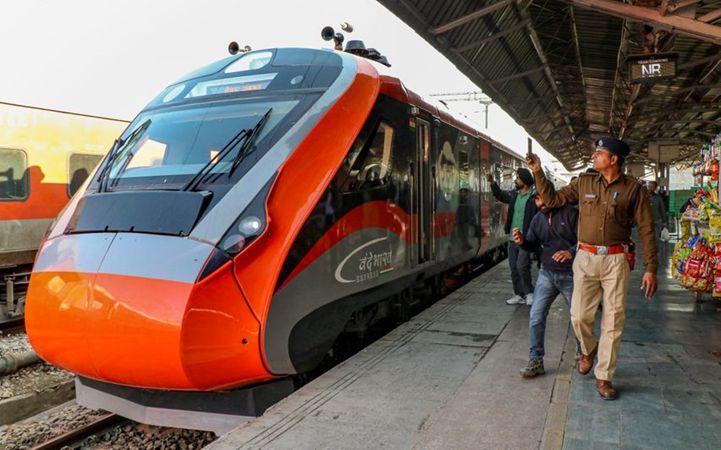
Srinagar : In a major push to rail connectivity in Jammu and Kashmir, Indian Railways will extend the semi-high-speed Vande Bharat Express service up to Jammu Tawi, with the inaugural run scheduled for April 30.
The move is expected to bridge a crucial gap in passenger movement within the Union Territory, linking the winter capital more seamlessly with the Kashmir Valley.
The extended service, currently operating between Mata Vaishno Devi Katra and Srinagar, will now originate from Jammu Tawi railway station, catering to a larger commuter base across the Jammu division.
Officials said the inaugural special train (No. 02601) will depart Jammu at 10:30 am, halt briefly at Katra, and reach Srinagar at 3:05 pm.
The extension comes amid sustained efforts by Indian Railways and Northern Railway to strengthen connectivity in the region, where terrain and weather conditions have historically posed major logistical challenges.
Senior Divisional Commercial Manager Uchit Singhal said the train would strengthen links between pilgrims visiting the Vaishno Devi shrine and the Kashmir Valley, while also giving a boost to tourism and local economic activity.
“The goal is to ensure seamless, year-round connectivity despite extreme weather,” he said.
The extension of the Vande Bharat service is being seen as part of a broader infrastructure push in Jammu and Kashmir, where improved rail connectivity is expected to reduce travel time, enhance accessibility, and integrate remote regions with major urban centres.
Regular operations and detailed schedules are expected to be announced separately.
Raghvender Singh, Public Relations Inspector, Jammu Division, said that keeping in view the challenging terrain and extreme weather conditions of Jammu & Kashmir, Indian Railways has introduced a specially designed Vande Bharat Express for the Jammu–Srinagar rail section.
He said train retains its semi-high-speed capability while, for the first time, incorporating advanced “winterisation” technology to ensure smooth operations even in sub-zero temperatures.
Singh said to tackle harsh winter conditions, several state-of-the-art heating systems have been integrated. Notably, self-regulating heating cables have been installed to prevent water pipelines from freezing, automatically adjusting heat output based on external temperatures.
“Additionally, 1800W silicon heating pads have been fitted in water tanks, while bio-tanks and auxiliary tanks are equipped with dedicated heating arrangements to ensure uninterrupted sanitation services,” he said.
Singh said that passenger comfort has been prioritised with provisions to channel warm air to restrooms through ducts connected to the main air-conditioning system.
“Indian-style toilets have been fitted with heaters and thermal insulation to maintain the efficiency of the vacuum evacuation system.A specialised water-draining facility has also been introduced to prevent freezing during stabling by ensuring complete drainage of water from pipelines,” she said.
In a first for Indian Railways, an embedded heating element has been installed in the front windshield of the driver’s cabin to prevent fogging during snowfall and low-visibility conditions, ensuring clear visibility. Heating elements have also been incorporated in the air dryer system to maintain the efficiency of the braking mechanism.
“To safeguard critical components, pneumatic valves near water tanks have been protected with stainless steel covers against ballast damage.The train retains the hallmark features of the Vande Bharat series, including an operational speed of up to 160 kmph, a fully air-conditioned 20-coach configuration, automatic plug doors, and LED lighting,” he said.
Singh said safety features include CCTV surveillance and an energy-efficient regenerative braking system.
Describing it as a milestone in indigenous engineering, he said the train is designed to offer a safe, fast, and comfortable travel experience in one of the country’s most challenging environments.