• Arrests mount, supply chains targeted, pharmaceutical misuse under scanner
• SPO dismissed in south Kashmir over NDPS case
• “Pandemic” warning as police seek public support to curb youth addiction
Irfan Yattoo
Srinagar: Days after Lieutenant Governor Manoj Sinha launched an intensified anti-drug 100 days campaign across Jammu and Kashmir, police have mounted a sweeping crackdown in the Valley, combining arrests, seizures, public outreach. While officials describe it as a “zero-tolerance” push against narcotics.
In the past several days alone, police have dozens of drug peddlers across the Valley, while also seizing heroin, charas, and banned pharmaceutical substances. While in a first, SPO was terminated for his alleged involvement in drug case in south Kashmir.
Senior Superintendent of Police Annatnag, AmodNagpuri, ordered the disengagement of a Special Police Officer (SPO), Mohammad Ashraf Malik, a resident of Kuchal, Kishtwar, after he was found to be involved in a narcotics case registered under the NDPS Act at Police Station Devsar.
“The case, registered in 2023, pertains to offences under Sections 8/20 of the NDPS Act. Following his alleged involvement, departmental action was initiated, culminating in his removal from service,” the police spokesman said.
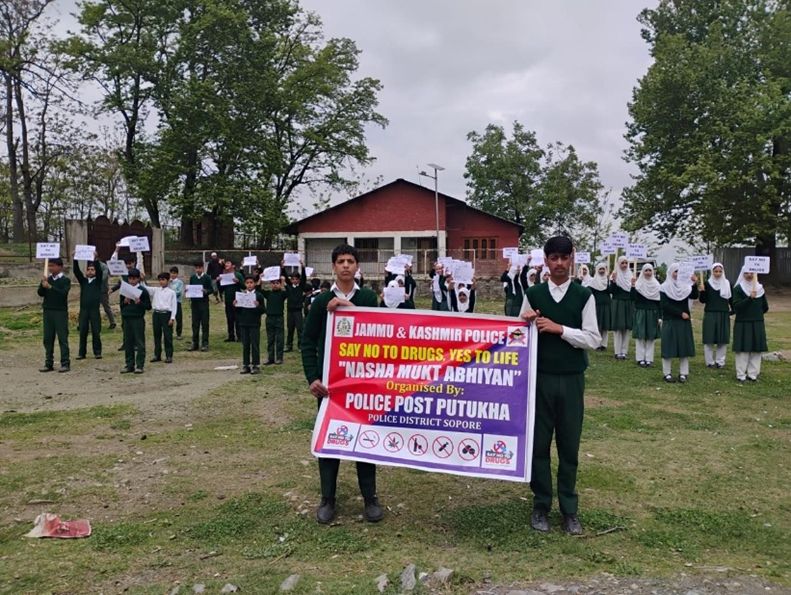
Simultaneously, awareness drives have been intensified in Valley districts including Shopian, Budgam, Pulwama and Ganderbal, targeting schools, colleges, markets and villages.
A senior police officer told Kashmir Horizon that the twin strategy enforcement and outreach aimed to tackle drug menace, particularly among the youth in Kashmir.
“This is not a routine exercise. There is a clear directive to act firmly at all levels, supply chains, local networks, and even within institutions if required. We are going after peddlers, monitoring hotspots, and building community pressure against the menace,” he said.
Police official said the focus has also expanded to regulating pharmaceutical misuse, an emerging trend in the region.
“The abuse of prescription drugs is a serious concern. We are inspecting medical shops to ensure compliance and prevent diversion into illegal channels,” he said.
Alongside enforcement, police have stepped up awareness programmes across the Valley. In Shopian, officers launched a public sticker campaign carrying messages such as “Say No to Drugs,” placing them on vehicles and public spaces to maximise visibility.
In various parts of valley, police held community meetings at the village level, urging residents to take collective responsibility in identifying and reporting drug-related activities. Pledge-taking ceremonies were also organised in educational institutions, where students committed to staying away from substance abuse
Talking to media, SSP Sopore Iftikhar Talib termed drug menace as silent pandemic and stated that it cannot be tackled by police alone.
“Unless people join this fight, the problem will not end. This is a war we have to fight together. Society as a whole including teachers, religious leaders and civil groups must step in,” he said.
SSP Sopore said 34 FIRs have been registered in Sopore this year, around 40 people arrested and a significant quantity of drugs seized.
“We have also cancelled registrations of about 20 vehicles and revoked 15 driving licences linked to drug cases. While enforcement is being stepped up,” he added.
Another police officer said that police (they) are deliberately focusing on young people. If we can prevent first-time use and break the social acceptance around drugs, we can significantly reduce the problem, he said.
“The community participation is central to the campaign. We have repeatedly appealed to the public to share information about drug peddling, assuring confidentiality and swift action,” he said.
The police officer said that fight against drugs cannot be won by police alone. Families, teachers, and local communities have to step in. We are seeing more people coming forward, which is encouraging,” he said.
At the same time, officials acknowledge that drug networks have adapted, often operating in small, decentralised units that make detection more difficult.
“These are not always large syndicates. Sometimes, it is local-level distribution that sustains the cycle. That is why intelligence at the grassroots level is critical,” the officer added.
Earlier this month, LG Sinha said the fight against drugs must become a mass movement, calling it one of the gravest challenges facing Jammu and Kashmir.
Launching a 100-day “Drug-Free Jammu & Kashmir” campaign, he stressed that the coming months would be crucial in taking the message to every village and household.
“This is not an individual problem but a collective crisis,” he said, urging families, institutions and communities to take responsibility as drug abuse continues to impact youth and families across the region adding that those who destroy society will face the full force of law.