
Irfan Yattoo
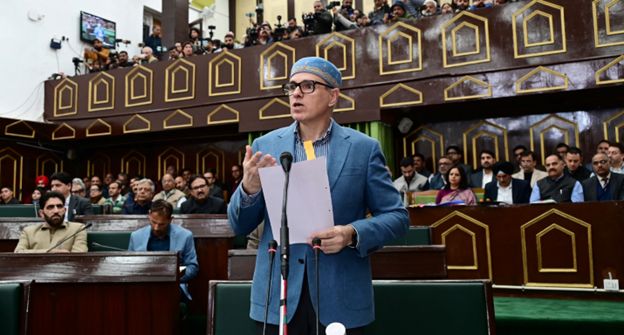
Srinagar: At least five glacial lakes in the Kashmir Himalaya have been identified as having a “very high susceptibility” to glacial lake outburst floods (GLOFs), Chief Minister Omar Abdullah informed the Assembly on Tuesday, while clarifying that none of them pose an immediate threat at present.
Responding to a query in the House, CM Abdullah said a preliminary geospatial assessment has mapped downstream exposure of glacial lakes, identifying habitations and key infrastructure along potential flood pathways in districts such as Ganderbal, Shopian and Kulgam.
The assessment, conducted by the University of Kashmir and published in the Journal of Glaciology, evaluated 155 glacial lakes using hydro-geomorphic indicators including lake expansion rate, dam stability, and surrounding terrain conditions.
According to the study, nearly 2,704 buildings, around 15 major bridges, road stretches and at least one hydropower project fall within potential impact zones in the event of a GLOF, a high-magnitude flood triggered by the sudden failure of a glacial lake dam.
“The study has identified Bramsar, Chirsar, Nundkol, Gangabal and Bhagsar lakes as falling in the ‘very high susceptibility’ category,” Omar said.
He, however, stressed that the classification does not indicate imminent danger.
“This does not mean an immediate threat but suggests a higher likelihood of an outburst under specific triggering conditions,” he said, adding that the findings provide a baseline for prioritising detailed investigations.
The study also flagged critical data gaps in accurately assessing risks. It noted that precise estimation of GLOF hazards requires reliable information on glacial lake volumes, which can only be obtained through field-based bathymetric surveys, a process that determines the depth and underwater topography of lakes. Such data, it said, is currently unavailable for most Himalayan lakes.
To address this, the Department of Geo-informatics at the University of Kashmir has acquired a high-precision RTK-enabled robotic echo-sounding boat with support from the Ministry of Earth Sciences.
Bathymetric surveys of vulnerable glacial lakes in the western Himalaya are planned for 2026 to improve hydrodynamic modelling and downstream risk assessment.
The study highlighted that high-susceptibility lakes pose potential risks to infrastructure and settlements located downstream, particularly in mountainous regions where sudden floods can have devastating consequences.
CM Omar further said continuous monitoring of vulnerable lakes through remote sensing and field studies is being prioritised. Measures such as early warning systems, eco-zonation of downstream areas and integration of GLOF risk scenarios into district-level disaster preparedness plans are also being considered.
Researchers are additionally working on developing customised early-warning mechanisms for mountainous regions. These systems aim to integrate satellite data, field observations, sensor-based hydro-meteorological inputs and near real-time communication tools to ensure timely detection and dissemination of hazard alerts.
It further said that authorities and research institutions are focusing on continuous remote monitoring of vulnerable lakes, targeted field studies, installation of early warning systems, and the development of eco-sensitive zoning regulations in downstream areas. Integration of GLOF risk scenarios into district-level disaster management plans is also underway.
Srinagar airport lifts operational restrictions ahead of winter schedule
• Late-evening flights expected to improve connectivity from October 25 Srinagar|Oct, 19: Srinagar International Airport has withdrawn restrictions limiting its...
Read moreDetails