In the intellectual and political history of the modern Muslim world, few figures embody the fusion of thought, passion, and social commitment as powerfully as Ali Shariati. To remember Shariati is not merely to recall a man, but to revisit a moment of profound unrest—an age marked by ideological struggle, cultural dislocation, and the urgent search for identity. He was, above all else, an intellectual: erudite, persuasive, and deeply engaged with the crises of his time. Yet unlike many scholars who remained confined to the ivory towers of academia, Shariati stepped into the public sphere, transforming ideas into instruments of awakening. At the heart of Shariati’s project was a deceptively simple yet deeply unsettling question: Which Islam? He challenged the prevailing assumption that Islam was a monolithic and self-evident reality. Instead, he argued that competing interpretations of Islam existed—some that inspired liberation, consciousness, and movement, and others that fostered passivity, submission, and stagnation. For Shariati, Islam was not merely a set of rituals or inherited traditions; it was an ideology in the fullest sense of the term, a dynamic and transformative force capable of reshaping both individual consciousness and collective destiny. He drew a sharp distinction between what he saw as the Islam of freedom, awareness, and struggle, and the Islam of captivity, slumber, and complacency. The former called believers to action, responsibility, and resistance against injustice; the latter lulled them into a state of quietism, encouraging acceptance of the status quo. This dichotomy was not simply theological—it was profoundly sociological. Shariati sought to uncover how religious discourse could either empower the oppressed or serve as a tool in the hands of the powerful.
To illustrate this tension, Shariati invoked historical and symbolic figures. He spoke of an Islam aligned with Abu Dharr, the early Muslim known for his uncompromising stance against inequality and accumulation of wealth, as opposed to an Islam associated with courtly scholars who legitimized authority. These were not merely historical references; they were archetypes, representing two divergent trajectories within Islamic history—one rooted in justice and resistance, the other in accommodation and hierarchy. This interpretive framework extended to his understanding of Shi‘ism, which he famously divided into “Red Shi‘ism” and “Black Shi‘ism.” Red Shi‘ism, in his formulation, symbolized a living tradition of resistance, sacrifice, and perpetual struggle against tyranny. It drew its inspiration from the martyrdom of Husayn ibn Ali, whose stand at Karbala epitomized the refusal to legitimize injustice. Black Shi‘ism, by contrast, represented a ritualized and depoliticized form of religion, one that reduced the tragedy of Karbala to mourning ceremonies devoid of transformative meaning. In Shariati’s critique, the spirit of Karbala had been domesticated, its revolutionary message muted by layers of ritual and tradition.
Understanding Shariati’s intellectual formation requires situating him within the turbulent history of modern Iran. A defining moment was the 1953 Iranian coup d’état, which led to the removal of the democratically elected Prime Minister Mohammad Mosaddegh. This event was more than a political upheaval; it was a profound psychological rupture. It instilled in the Iranian public a deep sense of dispossession, the realization that their political fate could be shaped by external powers. For a young Shariati, this moment crystallized the need to confront not only political domination but also cultural and intellectual dependency. His journey to Paris in 1959 marked another crucial phase in his development. Paris at the time was a hub of intellectual ferment, alive with debates on existentialism, anti-colonialism, and social transformation. Shariati encountered the works of Jean-Paul Sartre, whose emphasis on freedom and responsibility resonated deeply, and Frantz Fanon, whose analysis of colonial oppression provided a framework for understanding the psychological dimensions of domination. Yet Shariati did not adopt these ideas uncritically. Instead, he engaged with them selectively, reinterpreting them through an Islamic lens.
Equally significant was the influence of Muhammad Iqbal, whose call for a revival of selfhood and spiritual autonomy found a powerful echo in Shariati’s thought. Iqbal’s concept of khudi—the realization of the self—was rearticulated by Shariati as a call for a “return to self,” an invitation for Muslim societies to rediscover their authentic identity in the face of cultural alienation. This synthesis of Western critical theory and Islamic intellectual tradition became a hallmark of Shariati’s work. Upon returning to Tehran, Shariati began delivering lectures at Hosseiniyeh Ershad, an institution that would soon become synonymous with intellectual revival. These lectures attracted thousands, particularly young people hungry for a vision that could reconcile faith with modernity.
Shariati’s intellectual legacy transcends his lifetime. Though he did not witness the revolution he inspired, his ideas remain a potent and relevant force, serving as a guiding influence for those still seeking freedom and truth today.
Shariati’s style was electrifying—he spoke not as a detached academic but as a passionate advocate for change. His words carried urgency, his arguments clarity, and his message a profound sense of purpose. This popularity, however, came at a cost. Shariati’s ideas threatened both the political establishment and segments of the religious hierarchy. To the regime of Mohammad Reza Pahlavi, he was a dangerous agitator capable of mobilizing the masses. To conservative religious scholars, he was a disruptive force, challenging established interpretations and questioning inherited authority. In a sense, Shariati occupied a liminal space—too radical for the state, too unconventional for the orthodox.
The state eventually moved to silence him. He was arrested by the notorious SAVAK, subjected to imprisonment and intense pressure. Although he was later released, he remained under constant surveillance and restriction. In 1977, he left Iran for England, seeking a measure of freedom. It was not to last. Within weeks of his arrival, he died under circumstances that remain shrouded in suspicion. Officially attributed to a heart attack, his death has long been regarded by many as a political assassination.
Just two years later, the Iranian Revolution erupted, bringing an end to the Pahlavi monarchy. The revolution bore unmistakable traces of Shariati’s influence. His writings had inspired a generation, his lectures had ignited a movement, and his ideas had provided a vocabulary of resistance. Yet in the aftermath, the leadership of the revolution consolidated around Ruhollah Khomeini, and the intellectual legacy of Shariati was gradually sidelined.
This paradox—of a thinker whose ideas help spark a revolution, only to be eclipsed by its outcomes—raises important questions about the relationship between intellectual movements and political power. Shariati’s emphasis on critical thinking, social justice, and perpetual questioning did not easily align with the demands of a centralized revolutionary state. His vision was inherently open-ended, resistant to closure, and therefore difficult to institutionalize.
Perhaps this is why Shariati remains such a compelling figure today. He resists appropriation. He cannot be neatly categorized as a traditionalist or a modernist, a religious scholar or a secular intellectual. He was, in many ways, all of these and none of them. His thought represents an ongoing conversation—a challenge rather than a doctrine. At its core, Shariati’s legacy lies in his insistence that religion must remain a force of liberation. He warned against the transformation of faith into an instrument of control, against the reduction of dynamic traditions into static rituals. For him, the true measure of a religious worldview was its capacity to awaken, to provoke, and to inspire action. His famous observation that “it is easier to make a revolution than to sustain the truth afterward” captures the enduring relevance of his message. Revolutions, he understood, are moments; truth is a commitment. The real test lies not in overthrowing a system but in resisting the temptation to replicate its patterns under new guises.
In an age where ideological polarizations continue to shape global discourse, Shariati’s voice offers a reminder of the power of critical engagement. He challenges us to question inherited narratives, to examine the social implications of belief, and to recognize the responsibility that comes with consciousness. His work invites not passive admiration but active reflection. Remembering Shariati, then, is not an exercise in nostalgia. It is an engagement with a living legacy—a call to think, to question, and to act. It is an acknowledgment that ideas matter, that intellectual courage can reshape societies, and that the struggle for justice is as much a battle of minds as it is of institutions. In the end, Shariati’s life and thought stand as a testament to the enduring power of ideas. He may not have lived to see the full unfolding of the revolution he helped inspire, but his influence continues to reverberate across time and space. For those willing to engage with his work, he remains not a figure of the past but a companion in the ongoing journey toward understanding, freedom, and truth.
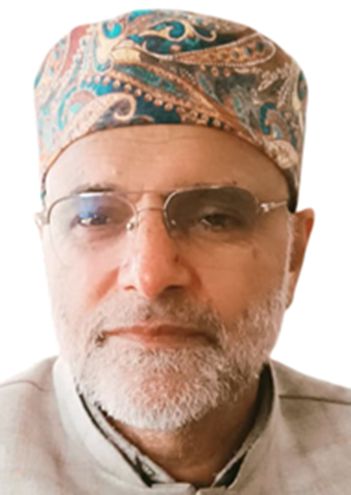
(The author a veteran academician is a former Professor and Head Department of Islamic Studies, Kashmir University. The views, opinions and conclusions expressed in this article are those of the author and aren’t necessarily in accord with the views of “Kashmir Horizon”)
[email protected]