Says “Tech driven connectivity Bridging Hearts, Transforming Kashmir”
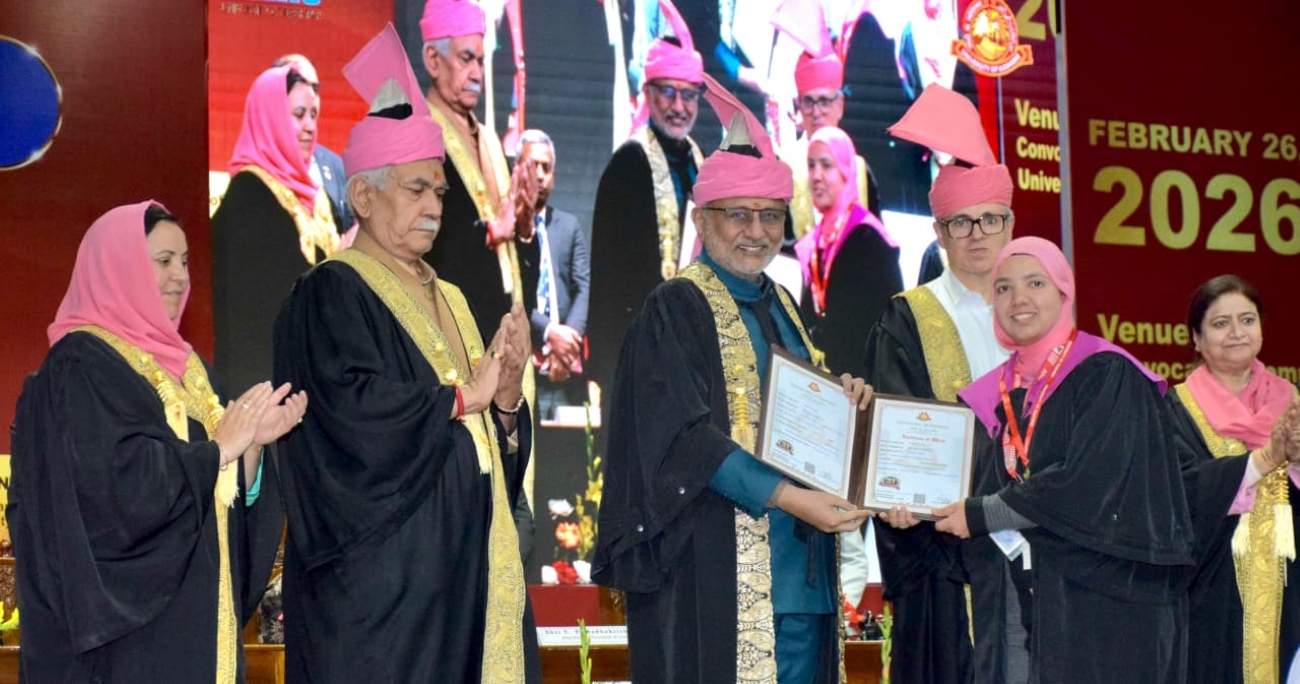
Srinagar: Vice President C. P. Radhakrishnan’s address at the 21st convocation of the University of Kashmir was more than a ceremonial speech; it was a calibrated intervention in Jammu and Kashmir’s evolving development narrative. On his maiden visit to the Union Territory after assuming office in June 2025, the Vice President placed sustainability, civic responsibility and technological adaptation at the centre of his message, framing them as the pillars of the region’s next phase. At a time when Jammu and Kashmir is witnessing renewed tourism inflows and major infrastructure approvals—including the proposed expansion of Srinagar International Airport cleared by Prime Minister Narendra Modi—Radhakrishnan offered both encouragement and caution. Tourism, he said, must grow “without disturbing the ecological balance.” The remark was pointed. Kashmir’s economic resurgence is increasingly tied to visitor numbers, but its fragile ecosystem—Dal Lake, mountain forests and alpine meadows—cannot absorb unchecked expansion.
Sustainability A State Policy: The Vice President’s appeal to balance development with environmental protection aligns with a broader global debate: how to reconcile economic ambition with ecological limits. For Jammu and Kashmir, this is not theoretical. Warmer winters, changing snowfall patterns and mounting waste management challenges in Srinagar underscore environmental vulnerability. By urging Lieutenant Governor Manoj Sinha and Chief Minister Omar Abdullah to transform Srinagar into one of the cleanest cities in the country, Radhakrishnan linked tourism to urban governance. Cleanliness, in this framing, is not merely cosmetic but structural—an index of planning efficiency, civic discipline and environmental stewardship. His suggestion that Srinagar should aspire to secure the Swachh Bharat Award signals an ambition to benchmark the Valley’s capital against national urban standards. Significantly, he referred to proposals to expand tourism beyond established destinations such as Gulmarg and Pahalgam to border areas like Gurez, Keren and Teetwal. Diversification of tourism circuits can reduce pressure on overburdened hotspots, but it also risks exposing ecologically sensitive frontier regions to unregulated construction and waste. The Vice President’s stress on ecological balance thus reads as a policy guideline: expansion must be strategic, not scattershot.
Infrastructure, Identity: The reference to Srinagar airport expansion was equally layered. Improved connectivity is essential for tourism growth and economic integration, yet airport upgrades can accelerate urban sprawl and environmental stress if not accompanied by careful planning. Radhakrishnan’s formulation—development with protection—implicitly calls for infrastructure that is green, efficient and context-sensitive. Earlier in the day, the Vice President took a morning cruise on Dal Lake, describing its timeless charm and natural splendour. The imagery of a constitutional office-holder beginning his visit with a symbolic immersion in Kashmir’s landscape reinforced the environmental undertone of his message. Tourism, he implied, must preserve the very beauty that attracts visitors.
Education as Transformation: Addressing nearly 60,000 students receiving degrees, certificates and medals at the University of Kashmir, Radhakrishnan broadened his focus to the transformative role of education. Congratulating parents, teachers and non-teaching staff, he situated academic achievement within a collective social effort. Convocations, he suggested, are not endpoints but launchpads into a rapidly changing world. “Change is the only constant,” he said, urging graduates to adapt to technological disruption, especially Artificial Intelligence. His remarks reflected an awareness that the global economy is increasingly defined by automation, data and innovation. For a region historically constrained by conflict and limited industrial diversification, equipping youth with digital skills is critical.
Yet the Vice President paired technological optimism with cultural rootedness. He encouraged Swadeshi solutions and called upon youth to shed colonial mindsets, invoking India’s COVID-19 vaccine development and free global supply to nearly 200 countries as a testament to indigenous capability.
The example was strategic: scientific achievement, when combined with humanitarian outreach, can enhance national prestige.
Bridges As Metaphor: In referencing the Chenab Rail Bridge in Reasi, Radhakrishnan introduced a metaphor that resonated beyond engineering. Bridges, he said, connect not only places but hearts. The symbolism is potent in Jammu and Kashmir, where physical connectivity projects—roads, railways and airports—are often interpreted as instruments of integration. Recalling his tenure as Governor of Jharkhand, he narrated hosting students from Jammu and Kashmir and emphasised that democracy requires respect for others’ sentiments. “Degrading the sentiments of others is not good; no democrat can do that,” he said. The remark underscored civility as a civic virtue, particularly in a region where political discourse has often been polarised.
Discipline, Social Responsibility: The Vice President also addressed social challenges directly. Advising students to stay away from narcotics and regulate social media use, he highlighted discipline and time management as prerequisites for success. These remarks reflect growing concerns about drug abuse and digital distraction among youth nationwide. In closing, his declaration—“Mera Kashmir Nahi, Tumhara Kashmir Nahi — Hamara Kashmir”—captured the unifying theme of shared ownership. It was a rhetorical consolidation of his broader message: development must be inclusive, respectful and environmentally responsible.
The LG’s Complementary Vision: Lieutenant Governor Manoj Sinha’s address complemented the Vice President’s themes with a focus on adaptability and ethical innovation. Calling education a “powerful instrument of change,” he urged graduates to contribute to nation-building. Notably, he highlighted women’s achievements—186 of 249 gold medals and 108 of 164 PhDs awarded to female students—presenting gender parity as evidence of social transformation. The LG emphasised that Artificial Intelligence should be used as a tool rather than a substitute for human judgment. Ethical deployment of technology, free from bias and aligned with societal good, was essential. He also advocated breaking academic silos, encouraging interdisciplinary integration to address complex challenges. Together, the speeches constructed a coherent narrative: Jammu and Kashmir stands at an inflection point. Infrastructure is expanding, tourism is surging and educational attainment is rising. Yet these gains must be managed with discipline, sustainability and ethical clarity.
A New Era, With Guardrails: Vice President Radhakrishnan described the ongoing transformation in Jammu and Kashmir as remarkable, stating that the Union Territory is moving confidently into a “new era of peace, progress and prosperity.” The optimism is evident in infrastructure projects, rising tourist arrivals and academic milestones. However, his address also served as a reminder that rapid change demands guardrails. Sustainable tourism, clean urban governance, technological readiness and democratic civility are not optional extras; they are prerequisites for durable growth. In emphasising ecological balance and civic responsibility, the Vice President reframed development as a balanced equation rather than a single-variable pursuit of expansion. As Jammu and Kashmir navigates its next chapter, the convocation at the University of Kashmir symbolised both achievement and accountability. Degrees were conferred, medals awarded and pride celebrated. But alongside applause came a call for discipline, adaptability and stewardship. If the region can align infrastructure expansion with environmental prudence, harness technology without sacrificing ethics and nurture youth talent within a framework of shared responsibility, the “new era” envisioned by its leaders may indeed take firm root.