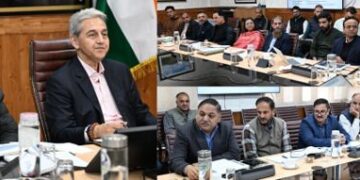

Jammu : Chief Secretary, Atal Dulloo, Tuesday chaired a high-level meeting of senior officers to deliberate upon and give shape to a robust mechanism for rehabilitation and reintegration of drug abuse victims across the districts of Jammu and Kashmir.
The meeting was attended by Principal Secretary, Home; Commissioner Secretary, General Administration Department (GAD); Commissioner Secretary, Social Welfare Department; Commissioner Secretary, School Education Department; Secretary, Health & Medical Education (H&ME); Secretary, Skill Development Department (SDD) and Labour & Employment (L&E); Secretary, Rural Development Department (RDD); Director General, Budget; Director, Information; Managing Director, JKRLM; Director Colleges and other concerned officers.
Reviewing the frame work Chief Secretary emphasized the importance of systematic tracking for every registered drug abuse victim seeking treatment, advocating for sustained support in rehabilitation and social reintegration. He highlighted the necessity of monitoring these individuals for several years post-treatment, providing tailored opportunities in livelihood generation, skill development, self-employment, or education based on their specific rehabilitation needs. Institutional support was underscored as critical, with a call for collaboration among various departments to ensure comprehensive assistance throughout the recovery process. The Chief Secretary noted that while family and societal support are vital, successful long-term reintegration into society heavily relies on robust institutional mechanisms. He pointed out that motivating victims to seek treatment is merely the initial step; it must be followed by regular follow-up, counseling, and livelihood support to mitigate the risk of relapse. To enhance accountability and effectiveness, he directed the establishment of a district-level monitoring framework led by senior officers, supported by dedicated teams to identify gaps and ensure lifelong rehabilitation outcomes. Additionally, he instructed the development of an integrated online platform to facilitate real-time tracking and case management, with clearly defined roles for each department and unique identification for beneficiaries. During the meeting, Sarmad Hafeez, Commissioner Secretary of the Social Welfare Department, presented a proposed inter-departmental coordination mechanism and post-rehabilitation framework. He reported the formation of a dedicated Task Force under the Nasha Mukt Bharat Abhiyan, aimed at planning, coordinating, and monitoring rehabilitation and reintegration efforts across departments. The Task Force will focus on multi-departmental coordination, standardized screening and referral processes, the availability of trained psychiatrists, and strengthening law enforcement to reduce supply while enhancing rehabilitation processes. The rehabilitation framework aims to establish standardized protocols and counseling units throughout Jammu and Kashmir, integrating skill development programs, livelihood support, start-up credit linkages, self-employment assistance, and partnerships with the private sector to ensure sustainable recovery for rehabilitated individuals. The meeting also highlighted the necessity for school-based preventive programs, community engagement initiatives, post-care monitoring systems, and the strengthening of infrastructure and capacity building. The roles and responsibilities of various departments, including School Education, Higher Education, Rural Development, Skill Development, Labour & Employment, Health, Home, and Social Welfare, were clearly defined to achieve the overarching goal of a drug-free Jammu and Kashmir. The Chief Secretary reaffirmed the government’s commitment to addressing drug abuse through a comprehensive approach that involves both government and society, aiming to safeguard the future of youth and foster a healthier community.