Free LPG cylinders, fee waivers, new hospitals , job push headline Omar Abdullah’s Budget 2026–27
• 32 welfare measures announced with focus on poor, youth, healthcare and rural economy
• Budget promises relief to AAY families, students, orphans and border residents
• Healthcare, horticulture and employment emerge as key pillars of J&K Budget
• Omar’s second Budget stresses welfare, growth and social security
• Trauma hospitals, LPG support and education relief mark people-centric Budget
• Border safety, youth jobs and farmer support get major push in Budget 2026–27
• Social protection and infrastructure drive at core of Omar Abdullah’s Budget
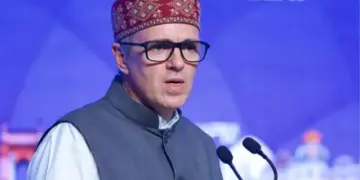
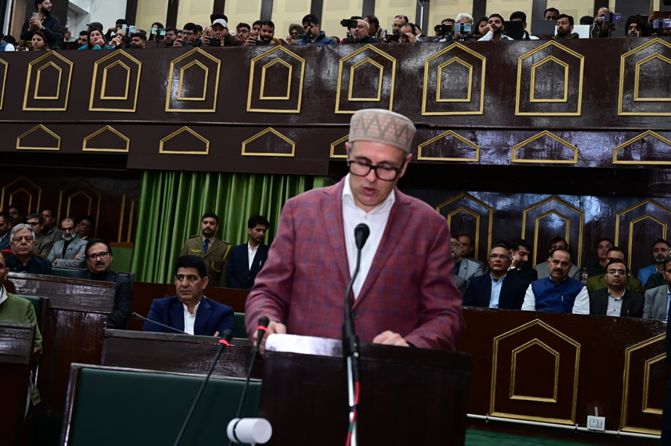
Jammu: Chief Minister Omar Abdullah on Friday presented the Budget for 2026–27 before the Jammu and Kashmir Legislative Assembly, marking his second Budget as Finance Minister and outlining a comprehensive, people-centric roadmap aimed at inclusive growth, social security and sustainable development across the Union Territory.
Describing the Budget as a fiscal compass for Jammu and Kashmir’s future, the Chief Minister said it lays a strong foundation for enduring economic growth, social harmony and long-term prosperity. Framed around the theme “Safar Jaari Hai”, the Budget places strong emphasis on welfare, healthcare, education, employment, rural development, horticulture, digital governance and infrastructure development, with a clear focus on the most vulnerable sections of society.
The Chief Minister announced 32 major welfare initiatives, including six free LPG cylinders annually for Antyodaya Anna Yojana (AAY) families, fee waivers for indigent students, sponsorship support for 6,000 orphans, major investments in healthcare infrastructure, and targeted measures for agriculture, horticulture and youth employment.
Beginning his address with a poetic couplet — Safar Taveel Hai, Bhoj Bhi Bari Hai, Par Har Surat, Yeh Safar Jaari Hai — Omar Abdullah said the Budget is not merely an accounting exercise but a reflection of the government’s vision for people-first governance.
“With deep humility and unwavering resolve, I rise to present my second Budget as Finance Minister. This Budget charts our path towards a brighter horizon and lays strong foundations for economic growth, social harmony and sustainable prosperity. I invite all members of this august House to work collectively to build a strong and flourishing Jammu and Kashmir,” he said.
The Chief Minister, who also holds the Finance portfolio, said that beyond sector-wise allocations, the Budget carries a set of focused measures that will directly touch the lives of citizens, particularly the most vulnerable sections, reinforcing the government’s commitment to social justice, targeted welfare and long-term empowerment.
For the financial year 2026–27, total gross receipts have been estimated at Rs 1,27,767 crore, while net budget estimates stand at Rs 1,13,767 crore, excluding ways and means advances and overdraft provisions. Own revenues are projected at Rs 31,800 crore, central assistance at Rs 42,752 crore and inflows under Centrally Sponsored Schemes at Rs 13,400 crore.
The Gross State Domestic Product for 2026–27 has been projected at Rs 3,15,822 crore, reflecting a growth rate of 9.5 per cent and indicating steady economic expansion.
Among the key welfare announcements was the provision of six free LPG cylinders per year to all AAY households in Jammu and Kashmir, aimed at reducing the financial burden on poor families and promoting the use of clean cooking fuel.
To ensure educational equity, the Chief Minister announced full fee reimbursement through Direct Benefit Transfer for students from AAY families studying in government schools from Class 9 to Class 12 and in government degree colleges at the undergraduate level who are not covered under any other scholarship schemes.
A Sponsorship Scheme for 6,000 orphan children under non-institutional care was also announced, under which eligible beneficiaries will receive Rs 4,000 per month through DBT.
In another significant social welfare measure, assistance under the Marriage Assistance Scheme has been increased from Rs 50,000 to Rs 75,000 per beneficiary. The eligibility condition of passing Class 8 has also been removed to ensure wider coverage for girls belonging to poor families.
Healthcare emerged as a major focus area in the Budget. The Chief Minister announced the establishment of two Emergency and Accident Hospitals at Uri and Poonch to cater to border and conflict-affected areas. Bullet-proof ambulances will also be procured for border districts such as Poonch and Tangdhar, which frequently face cross-border firing and emergencies.
Key healthcare initiatives include commissioning of the extension block of Lal Ded Hospital in Srinagar at a cost of Rs 118 crore, adding 108 beds along with NICU and IVF facilities. Construction of a 249-bedded Mother and Child Care Hospital at Government Medical College Anantnag will begin in 2026–27.
Emergency Medicine Departments will be established in all Government Medical Colleges over the next two years. PET scan facilities will be installed at GMC Srinagar and GMC Kathua, while cardiology services will be expanded through the establishment of Cath Labs at GMC Rajouri, Baramulla and Doda with an outlay of Rs 30 crore.
Recognising the rising incidence of cancer in the region, the government will roll out a comprehensive Cancer Control Strategy in collaboration with NITI Aayog and the Indian Council of Medical Research. The strategy will focus on prevention, early diagnosis, improved treatment facilities and creation of a population-based cancer registry.
The Budget also provided strong support for horticulture and agriculture, which form the backbone of Jammu and Kashmir’s rural economy. To protect farmers and orchardists from climate-related risks, the Chief Minister announced implementation of the Restructured Weather Based Insurance Scheme for apple, saffron, mango and litchi crops, covering a total sum insured of Rs 6,594.93 crore.
The Holistic Agriculture Development Programme will continue to drive diversification of the agri-economy. The Chief Minister said the cultivated area has increased from 12.71 lakh hectares to 13.50 lakh hectares, reflecting the positive impact of ongoing reforms and schemes.
Expansion of Controlled Atmosphere storage infrastructure was also announced. Currently, 68 CA stores with a capacity of 2.92 lakh metric tonnes are operational against a requirement of 6.00 lakh metric tonnes. Additional capacity of 15,000 metric tonnes will be added in 2025–26, while 38,000 metric tonnes is targeted in 2026–27.
To ensure balanced regional dispersal, top-up subsidies for CA storage will focus on districts other than Pulwama and Shopian. The government plans to establish 40 CA stores with an investment of Rs 1,400 crore, including subsidy support of Rs 600 crore from 2026–27 onwards.
A 25 per cent top-up subsidy for micro and sprinkler irrigation, with an outlay of Rs 116.86 crore, was also announced. This is expected to benefit farmers across nearly three lakh hectares and improve water-use efficiency by 60 to 80 per cent. An Aromatic and Medicinal Plant Mission with a total outlay of Rs 150 crore was announced, with Rs 10 crore earmarked for the next financial year.
To strengthen the livestock sector, the Chief Minister announced the establishment of one Embryo Transfer Technology laboratory in every district with a phased investment of Rs 65 crore, aimed at preserving and improving high genetic breeds.
On employment and industry, the Chief Minister announced that all industrial units availing government concessions, including subsidies, electricity or land, will be required to give due priority to employment of local youth so that industrial growth directly translates into jobs and income opportunities for residents.
Acknowledging persistent vacancies in far-flung and difficult areas, the government is actively contemplating a structured incentive scheme for employees posted in remote and hardship zones to improve retention and ensure equitable access to public services, particularly in health and education.
In the education sector, the Chief Minister announced the launch of JK e-Pathshala, a free-to-air DTH channel delivering curriculum-aligned lessons from Class 1 to 12 without internet dependency. Over 300 educational videos have already been produced, and class-specific channels will be developed in the coming year. Indoor games facilities will be introduced in all government schools, with an outlay of Rs 18 crore.
To strengthen early childhood care, 1,000 Anganwadi Centres will be upgraded into modern Bal Vidyalayas with improved infrastructure and safety standards, while 127 new Anganwadi Centres will be constructed across CDPO blocks.
The Chief Minister also highlighted reforms in digital financial governance, stating that all Centrally Sponsored Schemes have transitioned to the SPARSH system, Aadhaar-based DBT has been mandated and more than 23,000 bills have already been processed through the cyber treasury.
On tourism, Omar Abdullah announced development of new world-class tourist destinations in collaboration with the Ministry of Tourism, Government of India. Despite setbacks due to the Baisaran incident, Jammu and Kashmir recorded around 1.61 crore tourist visits during the current year. The government is also investing in sewage treatment plants and solid waste management to protect fragile ecosystems, and an International Film Festival is planned to be held shortly.
On the issue of regularisation of daily rated workers, the Chief Minister assured the House that the recommendations of the High-Level Committee constituted for the purpose will be implemented to find a just and humane solution within the framework of law and fiscal responsibility.
Commending the Budget to the House, Omar Abdullah said it strengthens welfare measures, accelerates infrastructure development, improves productivity and ensures a more prosperous and inclusive Jammu and Kashmir. He concluded by presenting the supplementary statement of expenditure for the year 2025–26 before the Assembly.