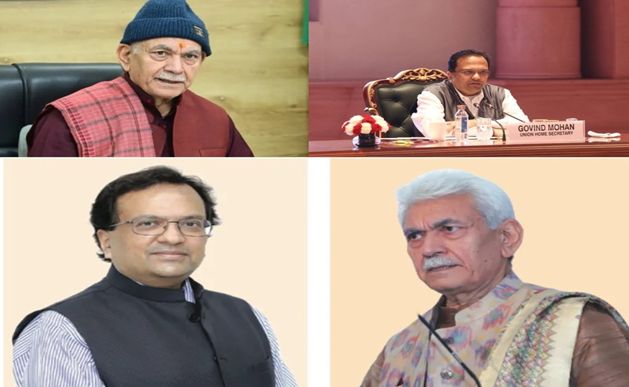
Unified Command Strategy In Place For Peaceful Republic Day
Srinagar: The high-level review of the security situation in Jammu and Kashmir by Union Home Secretary Govind Mohan, in consultation with Lieutenant Governor Manoj Sinha and top security leadership, signals a renewed and intensified push by the Centre to consolidate counter-terror gains while responding to emerging threats in the Union Territory. The two-day visit, marked by back-to-back meetings with the civil administration, military commanders, police chiefs and intelligence heads, comes at a time when the security landscape in J&K is witnessing a complex mix of traditional infiltration attempts, drone-based threats and renewed terror activity in the hilly belts of the Jammu region. Officials said the discussions focused on the current security situation across both Kashmir Valley and Jammu region, with special emphasis on ongoing anti-terror operations, operational preparedness and inter-agency coordination. The review also assessed border management along the International Border and the Line of Control (LoC), particularly in view of increased drone activity and intelligence inputs suggesting infiltration attempts under the cover of dense winter fog.
Strategic Timing Amid Heightened Security Concerns: The Home Secretary’s visit assumes significance as it follows Union Home Minister Amit Shah’s January 8 directive to security forces to target terrorist infrastructure and terror financing in a “mission mode.” The emphasis on sustained, intelligence-led operations underscores the Centre’s resolve to prevent any resurgence of terrorism, particularly in areas that have seen sporadic violence over the past two years. The timing is also crucial given the approaching Republic Day celebrations, traditionally a period of heightened security sensitivity in the region. Officials confirmed that Mohan chaired a separate meeting to review security arrangements for the national event, reflecting the government’s focus on pre-emptive measures rather than reactive responses.
Jammu Region In Sharp Focus: While Kashmir Valley has historically been the epicentre of terrorism, recent security assessments indicate a tactical shift by terror groups towards the hilly and forested areas of the Jammu region, including Rajouri, Poonch, Doda and parts of Udhampur and Kathua. Security agencies believe that nearly three dozen terrorists, including Pakistani nationals, are currently hiding in these difficult terrains after infiltrating over the past two years. The Home Secretary’s review of “heightened operational security in hilly areas” points to concerns over these forest belts being used as staging grounds for ambushes, reconnaissance and logistics. The rugged geography, sparse population and dense foliage pose operational challenges, necessitating close coordination between the Army, paramilitary forces, Jammu and Kashmir Police and intelligence agencies. Officials said the meetings reviewed the progress of ongoing search-and-destroy operations and evaluated the deployment pattern of forces to ensure sustained pressure on terror networks without creating security gaps.
Drone Threats, Border Management: Another key focus of the discussions was the growing use of drones by terror handlers across the border. The spurt in drone activity along the International Border and the LoC has added a new technological dimension to the security challenge, with drones being used to drop arms, ammunition, narcotics and communication equipment. Intelligence inputs suggest that terrorists waiting to infiltrate are attempting to exploit periods of low visibility, particularly dense fog, to evade detection. The Home Secretary’s review of border security management indicates a push to further integrate technological solutions such as anti-drone systems, surveillance radars and night-vision capabilities with traditional border guarding measures. Senior officials present at the meeting said the emphasis was on closing gaps in surveillance, improving real-time intelligence sharing and ensuring rapid response mechanisms to counter drone incursions.
Inter-Agency Coordination Under Lens: A recurring theme in the security review was the need for seamless coordination among multiple agencies. With the presence of senior leadership from the Intelligence Bureau, Border Security Force, Central Reserve Police Force, Jammu and Kashmir Police and the Army, the meetings underscored the importance of joint planning and execution. Officials said the Home Secretary stressed the need for institutionalised coordination rather than ad-hoc responses, particularly in intelligence sharing and operational decision-making. The complex threat environment—combining cross-border terrorism, local radicalisation and technological tools—demands a unified command approach and shared situational awareness. The emphasis on coordination also reflects lessons drawn from past operations, where intelligence gaps or delayed responses were exploited by terrorists.
Centre–UT Synchronisation: The meeting between Govind Mohan and Lieutenant Governor Manoj Sinha at the Lok Bhawan highlighted the Centre’s continued hands-on approach to governance and security in Jammu and Kashmir. Apart from security issues, the discussions reportedly touched upon development-related matters, reflecting the government’s stated policy of pursuing security and development in parallel. Officials said the LG briefed the Home Secretary on ground-level assessments and administrative measures being taken to support security operations, including logistics, infrastructure and coordination with district administrations. This synchronisation between the Centre and the UT administration is seen as critical in maintaining operational momentum and public confidence.
Security Operations, Civilian Outreach: While the security review focused heavily on counter-terror operations, officials indicated that civilian safety and minimal disruption to daily life remain key considerations. The government has repeatedly emphasised that sustained peace cannot be achieved through force alone and must be complemented by development, governance reforms and community engagement. However, the scale of ongoing operations—particularly in high-altitude areas and forest belts—reflects the seriousness of the threat assessment. Security forces are operating in challenging weather conditions, with winter snowfall further complicating movement and logistics.
Republic Day | Preventive Strategy: The Home Secretary’s review of security arrangements for Republic Day celebrations is part of a broader preventive strategy aimed at denying terror groups symbolic or high-impact targets. Historically, national events have been used by terror groups to attempt attacks that attract maximum attention. Officials said enhanced security layers, intelligence monitoring and area domination exercises have been put in place across the UT to ensure smooth conduct of the celebrations. The review also assessed contingency planning and emergency response preparedness.
Broader Security Context: The renewed focus on Jammu and Kashmir comes against the backdrop of a relatively improved security situation in the Valley compared to previous years. While incidents of violence have reduced, security agencies remain cautious, noting that terror networks across the border continue to adapt their tactics. The emphasis on dismantling terror financing networks, as directed by the Home Minister, reflects an understanding that sustained terrorism is dependent on financial lifelines. Cutting off these channels is seen as essential to achieving long-term stability.
Kashmir Horizon View: Despite the intensive security review and ongoing operations, challenges remain. The rugged terrain of Jammu’s hilly districts, evolving drone technology, and attempts to exploit weather conditions pose operational difficulties. Additionally, maintaining public trust while conducting prolonged security operations requires careful balancing. Experts note that sustained peace will depend not only on neutralising terrorists but also on preventing recruitment, countering misinformation and ensuring that development initiatives reach remote and sensitive areas. The two-day visit of Union Home Secretary Govind Mohan and his extensive engagements with the UT leadership and security establishment send a clear message of vigilance and resolve. By reviewing operations at a granular level and emphasising coordination, preparedness and technological adaptation, the Centre appears determined to prevent any rollback of security gains in Jammu and Kashmir. As anti-terror operations continue across forest belts and border areas, the challenge for the security establishment will be to sustain pressure on terrorists’ networks while reinforcing governance and development efforts. The high-level review in Jammu underscores that the security situation in J&K remains a top national priority one that demands constant monitoring, adaptability and unwavering coordination across agencies.