Says “Self-reliance remains the cornerstone of India’s long-term economic roadmap, structural transformation”
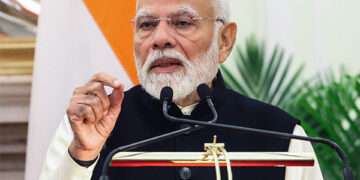
New Delhi : Prime Minister Narendra Modi on Tuesday held an extensive interaction with a group of eminent economists and experts at NITI Aayog to discuss India’s long-term economic roadmap with a focus on ‘Aatmanirbharta’ and structural transformation as the country moves towards becoming a developed nation by 2047.
During the interaction, the Prime Minister said that the vision of a developed India by 2047 has evolved into a shared national aspiration and is no longer limited to policy discussions alone.
He noted that this aspiration is increasingly reflected in changing patterns of education, consumption, mobility, and workforce participation across the country. Emphasising the need for preparedness, he said, institutions and infrastructure must evolve in line with these transformations.
The Prime Minister stressed that India’s policy planning and budgeting processes must remain aligned with the long-term vision of Viksit Bharat.
He underlined the importance of mission-mode reforms across sectors to strengthen India’s global competitiveness and integration with international markets, while also positioning the country as a key contributor to the global workforce.
The economists shared their perspectives on accelerating structural transformation in the Indian economy.
Discussions focused on improving productivity and competitiveness in both manufacturing and services sectors, increasing household savings, and strengthening infrastructure development to support sustained growth.
Participants also highlighted the growing role of technology in driving economic transformation. Artificial Intelligence was discussed as a major enabler of productivity across sectors, while India’s Digital Public Infrastructure was highlighted as a critical foundation for inclusive and efficient economic growth.
The discussions took note of the cross-sectoral reforms undertaken during 2025 and the planned reform agenda for the coming period. These reforms were seen as essential to maintaining India’s position as one of the fastest-growing major economies and to unlocking new growth opportunities across sectors.
The interaction reflected the government’s continued emphasis on wide-ranging consultations with experts and stakeholders to shape future policy. The insights shared during the meeting are expected to contribute to further strengthening India’s economic framework and advancing the goal of a resilient, competitive, and self-reliant economy as the country approaches its centenary year of independence.