From Power to Service Modi Renames PMO
“Sewa Tirth , Lok Bhavan The Symbols of Citizen-Centric Governance”
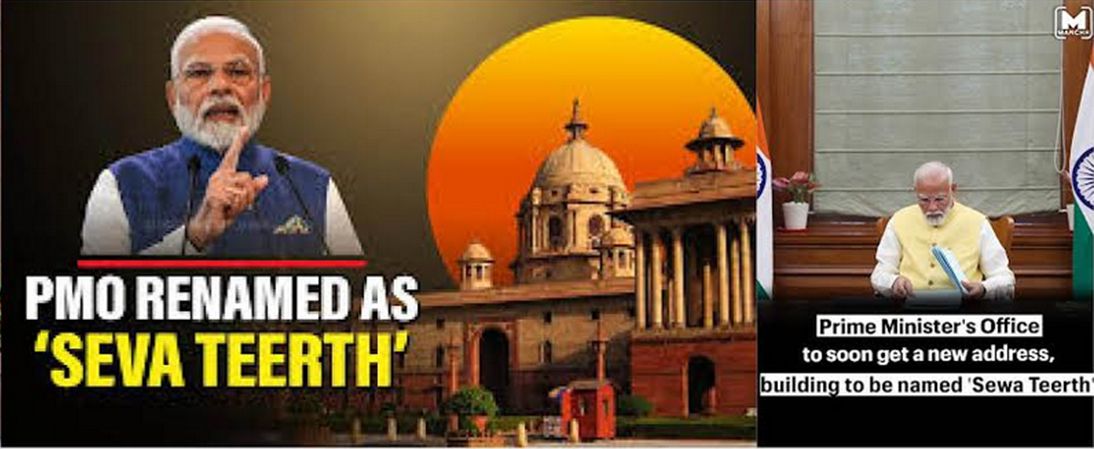
Srinagar: In a landmark step reflecting a renewed focus on service-oriented governance, Prime Minister Narendra Modi has renamed the Prime Minister’s Office (PMO) as “Sewa Tirth”, signalling a symbolic yet profound shift in the perception of India’s highest administrative office. The announcement, shared on social media, underscores the government’s emphasis on public service and accessibility, aligning with its broader narrative of governance centered on citizen welfare rather than mere authority. Union Home Minister Amit Shah, in a social media post, confirmed that the change is part of a larger effort to rename the Raj Bhavan and Raj Niwas in states and Union Territories as Lok Bhavan and Lok Niwas, respectively. Shah described this as a historic milestone in India’s journey toward building a developed and “superior” nation, where governance is closely intertwined with service, transparency, and accountability. The Home Minister highlighted that over the past eleven years, the Modi government has sought to redefine political leadership as one of service rather than power, portraying the Prime Minister as a Pradhan Sewak, working round-the-clock for citizens.
J&K Aligns With National Move: In Jammu and Kashmir, the Lieutenant Governor’s Secretariat has followed suit by renaming the Raj Bhavan to “Lok Bhavan, Jammu and Kashmir.” According to reports from Akashvani Jammu, the Raj Bhawan building, serving as the official residence and office of the Lieutenant Governor, will now be referred to exclusively by its new nomenclature. An official order, signed by Principal Secretary to LG, Dr. Mandeep K. Bhandari, stated that the change is effective immediately, marking a seamless alignment with the directives issued by the Ministry of Home Affairs (MHA). The move reflects the government’s desire to symbolically democratize official spaces and shed vestiges of colonial-era nomenclature, replacing hierarchical connotations with terms denoting public service and accessibility.
National Context|Eight States, UTs Follow Suit : The renaming of Raj Bhavan and Raj Niwas is not limited to Jammu and Kashmir. Following the MHA directive, eight states and one Union Territory have already implemented the changes. The states include West Bengal, Tamil Nadu, Kerala, Assam, Uttarakhand, Odisha, Gujarat, and Tripura, while Ladakh’s Raj Niwas has been rechristened Lok Niwas. The MHA’s directive was inspired by suggestions from the Conference of Governors held last year, which observed that the term “Raj Bhavan” evokes colonial overtones, incompatible with India’s post-independence democratic identity. The letter from the Home Ministry requested that all governor and lieutenant governor offices adopt the new nomenclature for all official purposes, signaling a broader symbolic effort to reclaim India’s administrative spaces from colonial vestiges.
Historical, Symbolic Significance : The move carries both historical and symbolic weight. “Raj” in “Raj Bhavan” and “Rajpath” has long been associated with the colonial governance framework established by the British, representing authority, hierarchy, and a top-down style of administration. By adopting Lok Bhavan and Lok Niwas, the government seeks to reinforce the idea that these offices are not temples of power but centres of public service—a subtle yet potent affirmation of India’s democratic ethos. Observers note that this step is part of a series of symbolic reforms aimed at shedding colonial legacies in the public sphere. Earlier, the government had renamed Rajpath as Kartavya Path, emphasizing civic duty over ceremonial grandeur. In addition, official communications increasingly use Bharat instead of “India,” and government websites prioritize Hindi content, reflecting a conscious shift toward India-centric terminology and cultural identity.
Governance As Service| “Pradhan Sewak” Philosophy: Prime Minister Modi’s renaming of the PMO to Sewa Tirth epitomizes the government’s philosophy of governance as service. The phrase “Sewa Tirth” can be interpreted as a pilgrimage of service, indicating that leadership is a continuous act of dedication to the public rather than a position of privilege. Amit Shah reinforced this view by stressing that the PM personally considers himself a Pradhan Sewak, emphasizing the ethos of service over power. This symbolic renaming also reinforces the government’s long-standing narrative that administrative offices should reflect citizen-centric values. By giving these official spaces names that emphasize service, the government is attempting to reorient public perception of political authority—from hierarchical and inaccessible to responsive, accountable, and service-oriented.
Decolonizing India’s Administrative Landscape: The decision to rename Raj Bhavan and Raj Niwas follows a broader initiative to decolonize India’s public and administrative lexicon. The MHA’s directive reflects an institutional consensus that India’s governance structures should represent sovereignty, democracy, and equality, rather than perpetuating colonial legacies. The renaming also has psychological and symbolic impact. By moving away from terms like “Raj,” the government is asserting that citizen welfare takes precedence over ceremonial or symbolic markers of power, reinforcing the idea that governance is a participatory and inclusive process.
Wider Implications For Indian Federalism: By implementing these changes across multiple states and Union Territories, the government is signaling a pan-India approach to administrative reform. The move transcends political affiliations and regional identities, reflecting a unified effort to modernize governance symbols. This uniformity in nomenclature may also have the practical effect of reducing hierarchical perceptions in bureaucratic interactions, subtly encouraging a more accessible relationship between citizens and administrative offices. Moreover, by aligning both the PMO and the Raj Bhavans/Lok Bhavans with a service-oriented philosophy, the government is creating consistency across the federal governance framework, reinforcing the notion that all offices—from the center to the states—exist primarily to serve the public.
Public Reception, Cultural Resonance: While symbolic in nature, these changes resonate deeply in the Indian socio-cultural context. Names carry emotional and historical significance; renaming Rajpath as Kartavya Path and the PMO as Sewa Tirth evokes a sense of moral responsibility, reminding citizens and officials alike of the ethical dimensions of governance. For many citizens, the renaming of Raj Bhavan to Lok Bhavan in their states reinforces the idea that public offices are spaces for all, reflecting India’s democratic ethos. It also ties into Prime Minister Modi’s larger narrative of transforming governance into a value-driven enterprise, emphasizing service, transparency, and citizen-centricity.
Continuity With Past Reforms: This step is part of a continuum of administrative and symbolic reforms pursued by the Modi government. Beyond renaming physical spaces, the administration has sought to Promote Hindi and regional languages as primary languages in official communication, Replace colonial-era ceremonial music at events like the Beating Retreat ceremony with Indian compositions. Recast India-centric narratives in digital and public communication channels. These changes, while symbolic, signal a long-term vision of governance where India is defined by its own values, history, and identity rather than inherited colonial markers.
Political , Administrative Analysis: Analysts view the renaming initiative as both symbolic and strategic. Symbolically, it asserts India’s sovereign identity and reinforces democratic values. Strategically, it aligns with the government’s broader image of accessibility, service, and citizen engagement. By presenting administrative offices as spaces of service rather than privilege, the government strengthens its narrative of people-centric governance. The move also highlights the government’s ability to drive coordinated reforms across federal and Union Territory structures, reflecting strong administrative cohesion. By achieving uniformity in nomenclature, the government signals its capacity to implement reforms decisively, a characteristic often emphasized in Prime Minister Modi’s leadership style.
National , Regional Implications: At the regional level, renaming the Raj Bhavan in Jammu and Kashmir as Lok Bhavan carries additional significance. It emphasizes integration, unity, and accessibility in a sensitive geopolitical region. The symbolic act communicates that governance in Jammu and Kashmir is oriented toward citizens’ welfare and public service, aligning with national governance standards. Similarly, for states like West Bengal, Kerala, and Tamil Nadu, the move transcends political divides, reflecting a broader consensus on shedding colonial vestiges. The uniform adoption across states and Union Territories underscores the government’s intent to create a cohesive administrative identity, grounded in India’s democratic and cultural ethos.