DGP Calls Detonation “Extremely Unstable”
Srinagar: Srinagar was shaken late Friday night when a powerful blast ripped through the Nowgam Police Station, killing nine people and injuring more than 25. By Saturday morning, Jammu and Kashmir Director General of Police (DGP) Nalin Prabhat confirmed that the explosion was an accidental one, triggered while forensic experts were handling a massive quantity of highly unstable explosive substances kept at the police station as part of an ongoing terror-linked investigation. The station had been central to the probe into a major interstate module connected to the Red Fort blast in Delhi, and the seized materials stored there were part of the large cache recovered during operations in the preceding week.
How The Explosive Material Reached Nowgam: DGP Prabhat explained that the explosion took place during routine but high-risk sampling of the seized explosives—procedures that had already been underway for two days. The materials in question had been retrieved from Faridabad on 9 and 10 November during the investigation of FIR 162/2025, which deals with the unravelling of a terror module. The seized cache included a huge quantity of chemicals, reagents, ammonium nitrate and other inflammable substances. These volatile materials were stored in the open evidence yard of the police station, awaiting mandatory forensic and chemical analysis. “It was the unstable and sensitive nature of the recovery that led to the unfortunate explosion,” DGP Prabhat said, urging the public to avoid speculation. He added that the forensic teams had been working with extreme caution, but the nature of the substances made them inherently unpredictable.
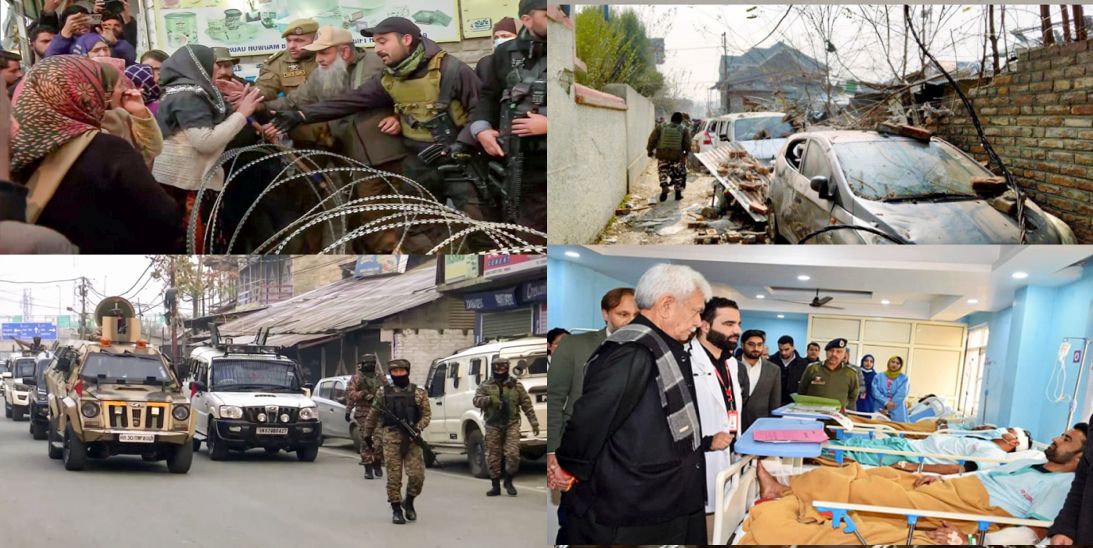
The Moment Of The Blast, Its Immediate Impact : The blast occurred around 11:20 pm and immediately engulfed the area in flames, sending shockwaves across adjoining neighbourhoods. The impact was so intense that the main police station building suffered severe structural damage, while several nearby houses were also affected. Residents described hearing a deafening noise followed by the sound of glass shattering and debris scattering across the locality. Emergency services rushed to the scene, and injured personnel and civilians were transported to nearby hospitals through the night. By morning, the scale of devastation was fully visible: mangled steel, collapsed walls, scattered forensic equipment, and a yard reduced to rubble.
Lives Lost In The Line Of Duty: In a sombre confirmation, DGP Prabhat announced that nine personnel who were directly involved in the forensic and investigative process had lost their lives. They included members of the State Investigation Agency, the Forensic Science Laboratory team, crime scene photographers, revenue officials attached to the magistrate’s oversight team, and even a local tailor who was assisting the officials. Each of them had been playing a critical role in the evidence-handling and documentation process when the explosion occurred. More than thirty others—including twenty-seven police personnel, two revenue officials and three civilians from nearby homes—were injured. Many of the injured remain hospitalised and are still undergoing treatment.
A Police Station At The Heart Of A Major Terror Probe : The Nowgam Police Station had, in recent weeks, emerged as a crucial centre for one of the most significant terror investigations in Jammu and Kashmir this year. The case began in October when posters linked to the Jaish-e-Mohammad surfaced in the area. What initially appeared to be a localised issue quickly expanded into an interstate investigation that took police across several states, culminating in the exposure of an elaborate terror module. As part of the crackdown, police had seized a staggering quantity of suspected explosive materials—more than 350 kg of ammonium nitrate alone—out of a total recovery of roughly 2,900 kg. This included potash, phosphorus, reagents, inflammable components, electronic circuits, remote controls, batteries, wiring, metal sheets and timers. Investigators have not specified the exact volume that was transferred to Nowgam, but they confirmed that the material being sampled at the time of the blast was part of this enormous seizure.
Risks Faced By Forensic Teams, Investigators : The tragedy has brought renewed focus on the risks faced not only by police and security personnel but also by forensic experts, documentation teams and administrative officials who play pivotal roles in terror-related investigations. These professionals often work behind the scenes, without protective gear that soldiers carry, yet they confront equally dangerous environments. The FSL team had been working continuously because of the sheer volume of the material, and revenue officials and photographers were mandated to supervise and document the sampling process. All of them were following standard evidence-handling protocols, yet the inherent volatility of the chemicals meant that even marginal instability could prove catastrophic.
Assessing Damage, Securing The Remaining Material : Following the incident, senior police officials, engineers and forensic specialists began assessing the structural damage to the site. The entire area has been sealed off for safety reasons. The remaining seized substances, considered potentially unstable, have been transferred to secure locations under expert supervision. A technical inquiry will determine the immediate cause of the explosion, though officials continue to emphasise that it was accidental, with no indication of any external trigger. DGP Prabhat reiterated that speculation around the cause would be unhelpful and premature given the sensitive nature of the ongoing investigation.
A Deep Loss For The Security Community: The blast has deeply affected the police force, forensic community and administrative ranks in Jammu and Kashmir. Senior officers remained stationed at hospitals through the night, monitoring the treatment of the injured and offering support to the families of the deceased. The loss of trained forensic experts and investigative personnel has been described as a significant setback for the ongoing probe, but officials stressed that the investigation into the interstate terror module would continue without interruption. Messages of condolence and solidarity poured in from security agencies and civil authorities, reflecting the collective grief and shock triggered by the tragedy.
A Reminder Of The Invisible Frontlines Against Terrorism: While the explosion was accidental, the circumstances surrounding it highlight the extraordinary pressures faced by those involved in counter-terror operations. The work of evidence recovery, chemical analysis and forensic sampling often takes place under dangerous conditions, especially when dealing with large volumes of unstable materials. The Nowgam tragedy stands as a stark reminder of the unseen frontlines in the fight against terrorism—frontlines where officers and technical experts operate without public spotlight but with high levels of risk. In the aftermath of the tragedy, Nowgam Police Station has become a symbol of both the dangers inherent in the fight against terrorism and the resilience of the personnel who continue this work despite such risks. The accident has shaken the police fraternity, but it has also strengthened their determination to pursue the investigation to its logical conclusion. The loss is immeasurable, the damage substantial, but the resolve to dismantle the terror network remains firm. For investigators, the tragedy is not an endpoint but a painful reminder of the hazards they navigate daily in their commitment to public safety.