- Says “heroes of Op Sindoor punished enemies beyond their imagination,“India to develop a new, powerful weapon system for national defense, retaliation”
- “IWT Suspension Linked To Terrorism, Blood and water won’t flow together”
- “A new ₹1 lakh Cr scheme to provide a ₹15,000 incentive to first-time private sector employees, targeting 3.5 Cr jobs”
- “National Deep Water Exploration Mission, To Be Set Up For Attaining the goal of increasing nuclear energy capacity tenfold by 2047”
- “First “Made-in-India” semiconductor chips to hit market by year end, New reforms to reduce taxes on daily-use items”
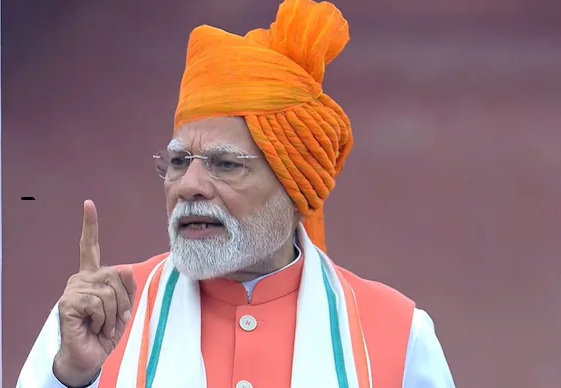
New Delhi |Aug,15: Prime Minister Narendra Modi, in his 12th consecutive address from the ramparts of the Red Fort on the 79th Independence Day, presented a comprehensive vision for a ‘Viksit Bharat’ (Developed India) by 2047. The Prime Minister began his address with a tribute to the Constitution of India, calling it a “lighthouse” that has guided the nation for 75 years. He also extended his sympathies to those affected by recent natural calamities, including landslides and cloudbursts, assuring them that the central and state governments were working together on rescue and relief efforts.The ceremony at the Red Fort began with Prime Minister Modi hoisting the national flag, followed by two Mi-17 helicopters of the Indian Air Force showering flower petals. One helicopter carried a banner of the Tiranga, while the other displayed a banner of Operation Sindoor, symbolizing the nation’s tribute to its armed forces. The speech, delivered to a nation immersed in the colors of the Tiranga, focused on a mix of national security, economic reforms, and strategic self-reliance.
A Firm Stance on National Security,Terrorism: PM Modi began his address by paying homage to the brave soldiers of “Operation Sindoor,” an action that had “punished enemies beyond their imagination.” The Prime Minister’s remarks were seen as a direct reference to Pakistan’s recent nuclear threats, which he said India “will not bow down to.” In a powerful declaration on foreign policy, Modi reaffirmed the suspension of the Indus Water Treaty with Pakistan, a decision made in response to continued cross-border terrorism. “Blood and water will not flow together,” he stated, arguing that the treaty was “unjust” and had allowed Indian river water to irrigate “the lands of the enemy” while Indian farmers suffered.
New Economic, Social Schemes: The Prime Minister unveiled a series of new initiatives to fuel economic growth and improve the lives of citizens. A key announcement was the “Pradhan Mantri Viksit Bharat Rojgar Yojana,” a ₹1 lakh crore scheme designed to support youth entering the private sector. Under the program, first-time private sector employees will receive a ₹15,000 financial incentive from the government. The initiative aims to generate a remarkable 3.5 crore job opportunities. For the common man, Modi promised a “Diwali gift” in the form of “Next Generation GST reforms.” These reforms, he said, would be implemented by the festival of lights and would significantly reduce the tax burden on daily-use items. He also announced the formation of a task force for next-generation reforms to align existing laws with the needs of a 21st-century India.Driving Towards Energy, Technological Self-Reliance: Modi also pushed for “Aatmanirbhar Bharat” (Self-Reliant India) by announcing two significant missions. The “National Deep Water Exploration Mission” was launched to search for oil and gas reserves in the sea, a move to reduce India’s dependence on foreign energy sources. He also highlighted the government’s focus on nuclear energy, stating the goal of increasing capacity tenfold by the time India celebrates its 100th year of independence. In a landmark announcement for the technology sector, PM Modi declared that the first “Made-in-India” semiconductor chips would hit the markets by the end of this year. He criticized past governments for a 50-60 year delay in semiconductor manufacturing, emphasizing the current government’s “mission-mode” approach to achieve technological independence.