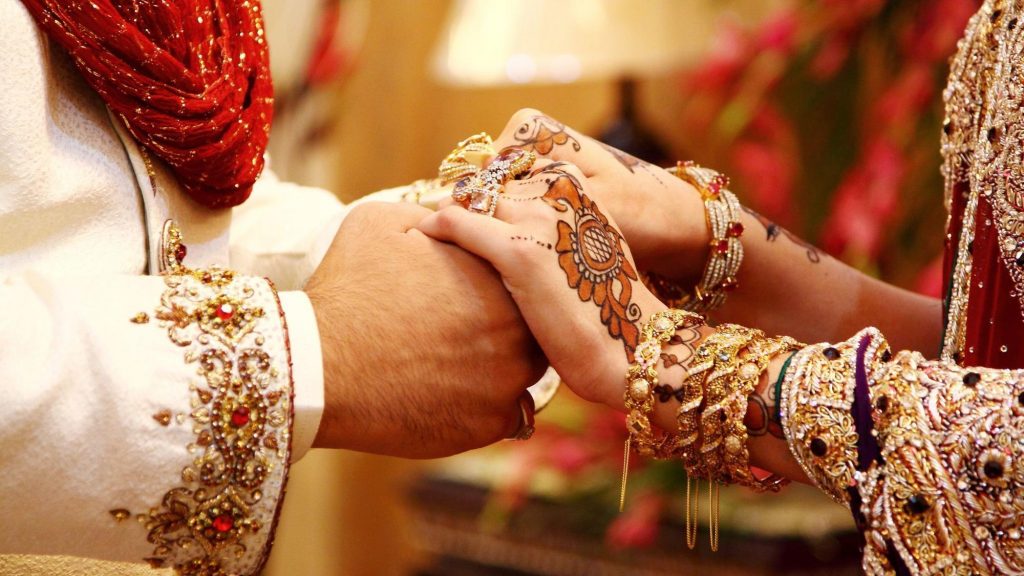
Marriage is one of the basic and primary institutions that exists in every society. As per Islam, Marriage is a legal contract between a man and woman on the basis of their free will and where both enjoy equal rights and duties. Marriage is a very beautiful bond and magnetic relation that cements organic love between the couple. It is a source of stability and companionship. It accelerates mutual respect, selflessness and forgiving factors between the couple. Islam emphasizes simplicity in marriages. Prophet Mohammad (PBUH) advocated marriages that are simple, accessible and free from undue hardship. Marriage is such a relationship between the people of two opposite sexes that helps in satisfaction of physical, biological, social, psychological and spiritual needs. It leads to the foundation of family and the procreation of children. Late marriage is one of the burning issues in Kashmir valley over the last many years. Its rate is increasing at a very high pace and thousands of girls in the Kashmir valley have crossed the marriageable ages and have not only become liabilities on their parents but also increased their anxiety level. For the last many years, the average-marrying age in Kashmir valley has increased from 24 to 35 for men and 21 to 32 for women. A survey was conducted by Tehreek e Fala-Ul-Muslimeen, a non-profit, non-political organization in April 2020. The survey revealed that more than 50,000 girls in Kashmir have crossed ideal marriageable ages. Amid high unemployment rate, inflation and expensive marriage expenditures’ for the last many years, the number of girls crossing marriageable ages would now be more than one lakh. There are many reasons for crossing marriageable ages among girls: poverty, dowry, unemployment, caste system, conflict, extravagant weddings, etc. Poverty is one of the many factors that slowdowns the pace and prospect of marriage proposals. Due to poverty, the poor families cannot afford to give dowry that becomes a potent factor in marriage proposals among girls of the poor families. In majority of cases, the poor girls’ families are selling their lands to others in order to pay dowry to grooms and their families. Failure of paying dowry by the daughters in law have to face cruelty in various forms like divorce, domestic violence, dowry deaths, strangulation etc. by the hands of in laws that Kashmir valley has been witnessing at an alarming rate. Dowry is a big curse and grave issue as it has ruined thousands of families. Compulsive and competitive social customs associated with marriages have converted marriage into a complex and costly affair that is sending chills down the spine among the middle and lower class families. Many families are not getting their girls married at a proper time as they put weird conditions like caste, income, academic qualification, family background, earning capacity, religious sect etc. There has been increasing spendthrifts in marriages particularly in Kashmir valley. Lakhs of rupees are being spent on unnecessary things like wazwan, sweets, gifts, and clothes that are making marriages more expensive and difficult. Expensive marriages have made the Nikah very difficult and evils like illicit relationships, adultery, unwed pregnancies very easy in contemporary societies.
“Promoting simple marriages and rejecting unnecessary social customs like extravagant expenditures, lavish feasts, and costly gifts can prevent late marriages. The government should create more youth employment opportunities and launch special poverty eradication programs. Organizing mass marriages by NGOs and providing financial assistance to poor families can also effectively prevent late marriages.”
Extravagant spendthrifts have created anxiety and tensions particularly among the middle and lower middle class families. Thousands of girls in Kashmir valley are eagerly waiting for marriages. They are the worst sufferers and they want satisfaction of physical, biological, social, psychological and spiritual needs. However, irony is that unnecessary traditions like hefty Dowry, lavish grand feasts, etc have been created in societies that frighten girls’ parents and that is why the birth of a female child haunts the nerves of a patriarchal father that could be the one of the reasons of declining sex ratio in Kashmir valley. Many girls also do not want to be married in Joint families. It has become so problematic and leads to late marriages. Many girls and boys also delay marriages for pursuing higher education and career aspirations thinking that marriages will hinder their professional growth. It is pertinent to mention that during Covid 19 pandemic lockdowns, extravagant marriage expenditures have been reduced to more extent that brought a sigh of relief to girls parents. During these days, Simple marriages were taking place all across the Kashmir valley not due to change in attitude of wedding families but due to covid 19 lockdown measures of the government and economic reasons of the families. The detrimental consequences of late marriages are multi-faceted. Be it physical health, mental health, familial and social relationships. Late marriages cause insomnia, anxiety, depressions, decline fertility rate and increase birth defects to newborn children, reproductive tract infection, irregular ovum production, menstrual irregularities and menopause.
Among these threats, the menopause adds more to the woes of girls that causes more mental agony and pain and is unbearable that cannot be relieved. To save our girls from late marriages and un-wedding, several constructive steps are needed on a war footing basis. Education and awareness among people by religious clerics, teachers, NGOs’ regarding the importance of simple and easy marriages can be very effective in promoting simple marriages with austerity. Dowry, a social evil needs to be eradicated in a society by strict implementation of Dowry prohibition act 1961 and change of patriarchal mind-sets of people. Promoting simple marriages in a society and saying good-bye to unnecessary social customs like extravagant marriage expenditures, lavish grand feasts, exchange of costly gifts etc. prevents late marriages in society. The government should create more employment opportunities for the youth and should launch special poverty eradication schemes and programs for the people. Organizing mass marriages by the NGOs’ and financial assistance for the poor families can also prove very effective in preventing late marriages. Parents, religious scholars and community leaders have a crucial role in driving this change by motivating, and educating people on the importance of simple marriages. It is the responsibility of all people to revive and restore the sanctity of marriages and overthrow all unnecessary malpractices in marriages. Let us pledge, welcome and appreciate simple marriages of girls and shun silly customs and traditions associated with marriages so that girls can get married at appropriate age and evils of late marriages can be eradicated in a society.
(The author is a teacher at Govt Boys Higher Secondary School Beerwah Budgam. The views, opinions and conclusions expressed in this article are those of the author and aren’t necessarily in accord with the views of “Kashmir Horizon”)
Mushtaq Ahmad Wani
[email protected]