Dairy cooperatives, tele-vet care, women-led models: New Thrust Areas
Srinagar: In a significant boost to Jammu and Kashmir’s agricultural landscape, Union Minister of Fisheries, Animal Husbandry and Dairying, Rajiv Ranjan Singh, today assured that the central government will provide all possible support to the Union Territory for the development and modernization of the dairy and fisheries sectors. His remarks came during a high-profile event titled ‘Reimagining Livestock & Fisheries with Future Ready Farmers: Vision 2030’ held at the Sher-e-Kashmir University of Agricultural Sciences and Technology of Kashmir (SKUAST-K).
The two-day visit by the Minister is being widely seen as a strategic step towards strengthening these vital sectors, which are crucial for the livelihood of thousands of small and marginal farmers across J&K. Speaking to a gathering of farmers, officials, academicians, and entrepreneurs, Rajiv Ranjan Singh underscored the need for organizing dairy farmers into cooperatives at various administrative levels — district, block, and panchayat — to empower them collectively and improve their market access and bargaining power. “The dairy farmers in Jammu and Kashmir are predominantly smallholders who require institutional support to scale up production and achieve better profitability,” the Minister said. “By reinforcing cooperative frameworks, we can ensure fair prices, reduce exploitation, and boost production quality. This will also pave the way for enhanced processing and value addition, which are critical for tapping into both domestic and international markets.”
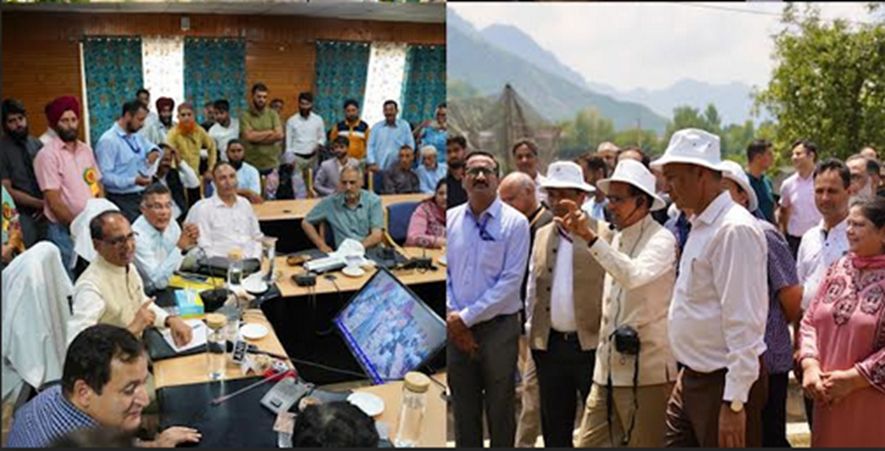
Highlighting Kashmir’s unique advantages, Singh pointed to the vast export potential of Kashmir trout — a highly prized product in the fisheries sector — along with specialty dairy products. “We recognize the tremendous opportunity that niche products from J&K hold in export markets. However, this potential can only be realized through focused efforts on processing, packaging, and brand-building,” he emphasized. The Union Minister also announced the central government’s commitment to supporting the J&K administration in establishing retail dairy outlets across every district of the Union Territory. These outlets will help create a direct-to-consumer model, reduce middlemen, and improve the income of dairy farmers. The event at SKUAST-K served as a vibrant platform to showcase cutting-edge agricultural innovations and foster dialogue between policymakers and the farming community. Upon arrival, Minister Singh toured the university’s high-density apple orchards and visited various stalls exhibiting breakthroughs in animal sciences and livestock management. One of the highlights of his visit was the interaction at a stall displaying India’s first gene-edited sheep, developed by SKUAST-K scientists using advanced genome-editing technology. This pioneering achievement places India among the global leaders in livestock genetic research and holds promise for enhancing productivity and disease resistance in farm animals. “SKUAST-K’s research breakthroughs are vital for ushering a new era of sustainable and resilient farming practices in Jammu and Kashmir,” Singh remarked. “Science and technology will be the backbone of transforming traditional farming sectors into future-ready enterprises.”
The Minister engaged directly with dairy farmers, Poshu Sakhis (women livestock entrepreneurs), fisheries cultivators, and entrepreneurs who shared insights about the progress they have made and the challenges they continue to face. Issues such as limited access to modern processing units, need for improved cold-chain infrastructure, and skill development for youth were among the key concerns raised. Singh assured that the Ministry is committed to addressing these challenges through collaborative efforts with the J&K government and stakeholders. He promised enhanced training programs, infrastructure development, and financial assistance schemes tailored for small and marginal farmers. Jammu and Kashmir’s Agriculture Minister, Javid Ahmad Dar, expressed his gratitude to the Union Minister for his unwavering support and stressed the critical role of value addition and processing in uplifting the rural economy. “Empowering the farming community economically requires us to go beyond production. We must focus on transforming raw produce into market-ready products to ensure better returns for our farmers,” Dar said. He said Dairy farming in Kashmir plays a critical role in empowering women, who form a significant part of the workforce in this sector. Through initiatives like Poshu Sakhi—women livestock entrepreneurs—many rural women are gaining financial independence and entrepreneurial skills. These women-led dairy cooperatives have become crucial in promoting gender inclusivity and strengthening community resilience in remote areas. Furthermore, the dairy sector contributes substantially to the region’s overall agricultural GDP. Milk and value-added dairy products such as cheese, yogurt, and butter have considerable market demand locally and beyond. Developing the dairy value chain, including processing and marketing, can enhance profitability for farmers and create employment opportunities in allied industries such as feed production, veterinary services, and dairy retail.
Kashmir’s unique climatic conditions allow for the production of niche dairy products that have potential for branding and export. Specialty products like traditional cheeses and organic milk have growing appeal in national and international markets, offering a chance for Kashmir to carve a distinct identity in the dairy industry. Unlocking this potential requires focused investment in quality control, cold-chain logistics, and product innovation. Principal Secretary Animal and Sheep Husbandry, Shalendra Kumar, presented an overview of the current status and future plans for dairy and fisheries in the Union Territory, highlighting the sector’s contribution to employment and food security. Vice Chancellor of SKUAST-K, Professor Nazir Ahmad Ganai, welcomed the dignitaries and briefed the audience on the university’s initiatives aimed at sustainable agriculture, livestock improvement, and fisheries development. He highlighted the institution’s role as a knowledge hub linking research with practical farming solutions.
The Union Minister’s visit also shed light on the broader Vision 2030 framework for livestock and fisheries development in J&K. This vision emphasizes sustainability, inclusivity, and modernization, seeking to leverage technology, scientific research, and market linkages to double farmers’ income and improve nutritional security. By organizing farmers into cooperatives, promoting innovative animal husbandry practices, and supporting niche product exports, the government aims to transform these sectors into engines of economic growth and rural empowerment. Minister Singh stressed the importance of integrating digital tools such as real-time monitoring, data analytics, and telemedicine for livestock health to increase efficiency and reduce losses. The gathering underscored the spirit of collaboration among central and UT governments, academia, and grassroots stakeholders to advance the dairy and fisheries sectors.
As the visit concludes, the commitments made by Union Minister Rajiv Ranjan Singh hold promise for Jammu and Kashmir’s farming community. With sustained policy support, improved infrastructure, and empowerment of farmers through cooperatives, the dairy and fisheries sectors are poised for transformative growth. For a region like J&K, where agriculture and allied activities form the backbone of rural livelihoods, such initiatives can not only raise incomes but also contribute to food security, employment generation, and export-led economic development. The fusion of traditional farming wisdom with modern technology, as seen in SKUAST-K’s pioneering work, along with focused government schemes, is expected to position Jammu and Kashmir as a leader in sustainable livestock and fisheries management in the years to come.