Srinagar: On the afternoon of June 12, 2025, India witnessed one of its most devastating aviation disasters in decades. Air India Flight AI171, a Boeing 787-8 Dreamliner en route to London’s Gatwick Airport, crashed just seconds after takeoff from Ahmedabad’s Sardar Vallabhbhai Patel International Airport.
The tragedy claimed 274 lives—including 241 of the 242 people on board and 33 civilians on the ground—leaving the nation in collective shock. The lone survivor, 45-year-old Vishwas Kumar Ramesh, emerged as a symbol of improbable survival.
As families grieve and investigations unfold, this anchor story captures the human heartbreak, the technical failures, the government’s response, and the broader implications of a catastrophe that has left an indelible scar on India’s conscience.
The Catastrophe; 33 Seconds To Disaster: At precisely 1:38 PM IST, Flight AI171 lifted off from Runway 23. Within 33 harrowing seconds, the cockpit issued a chilling “Mayday” call. The aircraft, under the command of Captain Sumeet Sabharwal and co-pilot Clive Kunder, failed to gain altitude, stalling at 825 feet before nose-diving into the densely populated Meghani Nagar locality. Tragically, the aircraft struck the hostel complex of BJ Medical College, triggering a fireball fueled by over 125,000 liters of jet fuel. Three buildings were decimated, including a student mess hall. The searing inferno, with temperatures exceeding 1,000°C, left rescue workers struggling to reach survivors. CCTV footage later revealed the final moments: the plane rising hesitantly, vanishing behind buildings, and a dark plume erupting into the sky. Among the victims were 169 Indian citizens, 53 British nationals, seven Portuguese, and one Canadian. Former Gujarat Chief Minister Vijay Rupani, flying to visit his daughter in London, was also among the deceased. The only survivor, Ramesh, seated in 11A near an emergency exit, managed to crawl out from the wreckage with minor burns. “It happened in front of my eyes… I don’t know how I survived,” he told DD News, still visibly shaken.
Grief on the Ground; Lives Interrupted: The human toll defies comprehension. Harpreet Kaur Hora, flying to London to surprise her husband on his birthday, had advanced her ticket by a day—an act of love that turned fatal. Her father-in-law, learning of her death from the news, stood frozen with disbelief. Among the crew was Roshni Songhare, a young air hostess from Dombivli who had just begun her dream job. In Manipur, the family of 23-year-old Kongbrailatpam Nganthoi Sharma learned of her death through a viral video clip. Another family, already grieving the loss of a son in a previous aviation accident, was wiped out entirely in this crash, their story reported by UK-based PA Media. The BJ Medical College community was devastated. Five MBBS students, a postgraduate doctor, and the wife of a superspecialist perished instantly. Over 60 students were injured. Yet amid the carnage, glimmers of heroism emerged—a nanny pulled a toddler to safety just moments before flames engulfed the hallway.
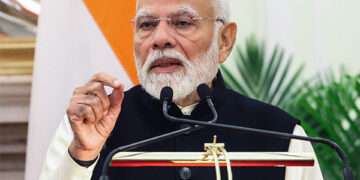
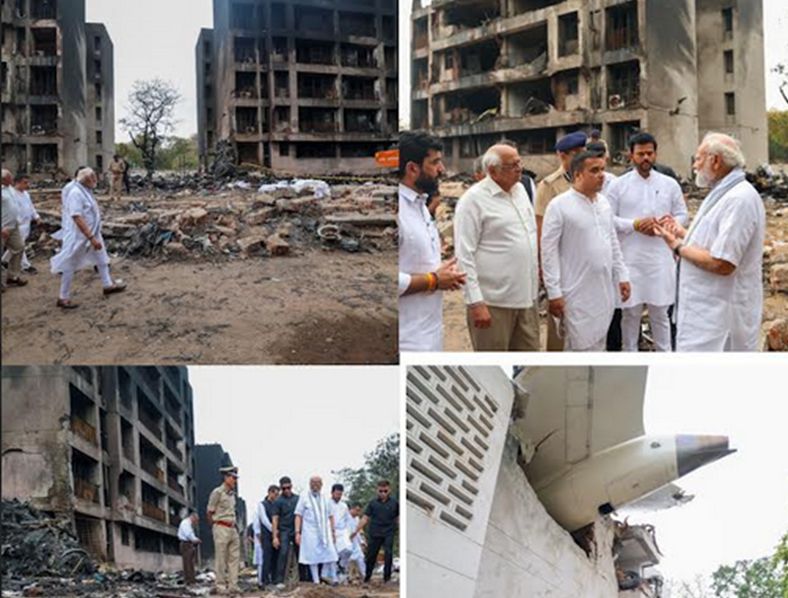
Leadership Under Pressure: Prime Minister Narendra Modi, himself a son of Gujarat, visited the crash site the following day. Meeting the lone survivor at Ahmedabad Civil Hospital, Modi described the devastation as “unbearable,” adding that the government would leave no stone unturned in ensuring accountability. Union Home Minister Amit Shah chaired a high-level emergency meeting, highlighting the immense challenge posed by the fuel load and the intensity of the fire, which allowed “almost no chance of survival.” Civil Aviation Minister Ram Mohan Naidu Kinjarapu announced a formal probe by the Aircraft Accident Investigation Bureau (AAIB), with support from a multidisciplinary panel. The aircraft’s black box—including the Flight Data Recorder (FDR) and Cockpit Voice Recorder (CVR)—was recovered from the rooftop of the hostel, giving hope that the true cause of the crash will be uncovered. Airlines across the country have been instructed to immediately submit updated airworthiness reports. While Chief Minister Omar Abdullah and Lieutenant Governor Manoj Sinha have remained focused on regional affairs in Jammu and Kashmir, their past crisis management—particularly in response to the April 2025 Pahalgam terror attack—has set a benchmark for handling disasters of national consequence.
Technical Failures And The Search for Truth: Preliminary reports suggest a catastrophic failure to climb, possibly due to mechanical malfunction or operational error. Aviation expert Sanjay Lazar speculated that engine failure or aerodynamic stall within seconds of takeoff may have doomed the aircraft. The Boeing 787-8, 12 years old but considered modern by industry standards, has faced past scrutiny. Although no definitive link to previous issues has been established, the incident has reignited safety concerns around the Dreamliner fleet. The National Disaster Response Force (NDRF) recovered 81 bodies from the wreckage. DNA testing is underway, as most remains were charred beyond recognition. U.S. agencies including the FAA and NTSB have joined the probe, while Boeing pledged full cooperation.
Medical Fallout , Societal Impact: The destruction at BJ Medical College—both human and infrastructural—has shaken Gujarat’s healthcare ecosystem. With 45 students hospitalized, the academic year stands disrupted, and a generation of young doctors has been scarred, if not lost. FAIMA and the Indian Medical Association have called for national support to the injured and bereaved. Meanwhile, Ahmedabad’s hospitals have seen a surge in blood donations, and counseling centers have been set up for students traumatized by the event. Economically, the crash could result in the most expensive aviation insurance claim in Indian history. LIC has confirmed that family compensation will be expedited using government-issued death certifications or airline records.
Political And International Reverberations: World leaders expressed shock. UN Secretary-General António Guterres extended “heartfelt condolences,” while UK’s King Charles III said he was “desperately shocked.” The British Foreign Office activated a dedicated helpline for affected families, reflecting the global scope of the tragedy. India’s opposition parties, too, expressed solidarity. West Bengal CM Mamata Banerjee called the incident “profoundly shocking.” Congress President Mallikarjun Kharge is set to visit the site, while condolences poured in from global diaspora groups and medical associations. Given the regional instability—including Israeli airstrikes on Iran and India’s Operation Rising Lion—speculation about sabotage surfaced. However, officials have clarified that no foul play has been confirmed, and the NIA’s presence at the site is purely precautionary.
Remembering The Past, Confronting The Present: This crash now stands as India’s deadliest aviation disaster since the 1996 Charkhi Dadri mid-air collision that killed 349. The echoes of past tragedies—such as the 1978 AI855 crash off Mumbai and the 2020 Kozhikode accident—have reignited debates about aircraft maintenance, urban zoning near airports, and crew training standards. While Ahmedabad’s airport lacks the “tabletop” risk factor seen in Kozhikode, its proximity to urban density has raised critical questions about flight path regulations and disaster preparedness. The recovery of the black box is just the beginning. The AAIB, along with international counterparts, will examine flight logs, maintenance history, and cockpit communication to determine what truly happened in those final seconds. Air India CEO Campbell Wilson visited the site, assuring families of full cooperation and support. Meanwhile, Minister Naidu has vowed sweeping reforms based on the investigation’s findings. As the world mourns, India prepares to heal. Ahmedabad’s resolve is on display in acts of kindness, resilience, and remembrance. The survival of Vishwas Kumar Ramesh stands as a symbol of hope—a reminder that even amid devastation, life endures. As Prime Minister Modi said in Ahmedabad, “We cannot undo the tragedy, but we can and must learn from it—so that no such heartbreak ever strikes our skies again.”