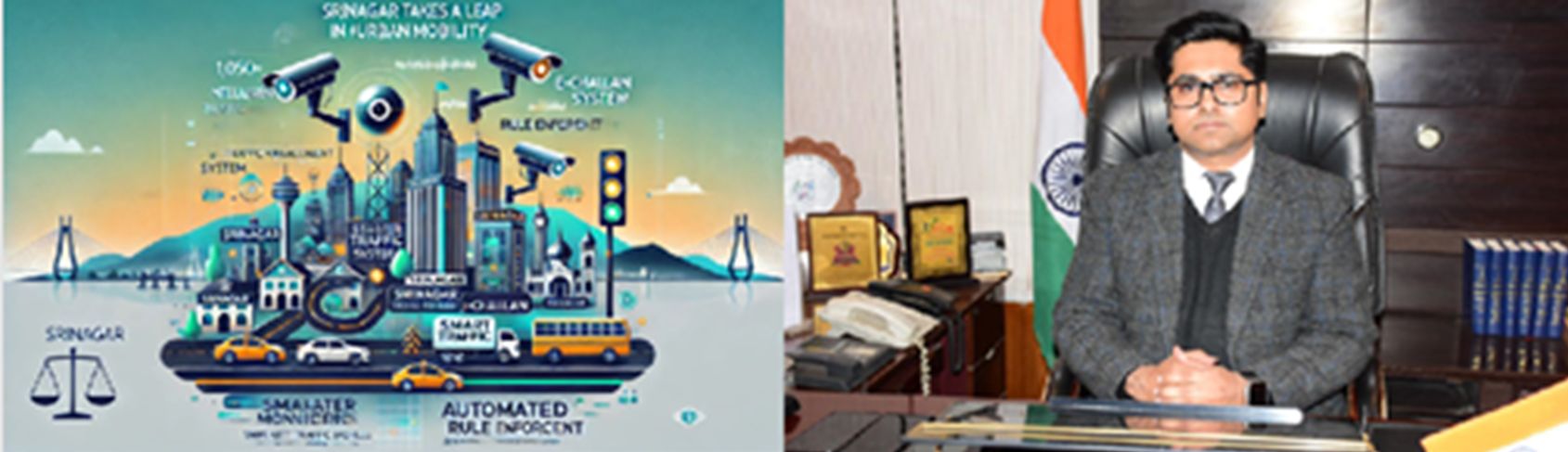
Srinagar: The Intelligent Traffic Management System (ITMS) has been launched in Srinagar as part of the city’s Smart City Project. The primary goal of the system is to improve traffic management, reduce congestion, and enhance road safety. With growing traffic challenges and frequent violations, the introduction of ITMS marks a significant step toward creating a more efficient and safer traffic environment in the city.
SSP Traffic City Muzaffar Shah said that cameras, which have been installed across the city, identify vehicles using registration numbers and, with the help of software, note violations of different sorts. “It retrieves the necessary data. The software identifies the violation of a particular vehicle with 100 percent accuracy,” he said. Dr. Owais Ahmed, CEO of Srinagar Smart City Limited, stated that this initiative will transform traffic management, making the urban environment safer and more efficient. He highlighted that one of the key features of the system is real-time traffic monitoring, using advanced cameras to strategically oversee traffic flow, enabling better management and a faster response to incidents. The ITMS is a sensor-based system that provides real-time monitoring of traffic conditions across Srinagar. High-resolution cameras, placed strategically at intersections and highway ramps, capture live video feeds. These feeds are analyzed using computer vision algorithms that detect traffic violations such as speeding, running red lights, mobile phone usage while driving, and riding without helmets. Along with cameras, sensors like inductive loop detectors and radar sensors are used to measure traffic volume, speed, and occupancy at key locations.
Automated Enforcement Of Traffic Rules: One of the core features of the ITMS is the automated enforcement of traffic rules. When a violation is detected, the system immediately generates an e-challan (electronic fine) that is sent to the violator’s registered address. The system uses the registration number of the vehicle, along with detailed data about the violation, such as time and location, to ensure that offenders are penalized accurately and promptly. This removes the need for human intervention, making the enforcement process more transparent and efficient.
Real-Time Monitoring , Data Integration: The data captured by the cameras and sensors are transmitted to a centralized Traffic Management Center (TMC) or cloud-based platform. Here, advanced software processes the data in real-time, allowing authorities to understand traffic patterns and potential congestion points. By analyzing the data, the system helps in identifying traffic bottlenecks and areas that need immediate attention. This allows for better resource allocation and quick response times to incidents or accidents on the roads.
Benefits Of ITMS For Srinagar: The introduction of ITMS brings several key benefits to Srinagar. One of the main advantages is improved road safety. By detecting and penalizing violators, the system aims to reduce reckless driving behaviors, ultimately making roads safer for everyone. As drivers are held accountable for their actions, the hope is that this will encourage more responsible driving habits across the city. Another significant benefit is the efficient traffic flow that the ITMS facilitates. The system enables authorities to monitor traffic in real-time, which helps in optimizing signal timings and reducing congestion, especially at busy intersections. This ensures that vehicles move smoothly, leading to reduced wait times and a more organized traffic pattern. Additionally, the system’s ability to manage traffic in real-time can help alleviate congestion during peak hours or tourist seasons, when the city experiences heavy traffic. By predicting and addressing these issues, the ITMS can significantly improve the overall driving experience. The automated e-challan system also plays a critical role in ensuring that penalties are issued fairly. This system eliminates the need for manual fines, which can sometimes lead to human error or bias. With the ITMS in place, offenders are automatically sent fines based on the violations detected, ensuring a transparent and consistent approach to traffic enforcement. The system also enhances better resource allocation, as authorities can focus on high-traffic areas or accident-prone zones based on the data collected. However, despite its many advantages, the implementation of ITMS also presents several challenges. One of the primary concerns is privacy.
Continuous surveillance through cameras and sensors could raise questions about the personal privacy of citizens. It is important that clear policies are put in place to address these concerns while ensuring that the system remains transparent and fair. Public awareness is another crucial factor. For the ITMS to be truly effective, drivers need to understand how the system works, the importance of following traffic rules, and the consequences of violations. Without proper education, the system may not achieve its desired impact. Regular maintenance of the system’s components—such as cameras, sensors, and software—is also essential for its smooth operation. Any technical failures could result in gaps in monitoring and enforcement, potentially undermining the effectiveness of the ITMS. Another challenge is the issue of juvenile and underage driving. There have been instances in Srinagar where young, unlicensed drivers have been involved in accidents. While the ITMS can identify these violators, strict enforcement and legal measures will be necessary to tackle this issue and prevent such dangerous driving behaviors. The response from the public regarding the ITMS has been largely positive. The Srinagar Traffic Police have actively promoted the system, urging drivers to comply with traffic regulations to avoid penalties.On platforms like ‘X’ (formerly Twitter), the police have posted reminders to drive safely and follow traffic rules. However, some drivers have expressed concerns about the potential fines and the fairness of the automated system, calling for transparency in the penalty process. The ITMS is expected to have a profound impact on road safety and traffic management in Srinagar.
By identifying violations in real time, the system encourages drivers to follow traffic rules, ultimately reducing accidents and improving the overall safety of the city’s streets. The ability to monitor traffic conditions in real-time also allows authorities to address congestion and incidents promptly, ensuring smoother traffic flow across the city. Looking ahead, the ITMS could serve as a model for other cities in India and beyond, as urban areas continue to face the challenges of increasing vehicle numbers and traffic violations. As Srinagar continues to implement and expand the system, it will likely see improvements in road safety, traffic management, and public compliance with traffic laws. Additionally, the integration of newer technologies, such as artificial intelligence and machine learning, could further enhance the system’s effectiveness in predicting and managing traffic patterns. The introduction of the Intelligent Traffic Management System (ITMS) in Srinagar represents a major advancement in urban traffic management. By combining cutting-edge technology with automated enforcement, the system promises to make the city’s roads safer and more efficient. However, for ITMS to be fully successful, continued public education, strong legal enforcement, and regular maintenance will be necessary. If these challenges are addressed, Srinagar could set a benchmark for smart urban traffic management in the future, creating a model for other cities to follow.
CM inaugurates three-day Kashmir Marathon Exposition at Polo View

Omar appeals people to participate enthusiastically in Sunday’s marathon Srinagar| Oct, 10:Chief Minister Omar Abdullah Thursday inaugurated the three-day exposition...
Read moreDetails