“Record Voter Turnout of 58.46% Reflects Renewed Faith in Democracy”
“Balidan Stambh’ Memorial Unveiled to Honor 1,200+ Police and Military Personnel”
“J&K ‘s GDP Soars to ₹2.45 Lakh Crore, Doubling Since 2017”
PM Fasal Bima Yojana Expanded to 20 Districts, Covering 2.50 Lakh Farmers.
“6,934 Investment Proposals Worth ₹1.26 Lakh Cr, Potentially Creating 4.74 Lakh Jobs”
“Mission Youth to Generate Over 8 Lakh Self-Employment Opportunities by Year-End”
“J&K Becomes First State to Integrate with Meri Pehchaan, Linking 1,140 Online Services”
“AB-PMJAY SEHAT Extends Coverage to 19.02 Lakh Families, AIIMS Jammu and Kashmir to Enhance Healthcare Infra”
“Over 2.11 Crores Tourist Visits Recorded in 2023, Boosted by G20 Tourism Working Group Meeting”
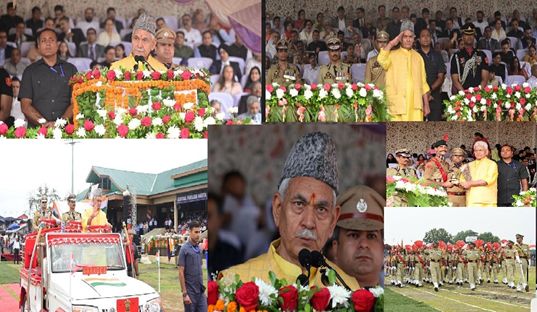
Srinagar : Lieutenant Governor, Manoj Sinha on Thursday hoisted the National Flag and addressed the people at Bakshi Stadium, Srinagar.
The Lt Governor in a posted on “X” said “Hoisted the National Flag at Bakshi Stadium, on the occasion of 78th Independence Day. As we celebrate the freedom and the spirit of unity, let us honor and remember the countless sacrifices made by our valiant freedom fighters and martyrs. Roots of democracy have deepened in the past five years. Today I appeal to the citizens of J&K for collective resolve to ensure that the ideals of democracy should become an important part of our consciousness and our innate nature”.
Addressing the Independence Day Parade at Bakshi Stadium Srinagar the Lieutenant Governor Manoj Sinha emphasized J&K Government’s and security forces’ commitment to thwarting any attempts by neighboring countries to rekindle militancy in J&K. Speaking at the 78th Independence Day event at Bakshi Stadium in Srinagar amid rain, he urged Jammu’s residents to support efforts to eradicate militancy. LG Sinha highlighted that recent developments, increased voter engagement, and a decrease in local indoctrination have frustrated the main sponsor of militancy, our neighboring country. He also urged reflection on the core values of justice, equality, and patriotism upheld by freedom fighters and martyrs. As we celebrate Independence Day, he called for a renewed commitment to these ideals, striving for a nation that not only cherishes its freedom but also ensures justice and prosperity for all its citizens. He encouraged honoring their sacrifices by dedicating ourselves to national service and unity. Furthermore, LG Sinha paid tribute to the bravery of J&K Police, Army, and CAPFs, acknowledging their heroism and sacrifice in protecting and developing the region. He introduced the ‘Balidan Stambh,’ a memorial dedicated to police personnel and soldiers who sacrificed their lives. This monument aims to inspire future generations to remember the patriotism and sacrifice of the martyrs.
Lieutenant Governor Manoj Sinha, addressing the 78th Independence Day celebrations at Bakshi Stadium in Srinagar, highlighted the dual significance of the occasion: celebrating India’s freedom and the unparalleled beauty and heritage of Jammu and Kashmir. He described the region as “Paradise on Earth,” emphasizing its majestic mountains, serene lakes, and lush valleys as symbols of divine artistry. He urged everyone to draw inspiration from the Himalayas and the region’s peacefulness, reminding us that light follows even the darkest tunnels.
LG Sinha congratulated the citizens on the successful General Elections of 2024, noting a significant increase in voter turnout and demonstrating a renewed faith in democracy. He praised the robust participation from diverse groups, including first-time voters, women, the elderly, and tribal communities, and highlighted that Jammu and Kashmir saw its highest voter turnout in 35 years.
He noted that the combined voter turnout of 58.46% reflects the democratic spirit of the people and their commitment to shaping the region’s future. The Kashmir Valley alone saw a dramatic rise from 19.16% in 2019 to 50.86% in 2024, indicating a strong belief in democratic processes.
LG Sinha stressed the importance of making democratic ideals integral to our consciousness and called for unity under the principle of “Vasudhaiva Kutumbakam.” He acknowledged the region’s quest for knowledge, spirituality, and equality as key to its reputation as a paradise. He also addressed the decrease in violence in Jammu and Kashmir, attributing it to a combination of development, higher voter engagement, and reduced local indoctrination. Despite ongoing challenges posed by militancy, including the loss of brave personnel, he assured intensified efforts to combat militancy and sought continued public support.
On the occasion, LG Sinha recognized the valor of J&K Police officers, who were awarded multiple honors, including five Shaurya Chakras and several other medals. He highlighted their commitment and bravery in upholding law and order. LG Sinha reviewed the progress made in transforming Jammu and Kashmir over the past four years, including economic growth, fiscal discipline, and infrastructure development. He pointed out that Jammu and Kashmir’s GDP had doubled from Rs. 1.17 lakh crore in 2017 to Rs. 2.45 lakh crore in 2023-24, with expectations for further growth. The Government has improved revenue, reduced expenditure, and enhanced fiscal transparency. Capital expenditure has doubled, and tax revenue has grown significantly. Over 2.5 lakh projects were completed in the past five years, supported by a special fund of ₹17,000 crore from the central government. Agriculture remains vital to the region’s economy. Investments in agricultural development through programs like the Holistic Agriculture Development Program (HADP) and J&K Competitiveness Improvement in Agriculture & Allied Sectors (JKCIP) aim to revolutionize the sector, enhance livelihood security for farmers, and create substantial job opportunities.
He said that LG Sinha announced that the PM Fasal Bima Yojana has been expanded to cover all 20 districts, benefiting nearly 2.50 lakh farmers. The launch of 500 Kisan Khidmat Ghars and the establishment of 2,000 Farmer Service Centers within this financial year will provide comprehensive support, including input supply, marketing, and technological assistance.
“The area under diverse crops has increased from 12.55 lakh hectares to 13.07 lakh hectares, and the registration of organic clusters has surged eight-fold from 33 to 294. The area under organic farming is expected to grow to 5,860 hectares, benefiting 14,550 farmers. The introduction of End-to-End Online licensing services under the Business Reform Action Plan reflects the government’s commitment to revitalizing the sector,” Lt. Governor said.
He said ‘Women Farmer Empowerment Project’ has connected 4.69 lakh women to integrated farming and livestock management. Women farmers have created 2.25 lakh agri-nutrition gardens, 40 integrated farming clusters, and 12 women farmer-producer organizations. Additionally, 287 Mini Custom Hiring Centers have been established to support women farmers with mechanical services.
“Campaigns such as Krishi Sakhi and Pashu Sakhi have not only enhanced financial security for women farmers but also ensured their active involvement in Jammu and Kashmir’s developmental progress,” Lt. Sinha said.
He said before 2019, Jammu and Kashmir faced significant industrial development challenges due to limited infrastructure, investment restrictions, and political uncertainties. Since reorganization, the government has implemented progressive policies and incentives to drive industrial growth. “The J&K has received 6,934 investment proposals worth ₹1.26 lakh crore, with a potential to create 4.74 lakh jobs. Industrial units with investments totaling ₹6,600 crore have commenced production. Groundwork for investments amounting to ₹18,185 crore is underway, and units with investments around ₹10,000 crore are expected to become operational this financial year.
“The current New Industrial Scheme is set to expire in September, but negotiations with the Government of India suggest it will be extended for at least one more year. Additionally, 46 new industrial estates are being developed, and the New Startup Policy 2024-27 will offer crucial support to startups, boosting Jammu and Kashmir’s presence in the national and global startup ecosystem. DPIIT-registered startups have increased to 825 in 2024, including 296 women-led startups, with a total of 1,600 startups registered with EDI, he said.
LG Sinha said that Jammu and Kashmir have secured the top rank among all States and UTs in India for projects established under PMEGP for 2023-24. During this period, employment was generated for 1,20,296 people through the disbursement of ₹281.06 crore in margin money for 15,037 self-employment enterprises.
“The Private Industrial Estate Development Policy 2021-30 has been amended with new incentives and investor-friendly provisions. Jammu and Kashmir is the first UT to achieve 97% reform implementation under Ease of Doing Business. A total of 185 online services have been integrated into a Single Window. Handloom and handicraft exports have doubled from ₹563 crore in 2021-22 to ₹1,162.29 crore in 2023-24,” he said.
“In the handicraft and handloom sector, 5,682 cooperative societies have been registered, marking an 1800% increase since 2020. A total of 7.39 lakh rural women have joined 90,683 SHGs, with 6,976 Village Organizations (VOs) and 574 Cluster Level Federations (CLFs) formed. To date, ₹454.84 crore has been provided to 67,754 SHGs,” LG Sinha said.
He said under PM Kissan Samrudhi Kendras, 123 PACS have been licensed for seed, fertilizer, and pesticide businesses. Currently, there are 3,714 functional cooperative societies, including 894 registered in 2023-24 and 250 in 2024-25, covering various sectors such as dairy, poultry, housing, health, and education. Programs like Hausla and Tejaswini have empowered thousands of women entrepreneurs, and the Lakhpati Didi scheme has identified over 1.5 lakh self-help group households.
“Youth development is a priority, with schemes designed to foster economic growth by creating a skilled workforce, promoting entrepreneurship, and reducing unemployment. Since 2019, over 42,000 selections have been made in the public sector, including 4,095 gazetted posts.
“A total of 10,477 vacancies have been referred to recruiting agencies (JKSSB/JKPSC), with 3,594 vacancies advertised and exams for 1,516 posts completed. Additionally, 6,780 new vacancies are in process, and 1,100 long-pending compassionate appointments have been made, benefiting dependent families,” he said.
LG Sinha said that mission Youth aims to create over 8 lakh self-employment opportunities this financial year. In 2023-24, 65,206 units were established, generating employment for 238,675 individuals. In 2024-25, 5,489 units have been established, providing jobs for 26,105 people. During these years, 116 job fairs were organized, with 1,459 companies participating and over 2,300 placements made.
“In PM Vishwakarma Yojana, Jammu and Kashmir ranks third nationally in terms of registration and second in skill assessment and basic training, with over 1.27 lakh applications approved,” LG Sinha said.
He said that under PMKVY 4.0, 18,000 youth have been enrolled in skill training programs at skill hub centers across universities, schools, ITIs, JNVs, and KVKs. ITIs are being developed as model institutions, and 600 additional seats have been added to polytechnic institutions. New trades are being introduced to meet the demand for new skills.
“The Union Budget 2024-25 prioritizes skill development, with a new Centrally Sponsored Scheme under the Prime Minister’s Package expected to significantly boost skill development and employment in Jammu and Kashmir,” LG Sinha said.
He said institutional support is vital for enhancing the operational capabilities of farmers, businessmen and women, young entrepreneurs, and aspirants, helping them access crucial resources, improve productivity, and contribute to local economies. This support fosters entrepreneurship and self-sufficiency while driving sustainable development and social empowerment.
“Significant investments in infrastructure, including industrial parks and improved connectivity, have created a favorable business environment. Emphasis on technology, manufacturing, and tourism has attracted national and international investors, driving rapid industrialization, creating employment opportunities, and positioning Jammu and Kashmir as a burgeoning industrial hub. The progress made since 2019 reflects the region’s potential and commitment to sustainable industrial growth,” he said.
The LG Sinha said that the focus on ‘last-mile connectivity’ has led to substantial advancements under the Pradhan Mantri Gram Sadak Yojana (PMGSY). By March 2024, 2,129 out of 2,140 targeted rural habitations will be connected through all-weather roads, with the remaining 11 expected to be completed by September 2024. PMGSY-I and II have seen the construction of 17,839 kilometers of road, and PMGSY-III has completed and upgraded 536 kilometers. These achievements significantly enhance rural connectivity, fostering development and accessibility across the region.
“Thirty-five projects have been completed under PMDP, with ongoing work on projects worth ₹1.5 lakh crore. Notable infrastructure projects include the Delhi-Amritsar-Katra Expressway, four National Highway projects worth ₹58,493 crore, two ring roads in Jammu and Srinagar, and 21 tunnels,”
He said rural infrastructure is being strengthened, with air traffic doubling compared to 2019. Rail services from Baramulla to Banihal have been extended to Sangaldan, and a direct train route from Kashmir to Kanyakumari is expected by year-end.
“The Ministry of Road Transport and Highways (MoRTH) has sanctioned the construction and upgrading of 294 major road and bridge projects at an estimated cost of ₹4,315 crore. Of these, 173 projects have been completed, with ₹2,840 crore spent. Currently, 338 bridges are under construction at an estimated cost of ₹1,785 crore, and 410 bridges have been completed in the last seven years at an estimated cost of ₹1,180 crore,”
LG Manoj Sinha emphasized the pivotal role of digital connectivity in enhancing transparency in governance and improving the ease of living. Efforts to transform Jammu & Kashmir into a digital society have been significant, with the launch of the e-unnat portal facilitating easier access to services.
“Notably, Jammu & Kashmir has become the first state in India to integrate with Meri Pehchaan (National Single Sign On), expanding its online services from a few to 1,140. Over 73 lakh applications have been filed through this system, with more than 63 lakh disposed of. The e-unnat portal integrates services with e-payment, email, SMS, RAS, UMANG, and DigiLocker, and 475 services have been linked to the Feedback System (RAS), collecting over 11.8 million SMS feedback messages with an 87% approval rating,” he saod.
LG Sinha said that in the power sector, the Government has faced challenges but is making progress with new policies and projects. Key initiatives include the 850 MW Ratle Hydro Electric Project, the 93 MW New Ganderbal Hydro Electric Project, and the 48 MW Lower Kalnai Hydro Electric Project.
“The region has seen a 42% increase in transmission capacity and a 30% rise in distribution capacity since 2019. The government has also introduced an amnesty scheme for domestic and commercial consumers. Efforts to clear bottlenecks in major projects like the Pakal Dul Hydro Electric Project and the Kiru Hydro Electric Project are underway, with work progressing on schedule,” he said.
Lt Governor said that the installation of 6 lakh smart meters has led to a 25% reduction in transmission and distribution losses and a 10% increase in tariff collection. Solar energy production has surged from 5 MW in 2019 to 55 MW, with plans to solarize 22,000 government buildings by December 2025.
“The significant strides have been made in healthcare, including the extension of Universal Health Insurance Coverage, AB-PMJAY SEHAT, to 19.02 lakh additional families, and the issuance of 85.50 lakh golden cards. With the inauguration of AIIMS Jammu and the upcoming AIIMS Kashmir, the healthcare infrastructure is set to improve significantly. The government is also focusing on expanding telemedicine services and incorporating AI in health services,” he added.
In education, Jammu & Kashmir is working towards becoming an educational hub with the presence of premier institutions and the introduction of innovative programs like Design Your Degree and College on Wheels. Efforts to bring out-of-school children back into the education system are ongoing, with 46,000 children reintegrated into schools. Upgrades to educational infrastructure and the expansion of scholarship programs aim to enhance educational outcomes across the region.
“Tourism has been revitalized with new initiatives, including the development of tourist circuits, adventure tourism, and heritage tourism. The region has seen a substantial increase in both domestic and international tourist visits, with over 2.11 crores recorded in 2023. The successful G20 Tourism Working Group meeting and other high-profile events have elevated Jammu & Kashmir’s global profile,” LG Sinha said.
He said Rural development remains a priority, with efforts to provide basic amenities like housing, water, and electricity to underprivileged families. The Government is also focused on enhancing rural infrastructure and employment opportunities through schemes like the Mahatma Gandhi National Rural Employment Guarantee Act.
“Finally, the government is committed to the upliftment of marginalized communities, including Kashmiri Pandits, with job allocations and housing construction. The Government continues to work towards inclusive growth and social equity, ensuring that progress benefits all sections of society,” he said.
As Jammu & Kashmir strides towards a brighter future, LG Manoj Sinha calls upon all citizens to contribute to the region’s development and uphold the ideals of unity and progress.