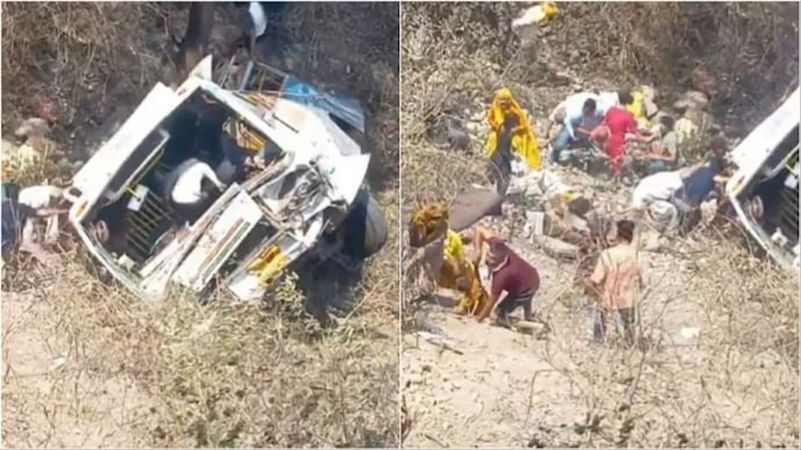
Srinagar: At least 22 pilgrims, including nine women and two children, lost their lives and 57 others sustained injuries when a bus from Hathras, Uttar Pradesh, veered off the road and plunged into a deep gorge in the Akhnoor area of Jammu district.
The tragic incident occurred around 12:35 pm at Tungi Morh, approximately 12 km from Akhnoor, on the Jammu-Poonch national highway. The pilgrims were en route to the Shiv Khori shrine, dedicated to Lord Shiva near Reasi town, which is about 50 km away. Inspector Tariq Ahmed, the station house officer of Akhnoor police station told Kashmir Horizon that the bus, carrying passengers from Hathras, UP, was on its way to the Shiv Khori shrine in Reasi district when it met with the accident. It tumbled into a 150 ft deep gorge near Choki Chora, Akhnoor in Jammu. He said the injured were promptly transported to the sub-District Hospital Akhnoor, from where critically wounded individuals were further evacuated to Government Medical College (GMC) Jammu.
Meanwhile Dr. Saleem Khan, the block medical officer of Akhnoor sub-division, reported that 22 people had succumbed to their injuries, while 57 others were being treated for various injuries. Most of the injured were shifted to the government medical college and hospital in Jammu, with some remaining at the sub-district hospital in Akhnoor, he added. Witnesses recounted that the driver might have been drowsy, as the bus failed to negotiate a turn and rolled down into the gorge. Amar Chand, one of the injured passengers, mentioned that the accident occurred while the driver was navigating a blind curve, and a car approached from the opposite direction, leading to the tragic mishap. Jammu Deputy Commissioner, Sachin Kumar Vaishya, confirmed the accident through social media, stating that rescue operations were underway. Transport commissioner Rajinder Singh Tara speculated that the driver might have fallen asleep, causing the bus to miss the turn and plunge into the gorge. Condolences poured in from various quarters, including President Droupadi Murmu, Prime Minister Narendra Modi, and Lieutenant Governor Manoj Sinha. PM Modi announced compensation for the families of the deceased and aid for the injured. Authorities cautioned that the death toll might rise as some of the injured were in critical condition. Top police and civil officials have mobilized to oversee the situation and aid in the ongoing rescue efforts.

Lieutenant Governor Manoj Sinha expressed deep sorrow over the tragedy, extending condolences to the bereaved families and assuring all possible support and medical assistance to the injured. In March this year also, 10 individuals lost their lives when a passenger vehicle they were traveling in veered off the road and plunged into a 300-foot-deep gorge near Battery Chashma along the Srinagar-Jammu highway in Ramban. Officials stated that among the deceased, eight were residents of Bihar. In November 2023, 39 lives were lost and 17 others injured when a bus plunged into a deep gorge in Doda district. The Srinagar-Jammu National Highway, crucial for transportation, has unfortunately become synonymous with fatal accidents, claiming an alarming 1155 lives over the past five years. These stark numbers underline the urgent need for immediate improvements in road safety along this vital corridor. Data released by the Traffic Department paints a grim picture of the National Highway’s toll: 211 fatalities in 2019, 178 in 2020, 271 in 2021, 261 in 2022, and an additional 234 lives lost in 2023. Particularly troubling is the contribution of the Chenab Valley region, accounting for a significant portion of the toll, resulting in a total of 4,251 road accident fatalities across Jammu and Kashmir during this period. On average, two lives are lost daily due to road accidents in J&K since 2019, serving as a sobering reminder of the urgent need for decisive action. While road safety concerns extend throughout the entire union territory, the disproportionate burden of tragedy falls heavily on the National Highway and Chenab Valley. Unfortunately, the trend of road accidents persists in the current year as well. Up until January, 55 individuals have lost their lives in 398 accidents across the region, with 486 sustaining injuries. The Kashmir division accounted for 284 accidents resulting in 17 fatalities, while the Jammu division reported 114 accidents claiming 38 lives.
In 2023 alone, a staggering 893 lives were lost in road accidents across Jammu and Kashmir, with 6,298 accidents recorded and 8,469 individuals sustaining injuries. The preceding years paint a similarly grim picture: 805 fatalities in 2022, 774 in 2021, 728 in the pandemic year of 2020, and a shocking 996 in 2019. As these distressing statistics mount, authorities and stakeholders face immense pressure to implement comprehensive measures to address road safety, particularly along the perilous Srinagar-Jammu National Highway and in the Chenab Valley region, to stem the tide of avoidable loss of life. Enhancing road infrastructure along the Srinagar-Jammu highway is imperative, including widening narrow sections, repairing potholes, and installing safety barriers at vulnerable areas, especially near steep cliffs or sharp turns. Regular maintenance checks should be conducted to ensure optimal highway conditions, with prompt repairs of damaged sections and addressing landslide-prone areas. Deploying advanced warning systems such as reflective road signs, speed limit indicators, and electronic message boards can alert drivers to hazardous conditions ahead, aiding in anticipation and navigation of potential dangers. Improving the visibility of road signs, particularly those indicating sharp curves, steep gradients, and accident-prone zones, is crucial for guiding drivers safely along the highway and reducing confusion or misinterpretation. Strengthening traffic enforcement measures through increased police patrols, speed cameras, and checkpoints along the Srinagar-Jammu highway can deter reckless driving behavior and promote safer driving habits among motorists. Conducting awareness campaigns and driver education programs to educate motorists about safe driving practices, including maintaining appropriate speeds, avoiding distractions, and using seat belts, plays a vital role in fostering a culture of responsible driving and reducing accident rates. Enhancing emergency response capabilities by establishing well-equipped rescue stations along the highway and training first responders to efficiently handle accidents and medical emergencies is essential.