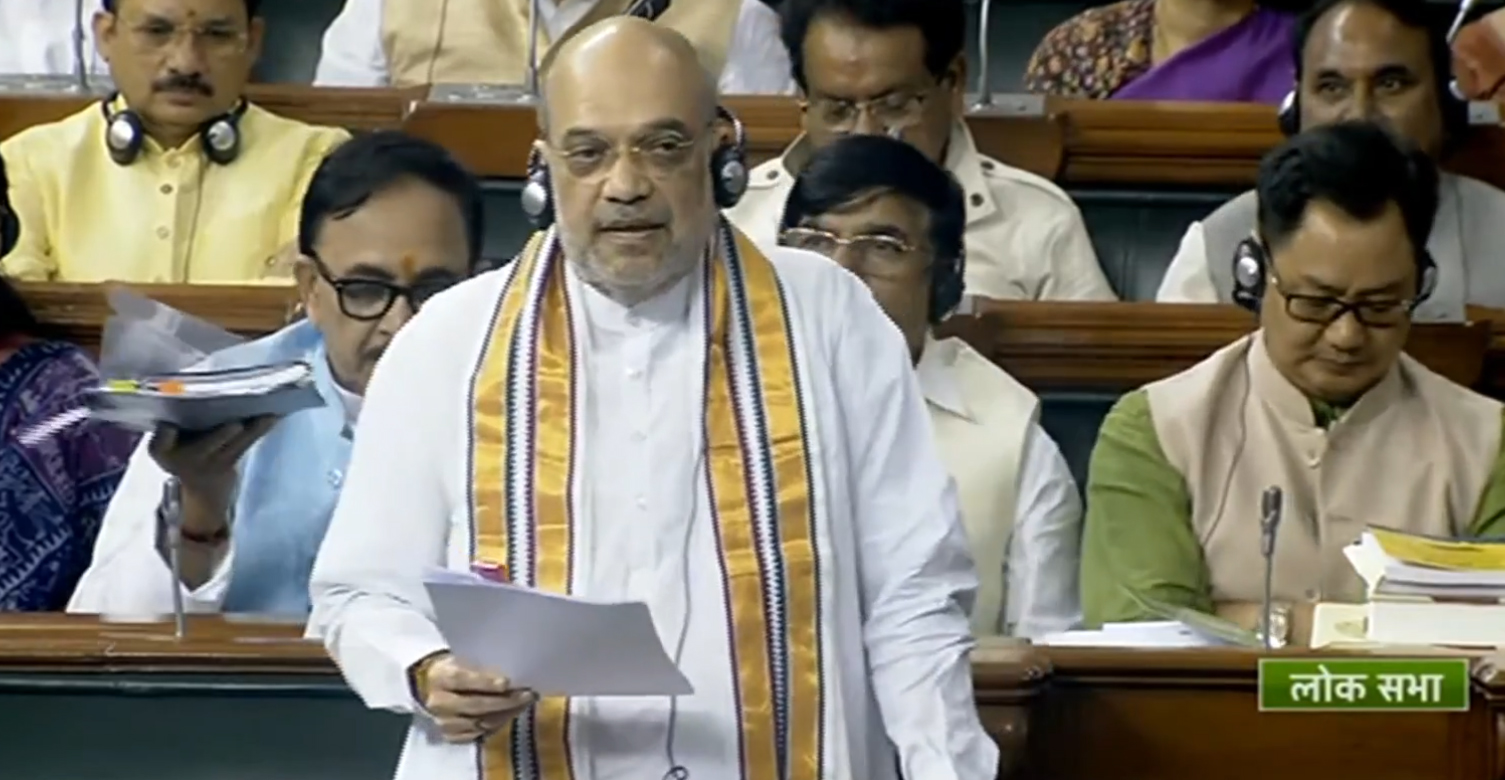
New Delhi: Home Minister Amit Shah on Wednesday delivered in what probably was his longest speech in parliament, listing out the achievements of the Modi government in the past nine years, taking on his political opponents and also clarifying all the efforts made by the centre in addressing the ethnic violence in Manipur.
Shah, who spoke for a little over two hours, steered clear of politics over sexual crimes while speaking on Manipur, and did not bring up the number of rape cases in opposition-ruled states, calling the recent case of a rape and parading of a Manipur woman as shown by a viral video a “blot on humanity.”
His speech was broadly divided into three areas – achievements of the government led by Prime Minister Narendra Modi, situation in Jammu and Kashmir and Manipur disturbance – but the broader emphasis was on national security and the attention that the government had paid to three turbulent zones of the country, namely Jammu and Kashmir, Maoist violence areas and the north-east. He said the government had actually taken extra care to ensure these zones were free from conflict and on the path to progress. He cited data for every claim, and contrasted every accomplishment with how the opposition handled the subject when in power. Shah said the BJP believed in “politics of performance and politics with principles,” and narrated how the Atal Bihari Vajpayee government lost the no-confidence motion by just one vote “because the party MPs did not compromise on their principles.” Home Minister also said that he has records to prove that the highest number of communal incidents have taken place under the rule of former Prime Ministers Jawaharlal Nehru, Rajiv Gandhi and Indira Gandhi. Speaking on Manipur, unlike the other areas, Mr Shah maintained a non-aggressive tone, somewhat also seeking support but also sounding optimistic to address the crisis. Just a few hours before he spoke in parliament, Mr Shah had a long meeting with Manipur’s hill-majority Kuki groups that had reached out to him for space in the state for mass burials. Shah appealed to Kuki and Meitei groups to resolve their differences and work together for peace, an appeal that he also made to the opposition, but the opposition refused to agree to making such an appeal. While on Jammu and Kashmir, he said the government – unlike the opposition – will not speak to the Hurriyat but to the youth, which is why militants are not being glorified after their deaths, the Home Minister added that only three districts now have presence of Maoist groups and the government is working on solving this issue. Shah added that PM Modi has constantly monitored the happenings in Manipur, often waking him up with developments in the northeast state, and over 16 meetings in the last three months have been held.
From changing the DGP (police chief) to sending a security adviser, to ensuring essentials, CAPF (central cops) and army personnel to Manipur, the centre has been working with all its might since the first incident of violence was reported on May 3. This, Mr Shah said, was contrary to how the United Progressive Alliance (UPA) handled Manipur when the state was constantly seeing blockades, and during times of severe conflict, it was only a Minister of State (MoS Rajesh Pilot) who was sent. “Leave apart from the PM or minister, they would not even ask for a discussion then, and now they want the PM to speak,” Mr Shah said.
“I agree that there have been incidents of violence in Manipur. No one can support such incidents. Doing politics on these incidents is shameful. From day one I was ready for a discussion on the Manipur issue, but the opposition never wanted a discussion. The opposition doesn’t want me to speak, but they can’t silence me. 130 crore people have selected us, so they have to listen to us… During the past six years of our government, the need for curfew never rose,” the Home Minister said.