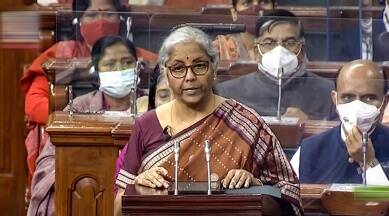
New Delhi | Feb,1 : Union Finance Minister Nirmala Sitharaman on Tuesday presented Union Budget 2022 in Lok Sabha and announced a huge boost in capital spending (35.4% to Rs 7.50 lakh crore) but belied the expectations of the salaried class by not announcing any changes in income tax rules. On taxes, she announced that the government will provide a one-time window to correct omissions in income tax returns (ITRs) filed. She said that the updated returns will have to be filed within two years. The minister also said that the government proposes to reduce Minimum Alternative Tax (MAT) to 15 per cent for co-operative societies, at par with corporates. “The government vows a stable and predictable tax regime,” she said.
India’s fiscal deficit will unexpectedly rise to 6.9 per cent of GDP in the current fiscal and it is being targeted to be cut to 6.4 per cent in the next financial year. The fiscal deficit. or the gap between expenditure and revenue was estimated at 6.8 per cent of GDP in the current financial year ending March 31, 2022. Total expenditure during the current year is estimated at Rs 39.45 lakh crore while total resources mobilisation would be Rs 22.84 lakh crore, the Union Finance Minister said.
Here are the highlights of the Union Budget 2022
- 108 States will be encouraged to adopt Unique Land Parcel Identification Number to facilitate IT-based management of land records
- No change in income tax in Sitharaman’s budget
- Custom duty on cut, polished gem stones reduced to 5%
- Corporate surcharge reduced from 12% to 7%
- Progressive and IT driven GST regime envisaged
- Tax rate for cooperative societies reduced to 15%
- 30% tax on income from sale or acquisition of virtual, digital assets
- Deduction limit for state govts to NPS increased by 14%
- Tax sops for start-ups extended by a year
- Minimum alternate tax of cooperatives reduced to 15%
- Taxpayers can file updated returns within two years
- Fiscal deficit estimated at 6.9% of GDP in FY22
- Rs 1 lakh crore assistance to states to revive economy
- Digital rupee using blockchain and other tech to be issued by RBI in 2022-23
- Sovereign ‘Green Bonds’ to be introduced
- 2,000 km of rail network to be brought under indigenous technology KAWACH
- Capex outlay increased by 35.4% to Rs 7.5 lakh cr in 2022-23
- Modern building by-laws will be introduced
- For developing India-specific knowledge, 5 academic institutions will be designated as Centres of Excellence
- 5G mobile services to be rolled out within 2022-23
- Women’s empowerment: Saksham Anganwadis, or 2 lakh next-gen anganwadis to be powered by clean energy
- TV Channels to provide supplementary education to children amid Covid
- Scope of ‘green clearance’ portal to be expanded
- e-passport to be introduced to help overseas travel in 2022-23
- Rs 6,000 crore programme to rate MSMEs to be rolled out over 5 years
- 75 digital banking units in 75 districts
- Desh stack e-portal to be launched to promote digital infrastructure
- Rs 1,500cr allocated for development of Northeast
- Masterplan for expressways for 2022-23
- 80 lakh homes to be completed under PM Aawas Yojna
- Use of Kisan drones will be promoted for crop assessments, spraying of insecticides
- National tele mental health facility to be launched with NIMHANS as nodal centre
- Make in India can create 6 million jobs
- Digital university in different Indian languages to be established
- One Channel PM e-Vidya to be expanded to include 200 channels
- Credit-linked guarantee scheme extended to March 2023
- 400 Vande Bharat trains in three years
- Agri varsities to upgrade syllabus to include organic farming techniques
- Chemical free natural farming to be provided
- Centre-state to ramp up skills for PM Gatishakti success
- PPP mode scheme for agri-tech promotion
- Metro connectivity to be enhanced
- Priorities: PM Gatishakti, Productivity enhancement, Energy transition and climate action
- FM: 7 engines of growth in PM Gatishakti Plan
- This year, the Budget was a paperless exercise for the second time in a row, as the finance ministry had earlier notified. The Union Budget 2022-23 was also made available on the Mobile App after the Budget spresentation was completed in Parliament.
- Sitharaman presented the budget in the backdrop of the Economic Survey, which was tabled in Parliament on Monday. The survey _ the annual report card of the state of the economy _ suggests that the finance ministry is fairly confident that it will be able to once again reclaim bragging rights as one of the fastest growing economies in the world.
- The Modi government believes that the economy will grow by 8 to 8.5 per cent in the next fiscal — slower than the 9.2 per cent projection this year, but higher than most estimates from the pundits.
- On the face of it, this year’s projected growth looks impressive. But the fact is that it’s a bounceback. It’s just 1.4 per cent above the pre-pandemic level of fiscal 2020 in real terms and many sectors involving personal contact such as trade, hotels, restaurants and transport will lag that figure even more. The surge of the new omicron variant also means “a threat to domestic passenger traffic,” so tourism and passenger traffic may take a while to pick up.
- Also, the survey’s forecast is built around several assumptions: that the pandemic will have no further debilitating impact on the economy, the monsoon will be normal, the withdrawal of global liquidity by central banks in advanced economies will be fairly orderly and oil prices will hover in the range of $70-$75 per barrel.
- The projections are in line with the forecast by the World Bank but lower than the 9 per cent projected by the IMF. They are slightly higher than that predicted by S&P and Moody’s.
- “It is quite likely that some of these assumptions may not hold and there could be other risks emerging from rising geopolitical tensions (that have not been stated in the assumptions). Therefore, we should realistically expect sub 8% GDP growth in FY23,” Ranen Banerjee – Partner and Leader Economic Advisory Services, PwC India, said.
- Opposition leaders on Monday were critical of the findings of the Economic Survey, with Congress leader and former Union Finance Minister P. Chidambaram saying it is a time for “contrition and change of approach, not for boasts and no change”.
- In a series of tweets, Chidambaram said that the Economic Survey repeats “ad nauseum” that at the end of 2021-22, the economy would have recovered to the pre-pandemic level.
- “In plain language, it means that on 31.3.2022 the GDP will be at the same level as it was on 31.3.2020. It means that it has taken two years to go back to where we were on 31.3.2020. The two years have impoverished people: millions of jobs have been lost; 84% households have suffered loss of income: 4.6 core have been pushed into poverty; India ranks 104 out of 116 countries in the Global Hunger Index,” he noted.
- In its editorial published on Tuesday, The Telegraph Online said: “…the Indian economy, at the moment, is riddled with three principal problems that need immediate attention. The first is unemployment, especially among youth and low-skilled workers. The next is the high rate of inflation, measured by both consumer price index and wholesale price index, fuelled by global forces and domestic supply disruptions. Finally, there is the problem of an alarming rise in the extent of inequality in wealth and income.
- “In 2021-22, while spending of the government has grown, rising tax revenues have brought comfort to the finance ministry in managing the deficits. However, this year, with uncertainty still hanging large over the world economy, fiscal consolidation may remain elusive, especially if the government’s assumption about a lower international crude oil price for 2022-23 does not hold.”