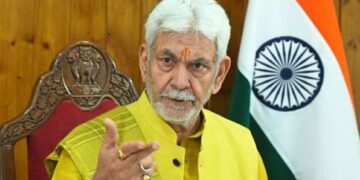

Jammu | Nov, 27:Chief Secretary, Dr. Sajjan Singh Yadav, Friday chaired a comprehensive review meeting of the Public Works (Roads & Buildings) Department to assess the progress of major road infrastructure projects, implementation of various development schemes and the department’s future roadmap for strengthening connectivity across Jammu and Kashmir.
The meeting was attended by the Additional Chief Secretary, Public Works Department; Divisional Commissioner, Kashmir/Jammu; Secretary, Transport Department; Engineer-in-Chief (Public Works); Regional Officer, NHAI; Chief Engineers of Project Beacon and Project SAMPARK; and other senior officers. All Deputy Commissioners participated in the meeting through video conferencing.
During the meeting, the department made a detailed presentation on its vision, infrastructure portfolio, ongoing projects, achievements and key priorities, covering works being executed through different agencies, including the National Highways Authority of India (NHAI), Border Roads Organisation (BRO), National Highways and Infrastructure Development Corporation Limited (NHIDCL) and the Public Works Department.
On this occasion the Additional Chief Secretary, PWD, Anil Kumar Singh apprised that Jammu and Kashmir has a road network of approximately 42,121 kilometres, while the overall infrastructure portfolio covered in the presentation is valued at around Rs 1.28 lakh crore, encompassing ongoing and sanctioned works as well as projects at the DPR and in-principle stages.
He also gave a detailed overview of the National Highway programme presenting that 43 works worth Rs 39,784 crore are under execution, besides 11 sanctioned works amounting to Rs 9,187 crore awaiting commencement. Another 31 works, involving an estimated investment of Rs 70,839 crore, are at the DPR or in-principle stage.
Reviewing the progress of major connectivity projects, the meeting was informed that the Z-Morh Tunnel has been commissioned and is operational, while the main breakthrough of the Zojila Tunnel was achieved on June 9, 2026, with physical progress reaching 49.64 per cent. Work on the Vailoo–Donipawa four-laning project has also commenced.
The progress of the Srinagar and Jammu Ring Road projects was also reviewed. Srinagar Ring Road Phase-I has achieved around 92 per cent progress, while the tunnels on Jammu Ring Road have also reached approximately 92 per cent completion. The meeting was further apprised of the completion of important works, including Pulwama Bypass, Sanat Nagar Flyover and Tengpora service road.
The department also highlighted the strategic importance of the two major tunnels sanctioned on NH-244 Sudhmahadev–Dranga Tunnel, measuring 12.85 km at an estimated cost of Rs 4,179.18 crore, and Singhpora–Vailoo Tunnel, measuring 38.61 km at a cost of Rs 5,600.28 crore. Land acquisition for both projects is under process. Progress and proposals relating to other strategic tunnel projects, including Pir Ki Gali and Sadhna, besides proposed tunnels in Keran, Machil and Gurez, were also discussed.
The meeting reviewed the progress of Project SAMPARK on NH-144A (Akhnoor–Poonch), which has achieved 90.35 per cent length-weighted physical progress. Of its eight packages, two have been completed, while work on the remaining packages is at different stages of execution.
Under PMGSY-IV, the department has sanctioned 644 roads covering approximately 3,357 km, aimed at connecting 789 eligible habitations by March 2028. The progress of the current batches was also reviewed, including the award and implementation status of the sanctioned works.
A detailed assessment of the financial and physical progress under various funding windows, including UT Capex, Centrally Sponsored Schemes, CRIF and NABARD-RIDF, was also undertaken. As on November 20, 2026, against the UT Capex budget allocation of Rs 5,969.55 crore for 2026-27, releases of Rs 4,061.07 crore had been made, with expenditure of Rs 2,142.13 crore.
The meeting was also apprised that under CRIF, 294 projects worth Rs 4,337.21 crore have been sanctioned, of which 203 had been completed up to March 2026. Similarly, 1,074 projects worth Rs 4,967.70 crore have been sanctioned under NABARD-RIDF, with 427 projects completed up to March 2026. The department also outlined the pipeline of new projects proposed under these funding mechanis
Further the meeting took stock of the ongoing restoration of infrastructure damaged by floods and other disasters. The department reported that 2,046 flood-restoration works had been completed between April 1 and October 31, 2026. Progress under the relevant restoration and rehabilitation components was also reviewed.
Highlighting the department’s achievements during April–October 2026, it was revealed that 1,500 kilometres of roads had been macadamised, while 68 identified black spots had been rectified and 1,265 road safety audits conducted. Of the 6,000 migrant transit accommodation units, 5,288 had been completed and handed over to the Department of Disaster Management, Relief, Rehabilitation and Reconstruction.
Emphasising the need for a coordinated and outcome-oriented approach to infrastructure development, the Chief Secretary stressed the importance of timely execution of projects, effective interdepartmental coordination, quality construction and optimal utilisation of available resources. He also underscored the significance of strengthening last-mile connectivity, particularly in remote, border and hilly areas, while ensuring that infrastructure is designed to withstand the region’s challenging climatic and geological conditions.