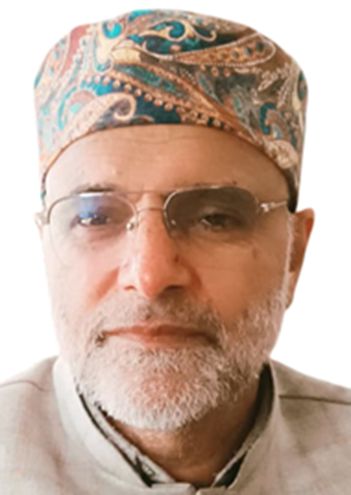
Prof. Hamid Naseem Rafiabadi
Maulana Abul Kalam Azad occupies a distinguished place in the intellectual and educational history of modern India. His contribution to nation-building went far beyond his position as the first Education Minister of independent India. He understood that political freedom could not become meaningful without intellectual emancipation, scientific advancement and the development of institutions capable of nurturing original knowledge. For Azad, education was not merely a means of obtaining employment or administrative qualifications; it was an instrument of individual fulfilment, social transformation and national self-reliance. In the twenty-first century, when Artificial Intelligence (AI), robotics, automation, biotechnology and digital communication are transforming human civilisation, Azad’s educational philosophy deserves renewed attention. The central question confronting India today is whether it will remain primarily a consumer of technologies developed elsewhere or emerge as an independent contributor to global scientific and technological advancement. Azad’s vision provides an intellectual foundation for addressing this challenge.
Beyond Colonial Education|The Quest For Intellectual Independence: The educational system inherited by independent India had largely evolved within the administrative priorities of colonial rule. It produced educated personnel for government offices and other institutional requirements of the British Empire, but it did not adequately prepare the country for technological self-reliance or indigenous industrial development. Azad recognised that an independent nation needed more than clerks, administrators and degree-holders. It required scientists, engineers, physicians, agricultural experts, researchers and skilled professionals capable of transforming its material and intellectual conditions. His understanding of education was deeply democratic. Addressing an educational conference on 16 January 1948, he declared: “We must not for a moment forget, it is a birthright of every individual to receive at least the basic education without which he cannot fully discharge his duties as a citizen.” This statement establishes education as a right rather than a privilege. In the contemporary context, the same principle must encompass scientific literacy, digital competence and the ability to evaluate information critically. Basic literacy remains indispensable, but citizens must also be equipped to understand and participate in a world increasingly shaped by technology.
Building Institutions For Scientific Excellence: Azad understood that national aspirations require strong institutions. His commitment to higher technical education found significant expression in the establishment of the Indian Institute of Technology at Kharagpur in 1951. He recognised that India could not achieve genuine independence while remaining excessively dependent on foreign institutions for advanced scientific and technical training. At the inauguration of the institute on 18 August 1951, he explained: “One of the first decisions I took on assuming charge was that we must so improve the facilities for higher technical education in the country that we could ourselves meet most of our needs.” He also expressed the aspiration that India should eventually become a destination for international scientific and technical education. This was a remarkable vision of academic excellence and national confidence. His contribution to the development of higher education, including his support for the institutional framework that led to the University Grants Commission, reflected his conviction that universities must become centres of research, innovation and intellectual leadership. Today, this institutional vision should inspire the strengthening of public universities, research laboratories and advanced centres devoted to AI, semiconductor technology, cyber security, robotics and data sciences. The objective should not be merely to train students to operate existing technologies, but to enable them to develop original solutions and contribute to the advancement of humanity.
Azad’s Vision In The Age Of Artificial Intelligence: Artificial Intelligence has transformed the ways in which information is produced, organised, communicated and applied. It offers extraordinary possibilities in medicine, agriculture, education, governance, scientific research and industrial development. Yet technological advancement also raises fundamental questions about intellectual independence, human responsibility and social justice. Azad’s philosophy invites us to ask whether India possesses the intellectual and institutional capacity to shape these developments. Technological self-reliance does not mean isolation from international cooperation. Rather, it means acquiring the ability to learn from global achievements, critically evaluate them and develop indigenous knowledge and technological capabilities. Education in the AI age must therefore move beyond memorisation and examination-oriented learning. The availability of information through digital platforms does not automatically produce knowledge, wisdom or understanding. Students must develop the capacity to distinguish reliable information from misinformation, examine competing arguments, recognise the limitations of technology and exercise independent judgment. AI can assist research, translation and analysis, but it cannot replace human responsibility for verifying evidence and evaluating conclusions.
“Reinterpreting Azad’s educational vision in the age of Artificial Intelligence, technological transformation and global knowledge economies.”
Education For All| Bridging The Digital Divide: Azad’s commitment to universal education is particularly relevant to the digital divide. Access to advanced technology remains unequal across economic, geographical and social groups. Rural communities, disadvantaged families, women and persons with disabilities may lack reliable internet connectivity, suitable devices and opportunities for digital learning. A technological revolution cannot be considered successful if its benefits remain confined to privileged sections of society. Digital education must therefore become an extension of the democratic principle that education belongs to everyone. Public schools, universities, libraries and community learning centres need adequate digital infrastructure and trained teachers. Technological innovation should strengthen public education rather than make quality learning increasingly inaccessible to those who cannot afford it. Azad also recognised that national progress depended upon women’s education. In his educational thought, he emphasised: “Our educational programmes will ultimately depend upon the proper education of women. If women are educated, more than half of our problems will be solved.” This conviction has particular relevance today. Women must have equal opportunities to participate in scientific research, engineering, AI development, digital entrepreneurship and technological decision-making. Their role should not be restricted to consuming technology; they must also become its creators and innovators.
Language, Culture And Ethical Responsibility: Azad’s educational vision also recognised the importance of Indian languages in making education meaningful and accessible. In the digital age, this principle calls for greater investment in language technologies, digital archives, translation systems and AI resources for Urdu, Kashmiri and other Indian languages. Technological modernisation should enrich linguistic and cultural diversity rather than produce intellectual homogenisation. Equally important is the ethical dimension of technological advancement. AI-generated misinformation, surveillance, privacy violations, algorithmic discrimination and intellectual dishonesty demonstrate that technical competence alone is insufficient. Education must cultivate moral responsibility alongside scientific excellence. From an Islamic philosophical perspective, this relationship may be understood through the concepts of ʿIlm (knowledge), Ḥikmah (wisdom), Amānah (trust and responsibility) and Khilāfah (human stewardship). Knowledge carries obligations concerning its acquisition and application. Technology should serve human dignity and the common good, not become an instrument of exploitation or domination.
Completing Azad’s Educational Project: The contemporary university must bring science and technology into meaningful conversation with philosophy, humanities, social sciences, law and ethics. The challenges of AI, biotechnology, climate change and digital governance cannot be addressed through isolated disciplines. They require interdisciplinary research, academic freedom and institutions committed to original knowledge creation. Azad’s educational legacy should not remain confined to commemorative speeches or historical anniversaries. Its principles—universal education, scientific advancement, institutional development, women’s empowerment, linguistic inclusion and intellectual independence—must inform India’s response to the technological age. The historical transition from colonial educational dependence to the creation of Indian engineers and scientists was an important achievement. The next stage must produce AI researchers, data scientists, robotics specialists, cybersecurity experts and interdisciplinary thinkers who combine technical competence with ethical sensitivity and social responsibility. The most meaningful tribute to Maulana Azad would be to realise his larger aspiration: an India that does not merely consume knowledge produced elsewhere but creates knowledge, develops technology, nurtures wisdom and contributes confidently to global civilisation. Political independence becomes truly meaningful when a nation possesses the intellectual freedom to think independently, the scientific capacity to innovate and the moral wisdom to employ its knowledge for the welfare of humanity.
(The author a veteran academician is a former Professor and Head Department of Islamic Studies, Kashmir University. The views, opinions and conclusions expressed in this article are those of the author and aren’t necessarily in accord with the views of “Kashmir Horizon”)
[email protected]