“Lauding the S-VYASA family and the millions of practitioners associated with the institution, the Prime Minister said its transformation demonstrated how a small initiative could develop into a major movement through sustained commitment and institutional support”……
Mohammad Irfan
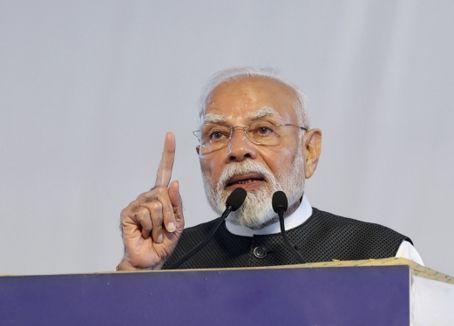 From the global popularity of yoga to India’s growing ambitions in space exploration, Prime Minister Narendra Modi on Friday sought to project the country’s traditional knowledge systems and modern scientific capabilities as complementary pillars of its emerging global identity, arguing that India’s future as a leading power would depend on its ability to combine civilisational wisdom with research, innovation and technological advancement. Addressing the golden jubilee celebrations of Prashanti Kutiram, the residential campus of S-VYASA Yoga University in Bengaluru, and later inaugurating COSMOS-Mysuru Planetarium, India’s first LED dome planetarium, Modi presented two distinct institutions as part of a common national vision: preserving India’s intellectual heritage while preparing younger generations to participate in contemporary scientific discoveries. The two engagements offered a glimpse into the government’s broader effort to connect India’s cultural influence with its scientific ambitions. While yoga and Ayurveda were presented as instruments of international outreach and economic opportunity, the planetarium inauguration provided an occasion to highlight investments in astronomy, space technology, research infrastructure and private-sector participation.
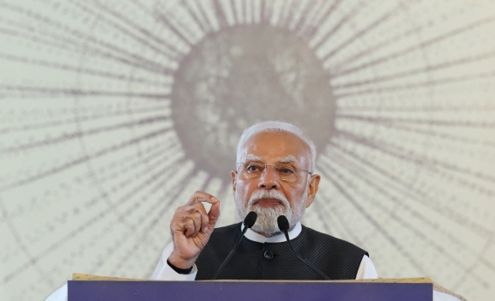
Yoga Becomes India’s Global Calling Card: At Prashanti Kutiram, Modi described the institution’s 50-year journey as a remarkable and unprecedented saga of service and dedication. Founded in 1975 to integrate modern scientific understanding with Indian spiritual wisdom, the institution has developed from a modest yoga centre into a residential university and an international centre for yoga education and research. Lauding the S-VYASA family and the millions of practitioners associated with the institution, the Prime Minister said its transformation demonstrated how a small initiative could develop into a major movement through sustained commitment and institutional support. He also recalled the contributions of H. V. Sheshadri, whose birth centenary coincided with the golden jubilee celebrations. A prominent thinker, writer and RSS leader, Sheshadri was among those whose guidance contributed to the development of Prashanti Kutiram. Modi said yoga had evolved into a significant international gateway for people seeking to understand India. Recalling his interactions with foreign leaders during overseas visits, he said conversations frequently turned towards yoga, with several dignitaries sharing stories of family members practising or teaching the discipline. The Prime Minister said he often clarified that he was a practitioner rather than an expert, but the interest displayed by international personalities reflected the extent to which yoga had entered different societies. “Yoga has become a gateway to exploring India,” he observed. The statement carries significance beyond the popularity of an individual wellness practice. Over the past decade, yoga has increasingly become part of India’s cultural diplomacy, offering the country an opportunity to exercise international influence through a tradition that has found acceptance across different cultures and societies. The establishment of the International Day of Yoga by the United Nations in 2014, following India’s initiative, provided the practice with an institutional platform for global recognition. Since its first observance in 2015, June 21 has become an occasion for participation by governments, educational institutions, civil society organisations and individuals across continents. For India, the annual event has served both as a cultural celebration and an instrument of international engagement, transforming yoga into a recognisable element of the country’s global identity.
AYUSH Seeks Larger Place In Global Healthcare Economy: Moving beyond yoga, Modi highlighted the government’s efforts to strengthen Ayurveda and other traditional systems of medicine through institutional support, research and international cooperation. He said the establishment of a separate Ministry of AYUSH represented an important administrative step towards giving traditional systems of medicine greater recognition within India’s policy framework. According to the Prime Minister, the government has encouraged research, innovation and patent development in Ayurveda, while exports of AYUSH and herbal products have continued to increase. He said the economy associated with the AYUSH sector had expanded to lakhs of crores of rupees. Prime Minister Modi also referred to more than 150 Ayurveda training courses receiving international recognition and bilateral cooperation agreements with 28 countries. These initiatives reflect the government’s attempt to develop traditional medicine into an organised economic and institutional sector rather than restricting it to cultural preservation. The introduction of the e-AYUSH visa for foreign nationals seeking treatment in India is another component of this strategy. It is intended to facilitate medical travel and create opportunities for Indian traditional healthcare institutions to attract international patients. The establishment of the World Health Organisation’s Global Centre for Traditional Medicine in Jamnagar has further strengthened India’s position in international discussions on traditional healthcare systems.
COSMOS-Mysuru Bridges Ancient Astronomy And Modern Science: If Bengaluru provided the cultural and traditional knowledge dimension of the Prime Minister’s message, Mysuru offered its scientific counterpart. Prime Minister Modi inaugurated COSMOS-Mysuru Planetarium, developed through the collaboration of the Indian Institute of Astrophysics, the University of Mysore and government departments. The facility is India’s first LED dome planetarium and represents a significant addition to the country’s astronomy education infrastructure. Featuring a 15-metre tilted dome comprising around 6,150 panels and 4.2 crore individual LEDs, the planetarium offers an immersive visual experience. Unlike conventional planetariums that rely on projectors, its LED panels can be controlled in real time, creating new possibilities for astronomy education and public engagement. The facility also includes a sky theatre, exhibition halls, a museum featuring astronomy models and artefacts, a lecture hall, a training centre and interactive outdoor exhibits. The Prime Minister described the planetarium as an important addition to Mysuru’s educational and scientific landscape, observing that it would bring the wonders of the universe closer to young minds. Drawing a connection between the Viveka Smaraka and the new planetarium, Modi said that while the former encourages introspection and spiritual exploration, the latter directs people’s attention towards the universe. He said the two institutions demonstrated that India’s traditions of spirituality and science had historically moved forward together. The reference was significant in the context of the government’s broader effort to present India’s civilisational heritage as a source of inspiration for contemporary scientific development. Prime Minister Modi recalled the contributions of ancient Indian astronomers, including Aryabhata, Varahamihira, Bhaskaracharya and Nilakantha Somayaji, who made important observations and mathematical calculations without the sophisticated instruments available to scientists today. Their contributions, he said, demonstrated the depth of India’s intellectual traditions and its historical engagement with astronomy and mathematics. However, the challenge for contemporary India lies in converting this historical legacy into a stronger modern research ecosystem capable of producing discoveries, technologies and globally competitive scientific institutions. The inauguration of COSMOS-Mysuru therefore carries significance beyond the creation of another public educational facility. Planetariums can play an important role in introducing children to astronomy, stimulating curiosity and creating early exposure to scientific concepts.
From Jai Vigyan To Jai Anusandhan: During his address, Modi traced the evolution of the national development slogan from ‘Jai Jawan, Jai Kisan’ to ‘Jai Vigyan’, introduced by former Prime Minister Atal Bihari Vajpayee, and subsequently to ‘Jai Anusandhan’, which he added to underline the importance of research and innovation. The Prime Minister argued that India cannot afford to move slowly in an era marked by rapid technological changes and intense global competition. He cited several developments in India’s space programme, including Chandrayaan-3, which made India the first country to achieve a soft landing near the Moon’s south polar region, and Aditya-L1, the country’s first space-based solar observatory. He also referred to India’s achievement in demonstrating space docking and undocking capabilities, making it the fourth country to demonstrate this capability. The recent participation of an Indian astronaut in a mission to the International Space Station was presented as another important milestone, with the experience and technical knowledge gained expected to contribute to the country’s human spaceflight programme, Gaganyaan.
“For decades, India’s space programme remained largely centred around government institutions, particularly the Indian Space Research Organisation. The emergence of private enterprises has the potential to broaden the country’s scientific and industrial base, encourage innovation and create new employment opportunities…….”
Opening The Space Sector To Private Innovation: The Government’s decision to open the space sector to private participation has created opportunities for domestic startups to develop rockets, satellites and other space-related technologies. For decades, India’s space programme remained largely centred around government institutions, particularly the Indian Space Research Organisation. The emergence of private enterprises has the potential to broaden the country’s scientific and industrial base, encourage innovation and create new employment opportunities. Prime Minister Modi said the reforms had provided Indian startups with opportunities to demonstrate their capabilities through private rocket launches, satellite deployment and other space-related ventures. The real measure of the reform, however, will be whether Indian companies can move beyond initial demonstrations and establish themselves as competitive players in the international space economy. Private participation will require predictable regulations, access to infrastructure, adequate financing, technology development and sustained demand for space-based services. The Government’s challenge will be to ensure that the opening of the sector creates a sustainable ecosystem in which research institutions, startups, universities and established industries can collaborate.
Science For Society |Technology Beyond Laboratories: An important aspect of Modi’s Mysuru address was his emphasis on the practical application of scientific achievements. He argued that India’s space programme should not be judged only by the distance its satellites travel or the complexity of its missions but also by the extent to which technology improves ordinary lives. Citing the satellite-based communication system developed for fishermen, he said boats equipped with receivers could receive timely warnings during storms, while authorities could track their safe return to the shore. He also referred to the Real-Time Train Tracking System developed through the collaboration of Indian Railways and ISRO, which enables the monitoring of train movements. Similarly, satellite imagery and field-level information are being used under the Pradhan Mantri FasalBima Yojana to estimate crop yields and facilitate the settlement of agricultural insurance claims. These examples underline the practical value of space technology in agriculture, transportation, disaster management, fisheries and public safety. For a developing country like India, the social and economic returns from scientific investment are particularly important. Satellite-based information can improve the efficiency of public services, help authorities respond to natural disasters and strengthen planning in sectors that directly affect livelihoods. The challenge is to ensure that such technologies reach their intended beneficiaries, particularly farmers, fishermen and communities living in remote areas. Technology-driven governance must also address accessibility, digital literacy, infrastructure and data reliability to ensure that the benefits are distributed equitably. Prime Minister Modi described the government’s approach as ‘Science for Society’, emphasising that research and innovation should ultimately contribute to public welfare.
Research Ecosystem Faces The Challenge Of Delivery: The Prime Minister highlighted the expansion of Atal Tinkering Labs, stating that more than one crore students had benefited from over 10,000 such laboratories across the country. These laboratories provide schoolchildren with opportunities to experiment, develop ideas and acquire practical exposure to technology and innovation. He also referred to the One Nation One Subscription initiative, intended to provide researchers and academic institutions access to leading international scientific journals. The establishment of the Anusandhan National Research Foundation and the launch of the one lakh crore rupee Research, Development and Innovation Scheme were cited as measures to strengthen the country’s research infrastructure and provide sustained financial support to domestic researchers. The significance of these initiatives lies in addressing a longstanding challenge faced by India’s research ecosystem: the gap between academic knowledge, institutional resources and the commercial application of scientific discoveries. Greater access to international research publications can improve the quality of academic work, while dedicated funding can enable universities and research institutions to undertake ambitious projects.
Kashmir Horizon View: The two events in Karnataka highlighted different dimensions of India’s knowledge ambitions but shared an underlying message about the importance of institutions. Prashanti Kutiram’s journey demonstrates how an initiative rooted in traditional knowledge can evolve into an organised institution with international outreach. COSMOS-Mysuru, meanwhile, represents the importance of modern scientific infrastructure in developing curiosity and research-oriented thinking among younger generations. Both underline the importance of sustained institutional investment, public participation and the transmission of knowledge across generations. There is also a strategic dimension to the Prime Minister’s emphasis on these areas. In an increasingly competitive global environment, countries exercise influence not only through economic and military capabilities but also through culture, technology, education and scientific achievements. Yoga provides India with a distinctive cultural identity and an accessible means of international engagement. Ayurveda offers economic opportunities alongside the possibility of contributing to global discussions on traditional healthcare systems. Space technology strengthens India’s scientific capabilities and expands its role in the global technological landscape. The challenge is to ensure that these ambitions are supported by measurable outcomes rather than remaining confined to public messaging and ceremonial announcements. India’s traditional knowledge systems need credible research, international quality standards and effective regulation. Its scientific ambitions require greater investment in universities, research laboratories, skilled human resources and innovation-driven industries. Equally important is the need to ensure that scientific progress is not limited to a few prominent institutions or metropolitan centres. Facilities such as COSMOS-Mysuru can make a meaningful contribution only when students from smaller towns, rural areas and economically disadvantaged backgrounds are able to access them. The Prime Minister’s addresses in Bengaluru and Mysuru therefore offered a wider picture of the government’s effort to connect India’s past with its aspirations for the future. From yoga mats to planetarium domes, the message was that India’s knowledge traditions can serve as a source of cultural influence, economic opportunity and scientific inspiration. Whether this vision translates into lasting global leadership will ultimately depend on the country’s ability to combine its historical strengths with rigorous research, institutional excellence, innovation and equal opportunities for its younger generations.
(“Team Kashmir Horizon” is committed to continuous improvement and invites feedback and suggestions from readers and its followers on social media sites. Reader insights are considered vital for enhancing content quality and empowering the community. The team encourages open communication and values the thoughts and ideas of its audience, believing that such input will enable them to serve the public more effectively. The initiative aims to ensure that readers have the best possible experience with “Kashmir Horizon”. Interested individuals can reach out to us via email at [email protected].)