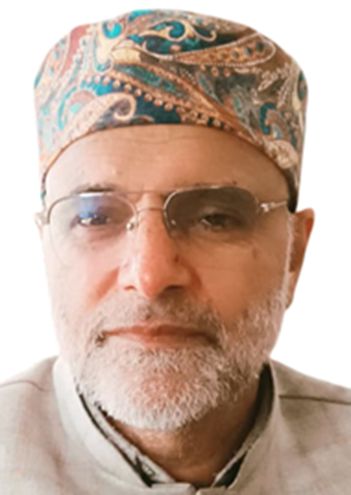
Prof. Hamid Naseem Rafiabadi
Allama Muhammad Iqbal occupies a distinguished position in modern intellectual history as a poet, philosopher and thinker who sought to awaken the moral, spiritual and intellectual consciousness of humanity. His significance extends far beyond poetry or literary expression. He developed a comprehensive vision of human existence, Islamic civilisation, individual freedom, social justice and the renewal of religious thought. At a time when Muslim societies were experiencing political decline, intellectual stagnation and the pressures of colonial domination, Iqbal called for a reconstruction of Muslim consciousness through a creative engagement with the Qur’an, Islamic intellectual traditions and modern knowledge. His thought remains particularly relevant in an age marked by technological transformation, moral uncertainty, social fragmentation and global crises.
One of the central concepts of Iqbal’s philosophy is Khudi, or the development of the self. It does not signify arrogance, egotism or individual self-interest; rather, it represents the cultivation of human personality through faith, discipline, knowledge, moral courage and purposeful action. Iqbal believed that human beings are not passive creatures condemned to accept their circumstances. They possess the capacity to shape their lives and contribute to the transformation of society. In the contemporary world, where consumerism, digital dependency and social alienation frequently weaken human individuality, the philosophy of Khudi offers a powerful reminder of human dignity, responsibility and creative potential.
Iqbal also sought to reconcile reason and spiritual experience. He did not regard rational inquiry and scientific investigation as enemies of religion. Instead, he maintained that intellectual reflection and spiritual insight should complement one another. His lectures, published as The Reconstruction of Religious Thought in Islam, represent a serious attempt to reconsider Islamic theology and philosophy in the light of modern scientific and philosophical developments. He encouraged Muslims to engage critically with contemporary knowledge rather than retreat into intellectual isolation. For Iqbal, religion was not merely a collection of inherited beliefs or rituals; it was a dynamic experience that should inspire ethical action, intellectual exploration and the transformation of human life. The foundation of Iqbal’s worldview was the Islamic principle of Tawhid, the unity and sovereignty of God. This principle provides the basis for human equality, moral accountability and the unity of creation.
Iqbal understood Islam as a comprehensive spiritual and civilisational framework that integrates faith, knowledge, justice and social responsibility. His deep attachment to the Prophet Muhammad (SAW) was central to his understanding of Islamic ethics. Prophetic guidance represented the ideal of compassion, justice, humility, courage and service to humanity. In an age of violence, intolerance and moral confusion, this ethical dimension of Iqbal’s thought deserves renewed attention. His conception of human fraternity was equally significant. Iqbal criticised racial arrogance, religious prejudice and narrow forms of nationalism that divide humanity. Although his intellectual journey included an early expression of patriotism, he later developed a broader vision centred on the spiritual and ethical unity of the Muslim community and the dignity of all human beings. His understanding of the Ummah was not intended to promote hostility towards other communities.
Rather, it emphasised solidarity, mutual responsibility and the possibility of a just international order. His thought encourages dialogue among religious and cultural traditions while resisting the forces of domination, discrimination and exclusion. Iqbal’s economic philosophy also has contemporary relevance. He criticised systems that legitimise exploitation, concentration of wealth and the degradation of human dignity. He believed that economic life must be governed by justice and ethical responsibility. The widening gap between rich and poor, unemployment, insecure labour and the exploitation of vulnerable populations demonstrate the continuing importance of his concerns. An Islamic economic vision, informed by Iqbal’s ethical outlook, must therefore promote equitable opportunities, social welfare, responsible ownership and the protection of human dignity.
“Allama Iqbal’s legacy extends beyond mere ceremonial tributes and poetic quotes; it demands rigorous critical study, historical context, and modern application. His lasting contribution is an integrated vision where intellectual renewal, spiritual grounding, social justice, and human dignity progress together. Rather than just anticipating modern challenges, Iqbal provides an ethical framework for building a civilization that balances scientific advancement with moral values, individual freedom with social welfare, and progress with human purpose.”
Another major contribution of Iqbal was his emphasis on Ijtihad, the principle of independent reasoning and intellectual renewal within the framework of Islam. He believed that Muslim societies could not respond effectively to changing circumstances through mechanical imitation or uncritical dependence on inherited interpretations. At the same time, renewal must remain rooted in the Qur’an, Sunnah and the intellectual objectives of Islam. Contemporary challenges require collective scholarship involving theologians, philosophers, scientists, economists, legal experts and social researchers. Such interdisciplinary engagement can help Islamic thought respond constructively to emerging questions without compromising its foundational principles.
The rapid development of artificial intelligence, biotechnology, digital communication and data-driven systems makes Iqbal’s emphasis on human agency especially important. Technology has expanded access to knowledge and created unprecedented opportunities for education, research and communication. Yet it has also raised serious concerns about privacy, surveillance, algorithmic discrimination, misinformation, employment and the manipulation of human behaviour. The central question is whether technological progress will strengthen human dignity or reduce individuals to instruments of commercial and political systems. Iqbal’s philosophy of Khudi reminds us that technology must remain subordinate to human moral purpose.
These developments can also be examined through the objectives of Islamic law, or Maqasid al-Shariah: the protection of religion, life, intellect, family and property. Digital technologies should protect privacy, preserve intellectual freedom, prevent exploitation, promote social welfare and safeguard human relationships. Artificial intelligence must be developed and employed within an ethical framework that recognises accountability, justice and human dignity. The integration of Islamic values with contemporary scientific and technological knowledge is therefore an urgent intellectual and institutional responsibility.
Education was another important dimension of Iqbal’s vision. He wanted an educational system that would cultivate independent thought, spiritual awareness, scientific understanding and social responsibility. Education should not merely produce individuals trained for employment; it should develop morally conscious and intellectually creative citizens. The integration of revealed knowledge and acquired knowledge is particularly important in this context. Muslim educational institutions must move beyond the artificial division between religious and modern disciplines and encourage research that connects philosophy, science, humanities, technology and ethics.
Iqbal also placed great hope in young people. He viewed youth as a dynamic force capable of renewing society through courage, creativity and commitment. His message is especially relevant to young generations confronted with unemployment, uncertainty, ideological extremism and the pressures of digital culture. They require education, meaningful opportunities and ethical leadership that enables them to become responsible contributors to society. His literary and philosophical works, including Asrar-e-Khudi, Rumuz-e-Bekhudi, Bal-e-Jibril, Zarb-e-Kalim and Javid Nama, offer valuable insights into the relationship between individual development, collective responsibility and spiritual aspiration.
Iqbal’s environmental relevance should also be recognised. His understanding of humanity as an active participant in creation can inspire responsible stewardship of the natural world. Climate change, environmental degradation and the unsustainable exploitation of resources demand a moral outlook that connects human freedom with accountability towards creation. The Islamic conception of human trusteeship, read alongside Iqbal’s emphasis on purposeful action, can contribute to an ethical environmental consciousness.
Ultimately, Iqbal should neither be confined to ceremonial remembrance nor reduced to selected poetic quotations. His thought requires critical study, historical contextualisation and creative application. His lasting contribution lies in his insistence that intellectual renewal, spiritual vitality, social justice and human dignity must advance together. The contemporary relevance of Iqbal is therefore not simply that he anticipated certain modern problems, but that he offered a philosophical and ethical framework through which humanity can confront them. His vision calls for an intellectually confident, spiritually grounded and socially responsible civilisation—one that embraces scientific progress without surrendering moral values, values individual freedom without neglecting collective welfare, and seeks progress without losing sight of its ultimate human purpose.
(The author a veteran academician is a former Professor and Head Department of Islamic Studies, Kashmir University. The views, opinions and conclusions expressed in this article are those of the author and aren’t necessarily in accord with the views of “Kashmir Horizon”)
[email protected]