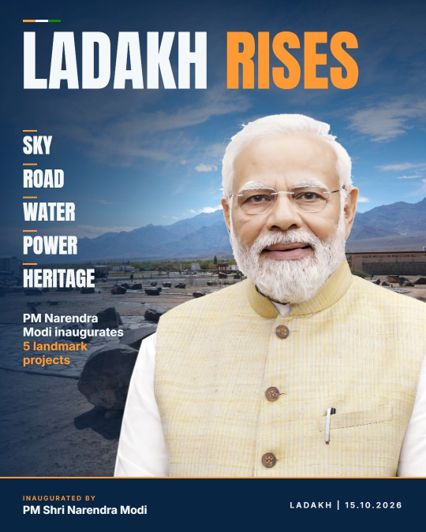
“Five projects include the expanded terminal at KushokBakula Rinpoche Airport in Leh, the Nimmu–Padum–Darcha road, the Hanuhydroelectric project and its associated transmission network, 40 reservoirs developed under Project Amrit Him Sarovar, and a Petroglyph Conservation Park in Leh…….”
Mohammad Irfan
 The Ladakh’s development priorities are increasingly being shaped by a combination of infrastructure expansion, environmental considerations, improved access to essential services and efforts to create new economic opportunities for its people. The inauguration of five development projects worth approximately ₹3,350 crore by Prime Minister Narendra Modi on Wednesday brings these priorities into focus, with investments spanning air connectivity, roads, hydropower, water management and cultural heritage conservation. Inaugurated through video conferencing, the projects represent different dimensions of development in a region where geography, extreme weather and long distances have historically influenced economic activity and access to services. Their importance extends beyond the infrastructure created: they also raise questions about how improved connectivity, more reliable electricity and better water management can strengthen livelihoods, support tourism and expand opportunities for younger generations. The five projects include the expanded terminal at Kushok Bakula Rinpoche Airport in Leh, the Nimmu–Padum–Darcha road, the Hanu hydroelectric project and its associated transmission network, 40 reservoirs developed under Project Amrit Him Sarovar, and a Petroglyph Conservation Park in Leh. Addressing the inauguration, Modi said the projects would make travel easier, strengthen electricity infrastructure, improve water availability and contribute to the preservation of Ladakh’s ancient heritage. He also highlighted the need to provide young people with quality education, modern skills and improved sporting facilities within the region. The broader development approach reflected in these initiatives is significant for Ladakh, where economic growth must be considered alongside ecological sensitivity, cultural identity and the practical challenges of living in a high-altitude landscape.
Connectivity| Opening New Possibilities For Ladakh: Connectivity remains one of the most consequential factors shaping Ladakh’s economic prospects. The region’s mountainous terrain, long winters and dependence on a limited number of transport corridors affect the movement of people, goods and essential supplies. Improvements in road and air infrastructure can therefore influence tourism, trade, healthcare access and the delivery of public services. The expanded terminal at Kushok Bakula Rinpoche Airport in Leh, developed at a reported cost of ₹650 crore, is designed to increase passenger-handling capacity from 10 lakh to 35 lakh annually. According to the Prime Minister, the facility triples the airport’s capacity and incorporates geothermal heating alongside solar energy to address the region’s climatic conditions. The expansion could help accommodate growing demand for air travel, particularly during peak tourist seasons. Greater passenger-handling capacity can improve the ability of the region to manage visitor arrivals while making travel more convenient for residents, business travellers and people seeking medical or educational services outside Ladakh. For tourism operators, hotels, homestays, taxi services, guides and local businesses, better air connectivity can provide access to a wider customer base. It may also make Ladakh more accessible for conferences, adventure tourism and other activities that depend on reliable travel arrangements. However, airport capacity is only one part of the tourism equation. The benefits will depend on the availability of accommodation, local transport, waste-management systems, trained workers and facilities capable of handling increased visitor numbers without placing excessive pressure on fragile ecosystems.
Power Infrastructure And The Challenge Of Reliable Energy: The inauguration of the Hanu hydroelectric project and its associated transmission network highlights another essential requirement for regional development: dependable electricity. Reliable power supports households, schools, hospitals, commercial establishments and small enterprises. In remote settlements, improvements in electricity infrastructure can reduce dependence on less reliable arrangements and help strengthen the delivery of essential services. For students, consistent electricity can improve access to digital learning and online educational resources. Healthcare facilities require dependable power for equipment, refrigeration and other essential functions. Businesses, meanwhile, need predictable electricity supplies to operate equipment, maintain communications and provide services.
Water Security And Climate Resilience: The dedication of 40 reservoirs developed under Project Amrit Him Sarovar brings water management into the centre of Ladakh’s development agenda. Water availability is fundamental to agriculture, horticulture, livestock rearing and the daily needs of communities. In a high-altitude region with limited growing seasons and difficult climatic conditions, the ability to store and manage water can influence agricultural productivity and the resilience of rural livelihoods. Prime Minister Modi said the reservoirs would help provide irrigation water to farmers when required during cultivation cycles. Their practical value will depend on local water availability, storage capacity, distribution arrangements and maintenance. Reservoirs can help manage seasonal supplies, but their effectiveness will be determined by whether they provide dependable access to water at the time and place it is needed. Water infrastructure also has a broader connection with climate resilience. Changes in temperature, precipitation patterns and the timing of snowmelt can affect water availability in mountain environments. Planning for these uncertainties requires careful monitoring, efficient use of available resources and coordination among communities and relevant departments. For agricultural households, improved water management can support efforts to diversify crops, improve productivity and reduce vulnerability to interruptions in supply. It can also help communities manage competing requirements for household consumption, livestock and cultivation.
Tourism And Livelihoods Beyond The Peak Season: Tourism remains an important source of economic activity in Ladakh, supporting accommodation providers, transport operators, restaurants, guides, adventure-tourism businesses and artisans. The region’s landscapes, monasteries, cultural traditions and winter conditions offer opportunities for a diverse tourism economy. During his address, Modi highlighted efforts to promote winter and adventure tourism and noted that homestays in Ladakh had increased from approximately 150 to 3,000. The expansion of homestays can create a direct link between tourism and household incomes. Unlike larger hospitality establishments, community-based accommodation can allow families to earn from spare rooms, traditional food, local knowledge and cultural experiences. Such enterprises may also create demand for local transport, food supplies, handicrafts and guiding services. If managed effectively, this can help spread tourism-related income across communities rather than concentrating it among a limited number of businesses. The promotion of winter tourism could further help businesses explore opportunities outside the main summer season. Activities associated with snow, ice hockey, mountaineering and other adventure pursuits can potentially diversify the visitor economy. However, winter tourism also requires investment in safety systems, trained personnel, emergency response arrangements, suitable accommodation and reliable transport. Weather-related disruptions and the environmental sensitivity of mountain destinations must remain central to planning.
Education, Skills: Investing In The Next Generation: One of the most significant themes in Modi’s address was the need to expand educational and professional opportunities for Ladakh’s young population. He said a major Centre of Excellence was being built in Leh and referred to proposals for satellite campuses of IIT Jammu and IIM Jammu. The stated objective is to help local students access quality higher education, research facilities and modern skills without having to depend entirely on institutions in other cities. For students from remote and high-altitude communities, access to higher education can involve substantial financial and logistical challenges. Travel, accommodation and living expenses may place additional pressure on families, particularly when specialised courses are not available locally. Expanding educational opportunities within Ladakh could help address some of these barriers. A Centre of Excellence, if supported by strong academic programmes, qualified faculty, laboratories and industry partnerships, could create a platform for developing skills relevant to the region’s future economic needs. Areas such as renewable energy, environmental science, tourism management, digital technology, agriculture, mountain studies and entrepreneurship could have particular relevance, depending on the institution’s mandate and available resources.
“Digital platforms, online complaint systems, CCTV networks, forensic technologies and data-based policing are changing the way police agencies interact with citizens and investigate offences.Young officers with familiarity with technology can play an important role in accelerating this transition….”
The Sports As An Avenue For Youth Development: Prime Minister odi also highlighted the implementation of Ladakh’s new sports policy and efforts to provide young athletes with improved training and facilities. Ladakh has a distinctive sporting environment, particularly in ice hockey, winter sports and mountaineering. Local climatic conditions and terrain provide opportunities for activities that require specialised facilities, coaching and technical preparation. A structured sports policy can help identify promising athletes, improve access to coaching and provide more consistent support for participation in national and international competitions. Sports development can also have benefits beyond competition. Training facilities, organisedprogrammes and community participation can support physical fitness, discipline and confidence among young people. There may also be links between sports and tourism. Well-managed sporting events and training programmes can generate demand for accommodation, transport and other local services. Such opportunities, however, require careful planning, safety standards and sustained investment. For young athletes, access to qualified coaches, equipment, nutrition support and medical assistance can be as important as the availability of venues. Transparent selection processes and opportunities for participants from different parts of Ladakh would help ensure that the benefits of the policy are widely shared.
Preserving Heritage While Expanding The Economy: The inauguration of India’s first Petroglyph Conservation Park in Leh adds a cultural dimension to the development programme. Ladakh’s ancient rock art, monasteries, Buddhist traditions, festivals and distinctive architectural heritage are important components of its identity. They also form part of the region’s appeal to researchers, historians and visitors interested in its cultural history. Petroglyphs offer evidence of past human activity and cultural expression. Their preservation requires specialised conservation practices, documentation and protection against damage caused by weather, human activity and unmanaged tourism. A dedicated conservation park can help improve public awareness and provide a setting in which visitors can engage with this heritage. It may also create opportunities for educational programmes, research and responsible cultural tourism. The Prime Minister said the initiative would help future generations and visitors from India and abroad become more familiar with Ladakh’s history.
Local Products And The Search For Better Markets: The Prime Minister also highlighted the commercial potential of Ladakh’s sea-buckthorn, handicrafts, GI-tagged apricots, high-altitude floriculture and Pashmina produced by the Changpa community. These products offer opportunities to connect traditional livelihoods with wider markets. However, producers often require more than access to raw materials or a distinctive product. Branding, quality standards, packaging, processing, transport and reliable market linkages can influence the income they receive. Sea-buckthorn, for example, has potential for value-added products, while apricots can support processing and differentiated marketing. Handicrafts and Pashmina can reach specialised domestic and international consumers if their provenance, quality and craftsmanship are communicated effectively. Digital commerce may also help small producers connect with buyers beyond local markets. Yet online platforms need to be supported by dependable logistics, transparent pricing, product standards and systems that allow producers to receive a fair share of the final value. The emphasis on improving branding and market access is therefore relevant to rural livelihoods. The objective should be to strengthen the position of farmers, artisans and pastoral communities within supply chains.
Development Must Be Measured By Its Local Impact: Prime Minister odi also outlined broader infrastructure gains since Ladakh became a Union Territory in 2019. According to the figures cited in his address, the road network has expanded from 1,800 kilometres to more than 4,000 kilometres, major bridges have increased from 19 to nearly 75, helipads from seven to more than 40, and household tap-water coverage from 3.5 per cent to nearly 99 per cent. He also said hospital beds had doubled and referred to the ongoing Zojila Tunnel project. These figures, presented by the Prime Minister, indicate the scale of infrastructure development claimed by the government. Their significance is best understood alongside the quality, accessibility and reliability of the services delivered. For residents, a road matters when it provides safe and dependable access. A water connection matters when supplies are adequate and regular. A power project matters when electricity reaches households and businesses reliably. Educational infrastructure matters when students can access quality teaching and meaningful career opportunities. This distinction is important in Ladakh, where geographical challenges can make the delivery and maintenance of public services particularly demanding. The establishment of a High Court Bench for Ladakh, which Modi said received government approval in August 2026, also addresses an institutional dimension of regional development. Improved access to judicial services could reduce the burden of travelling long distances for legal proceedings, subject to the arrangements and services established under the approved framework. Digital connectivity, including the expansion of BharatNet and high-speed internet in remote areas, can complement these improvements by supporting e-governance, online learning and commercial activity. The combined impact of physical infrastructure, digital access and public institutions could help make essential services more accessible across the territory.
Kashmir Horizon View: The inauguration of five projects worth approximately ₹3,350 crore provides an opportunity to examine how infrastructure investment can support a broader development strategy for Ladakh. The projects address different but interconnected requirements: mobility, electricity, water management and cultural preservation. Their benefits could extend to tourism, agriculture, education, local commerce and the delivery of public services. Yet the results will depend on implementation beyond the inauguration stage. Roads and reservoirs require maintenance; power infrastructure needs reliable distribution; airports must operate efficiently; and conservation projects need sustained professional oversight. Equally important is the participation of local communities in determining how development priorities are implemented. Ladakh’s geography and cultural diversity mean that the needs of different settlements may vary considerably. Local consultation can help ensure that investments respond to practical requirements and that the resulting opportunities are accessible to residents. The region’s development strategy will also need to account for environmental pressures. Tourism, transport and construction can create economic benefits, but they must be balanced with the protection of water resources, fragile landscapes and cultural sites. For young people, the greatest long-term gains may come from the interaction of infrastructure with education, skills and entrepreneurship. Better roads and power can support businesses, while stronger educational institutions can prepare local residents to take advantage of the opportunities created. For farmers and artisans, improved transport, digital access and market linkages can help connect traditional products with new customers. For remote communities, reliable essential services can improve everyday life and strengthen economic resilience. The five projects, taken together, reflect an approach that combines large infrastructure investments with efforts to protect heritage and improve the foundations of local livelihoods. Whether this approach produces lasting and broadly shared benefits will depend on how effectively the new facilities are maintained, how well they serve local needs and how closely future investments are linked to skills, employment and environmental sustainability.
(“Team Kashmir Horizon” is committed to continuous improvement and invites feedback and suggestions from readers and its followers on social media sites. Reader insights are considered vital for enhancing content quality and empowering the community. The team encourages open communication and values the thoughts and ideas of its audience, believing that such input will enable them to serve the public more effectively. The initiative aims to ensure that readers have the best possible experience with “Kashmir Horizon”. Interested individuals can reach out to us via email at [email protected].)