Says ‘Power to Empower’ Vision to Tackle Global Volatility
“From Digital Infra To Green Energy India Belives In Collaborative Global Growth”
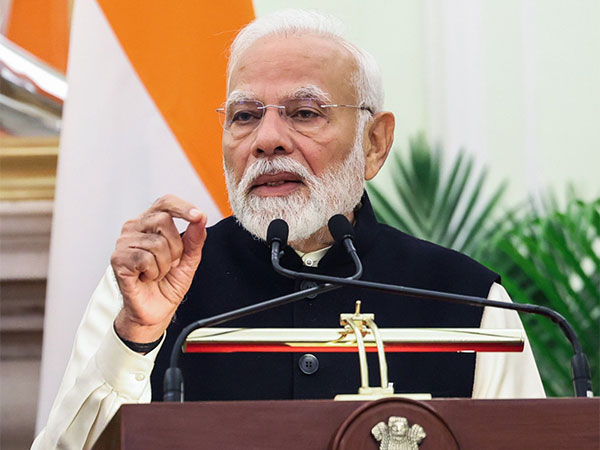
New Delhi | October, 13: In a major geopolitical and economic policy statement, Prime Minister Narendra Modi on Tuesday positioned India as an indispensable anchor of reliability and stability for an increasingly fragmented global economy.
Addressing international business leaders, economists, and policymakers at the prestigious Bloomberg New Economy Forum—hosted in India for the first time—the Prime Minister delivered a compelling defense of the country’s structural economic agenda while advocating for a fundamental rethink of global power dynamics.
Addressing the gathering, Prime Minister Modi highlighted India’s policy trajectory, declaring, “For us, reforms are not a compulsion. They are a conviction.” He reassured international investors that India’s economic expansion is inherently inclusive and non-adversarial, asserting, “We do not grow at anyone’s cost. We grow with the world and for the world.” Emphasizing India’s resilience amid global trade disruptions and supply chain chokepoints, he added, “In a world full of uncertainties, India offers reliability and stability.”
At the heart of the Prime Minister’s address was the concept of “Power to Empower,” an alternative paradigm that seeks to redefine political and technological authority. “Today, technology is power, data is power, knowledge is power, innovation is power,” Modi observed, raising the critical issue of whether these vital resources will remain concentrated among a select few or be harnessed to benefit millions. “The real question is not who possesses power, but how it is being used,” Modi said, calling for a transition from “power to control” to “power to enable”, from “power to compete” to “power to collaborate”, and from “power to succeed” to “power to help others succeed.”
Drawing upon ancient philosophy to underscore the ethics of capability, Modi illustrated how digital access had converted connectivity into an engine of grassroots social and economic mobility. “Connectivity has not merely connected people; it has connected opportunities,” Modi noted, citing India’s scalable public digital infrastructure. Extending an invitation to partner nations, particularly across the Global South, to adopt platforms like CoWIN and unified payment systems, he affirmed, “Our constant endeavour is to ensure that India’s capabilities open new doors of opportunity for other countries as well.”
Beyond domestic milestones—such as reaching over 250,000 startups, lifting 250 million people out of poverty, expanding renewable energy capacity to 300 gigawatts, and achieving 7.8 per cent GDP growth alongside $700 billion in foreign exchange reserves—Modi warned against the weaponization of economic architecture. “Things that once connected the world are today becoming weapons,” he cautioned, referencing vulnerable supply chains, critical minerals, and payment networks.
Amid these challenges, Modi presented India as a steady, trusted pillar committed to global welfare. “Whenever the world needs a steady pillar, India steps forward, understanding its responsibility,” he affirmed.
Reaffirming the country’s commitment to continuous governance and economic modernization, the Prime Minister reiterated, “For us, reforms are not a compulsion. Reforms are our conviction,” before concluding with a call for unified international action: “Let us walk together. Let us speak together. Let us strive to understand one another.”