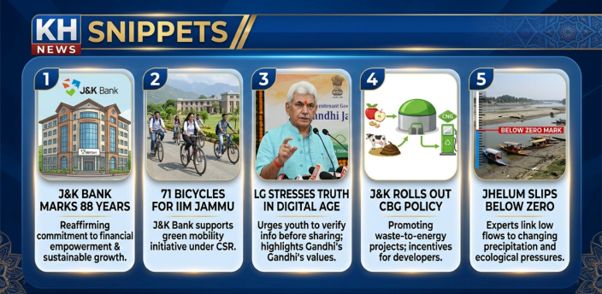
Srinagar| Oct, 03:A quick look at five developments from Jammu and Kashmir this week in KH Snippets—from J&K Bank’s 88th anniversary and green mobility initiatives to the new Compressed Bio-Gas policy, Gandhi Jayanti message on truth, and concerns over falling Jhelum levels.
1. J&K Bank Marks 88 Years: J&K Bank marked its 88th anniversary by reaffirming its commitment to financial empowerment and sustainable growth in Jammu & Kashmir and Ladakh. MD & CEO Amitava Chatterjee said the Bank would continue supporting regional economic development while strengthening its business for future generations. The Bank, principal financier of Mission YUVA, has sanctioned loans worth ₹1,902 crore to nearly 40,000 entrepreneurs. It also spent over ₹46 crore on CSR initiatives during 2025-26.
2. 71 Bicycles For IIM Jammu By J&K Bank: J&K Bank has supported a green mobility initiative at IIM Jammu by providing 71 bicycles and cycle stands under its CSR programme. MD & CEO Amitava Chatterjee said the initiative was aimed at promoting healthier living, environmental awareness and responsible leadership among students. IIM Jammu Director Prof B.S. Sahay welcomed the initiative, which seeks to reduce dependence on motorised transport within the campus.
3. LG Stresses For Truth In Digital Age: Lieutenant Governor Manoj Sinha, at a Gandhi Jayanti event in Srinagar, urged young people to verify information before reacting or sharing it. Referring to Mahatma Gandhi’s philosophy of truth and non-violence, he said technology should remain an instrument under human control and not replace individual conscience. He also stressed dialogue, inclusivity and character-building among children.
4. J&K Rolls Out CBG Policy: The J&K Government has notified the Compressed Bio-Gas Policy 2026 to promote waste-to-energy projects using cattle dung, apple pomace, crop residues, pine needles and municipal waste. The policy offers capital support of ₹0.50 crore per TPD, capped at ₹10 crore per project, along with SGST reimbursement and other incentives. It targets around 2,000 direct rural jobs by 2030.
5. Jhelum Slips Below Zero: The Jhelum fell below the zero-gauge mark at Sangam, recording –0.13 feet on October 2. Experts have linked the river’s increasingly erratic flows to changing precipitation, rising temperatures and ecological pressures. Environmentalists have also flagged pollution, encroachment and degradation of wetlands and natural drainage systems as concerns for Kashmir’s water security.