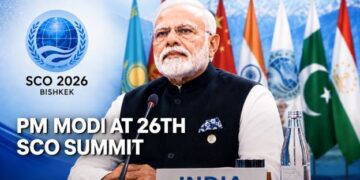
“Prime Minister Narendra Modi said more than 350 meetings had been organised during India’s chairship, with participating teams welcomed in nearly 30 cities across the country. He described the approach as “people-centric” and “humanity-first”, ….”
Mohammad Irfan
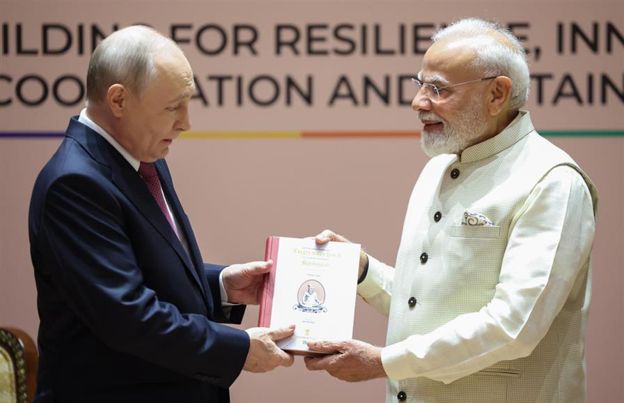 From Prime Minister Narendra Modi has called for a new and more ambitious agenda for BRICS as the grouping marks its 20th anniversary, arguing that its growing economic and political weight must now translate into greater influence over global decision-making, stronger institutional continuity and a larger role for the Global South in shaping international rules.Addressing BRICS leaders and representatives, Modi said the grouping had reached a “coming of age” moment and needed to move beyond consensus-building within the bloc towards concrete outcomes on the global stage. He proposed a BRICS Continuity and Implementation Mechanism to ensure that initiatives agreed upon during successive presidencies do not lose momentum when the chairship changes hands. His proposals also included a BRICS Reform Roadmap on global governance, with ten proposals to be developed around three broad principles—representation, responsiveness and rule-making.The speech placed institutional reform at the centre of India’s BRICS agenda, reflecting New Delhi’s broader effort to position the grouping not merely as an economic coalition but as an important platform through which developing countries can seek a greater voice in international institutions.
From Economic Grouping To Wider Global Platform: BRICS began two decades ago as a grouping centred largely on the economic significance of emerging economies. Over time, however, its agenda has expanded into development, finance, technology, health, climate change, food and energy security, multilateral reform and other areas of international cooperation. Prime Minister Modi’s assessment that BRICS has reached a “coming of age” moment therefore carries significance beyond the symbolism of its 20th anniversary. The grouping today operates in a substantially different international environment from the one in which it was created. Global economic power has become more dispersed, developing economies have acquired greater weight in international trade and investment, while geopolitical tensions have complicated cooperation through traditional multilateral institutions. India’s approach under its chairship has attempted to connect BRICS cooperation with practical issues affecting ordinary citizens. PM Modi said more than 350 meetings had been organised during India’s chairship, with participating teams welcomed in nearly 30 cities across the country. He described the approach as “people-centric” and “humanity-first”, with resilience, innovation, cooperation and sustainability identified as key priorities. The emphasis on the people-centric character of BRICS is important because the credibility of multilateral institutions increasingly depends on whether their decisions produce visible benefits beyond diplomatic conferences. For developing countries, the test is particularly acute. Issues such as food security, access to finance, energy affordability, climate vulnerability, digital inclusion and public health directly affect millions of people, while many of the international institutions dealing with these issues continue to operate through structures established decades ago. Prime Minister Modi’s speech attempted to bridge that gap by arguing that BRICS should become more effective internally while simultaneously advocating structural reform externally.
Continuity Mechanism Proposed To Prevent Loss Of Momentum: One of the most concrete proposals in Modi’s address was the establishment of a BRICS Continuity and Implementation Mechanism. The annual rotation of the BRICS chairship provides each member with an opportunity to place its priorities on the organisation’s agenda. But rotating leadership can also create a structural challenge: initiatives launched under one presidency may lose momentum once another country assumes the chair. Prime Minister Modi proposed addressing this through the BRICS Troika, with a mechanism that would systematically follow up on decisions and initiatives. He suggested creating a secure digital repository where every decision could be linked to a nodal point, a timeline and its implementation status. On paper, this is a relatively administrative proposal. Politically, however, it addresses one of the central challenges facing multilateral groupings—the gap between declarations and delivery. International summits routinely produce lengthy communiques, commitments and initiatives. The more difficult question is what happens after leaders return home. A digital system tracking responsibilities and deadlines could create greater institutional memory within BRICS. It could also allow future presidencies to inherit an established implementation framework rather than beginning with a fresh set of priorities. The proposal reflects India’s attempt to move BRICS towards a more institutionalised model without necessarily creating a heavily centralised bureaucracy. For a grouping that has expanded in membership and broadened its agenda, such institutional continuity could become increasingly important.
The ‘Pyramid Of Privilege’ And Global South: The most politically significant section of Modi’s speech focused on global governance. Describing the existing international system as resembling a “pyramid”, he argued that decision-making power remains concentrated at the top while countries at the bottom are often affected by decisions in which they have limited participation. His formulation that the Global South is “in the front row of global crises, but in the back row of decision-making” captures one of the principal arguments behind India’s advocacy for reform of global institutions. The Global South is disproportionately exposed to several transnational challenges, including climate change, food and energy insecurity, debt pressures, conflicts and economic disruptions.Yet many developing countries argue that the institutions responsible for making or influencing global decisions do not adequately reflect the distribution of economic and demographic power in the contemporary world.Modi proposed replacing what he termed a “pyramid of privilege” with a “platform of partnership”.
The Distinction Is Central To India’s Diplomatic Positioning: New Delhi has consistently argued for a more representative multilateral order while avoiding the framing that reform should be directed against existing powers. In his speech, Modi again stressed that BRICS should not be “against anyone” but should seek to take everyone along. This positioning could become particularly important as BRICS seeks to expand its influence without being defined exclusively through rivalry with established Western institutions.UN Security Council Reform At CentreModi’s call for reform of the United Nations Security Council was among the clearest elements of the proposed global governance agenda. He said reform could no longer be delayed and argued that text-based negotiations should be connected to a clearly defined timeline and concrete outcomes. The demand for Security Council reform is not new. India has for years sought permanent membership of the Council, arguing that the existing structure does not adequately reflect contemporary geopolitical and economic realities. The composition of the Security Council reflects the world that emerged after the Second World War. The five permanent members—the United States, Russia, China, France and the United Kingdom—retain veto powers, while the wider UN membership has expanded substantially since the organisation was founded. For countries such as India, the issue is therefore one of representation as much as status. PM Modi linked Security Council reform with broader changes in international financial institutions. He argued that voting power, leadership positions and policy priorities should better reflect today’s economic realities.The underlying argument is that global economic governance cannot remain disconnected from the countries responsible for a growing share of global economic activity.This issue could become one of BRICS’ most consequential areas of collective diplomacy, although translating broad support into agreement on the precise structure of reform remains difficult.
“India does not need to build every component from scratch.It can learn, adapt and develop systems suited to its own conditions. This becomes particularly important for sports in which India is only beginning to establish a competitive presence.…..”
The Responsiveness As A Measure Of Multilateralism: Modi’s second proposed pillar—responsiveness—shifted the discussion from who controls international institutions to how effectively those institutions respond to crises. He argued that global institutions will retain public trust only if they can deliver effective solutions at speed and scale, particularly at the last mile. The focus on implementation is particularly relevant for developing countries, where international commitments often encounter capacity constraints before reaching communities. As crises increasingly cross borders, the demand for faster international responses has also grown. Climate-related disasters, pandemics, conflicts, disruptions to maritime trade and humanitarian emergencies rarely remain confined to one jurisdiction. Yet international responses can be slowed by bureaucratic procedures, fragmented responsibilities and political disagreements.
PM Modi’s proposal for a Seafarers Emergency Support Network: Seafarers are central to international trade but can face serious difficulties when ships encounter emergencies, medical crises or other disruptions. Modi suggested a network linking maritime authorities and diplomatic missions to facilitate distress alerts, medical assistance, communication with families and evacuation support. The proposal is narrower than Security Council reform, but its importance lies in its practical character. It demonstrates the kind of cooperation Modi wants BRICS to pursue—less focused solely on declarations and more focused on mechanisms capable of solving specific problems. The challenge will be to determine whether such proposals can be converted into functioning institutions, with clear responsibilities, funding and operational protocols.
From Rule-Takers To Rule-Shapers : The third pillar of Modi’s proposed reform agenda—rule-making—looks towards the technologies that will define the next phase of global competition.Artificial intelligence, cyberspace, outer space, biotechnology and critical technologies are rapidly creating new economic opportunities while simultaneously raising questions about security, privacy, ethics, intellectual property and international law.Many developing countries have historically had limited influence over the formulation of global standards governing emerging technologies. Prime Minister Modi argued that the Global South must move from being a collection of “rule-takers” to becoming “rule-shapers”.This is likely to become an increasingly important dimension of BRICS cooperation. The rules governing artificial intelligence, for example, will have consequences extending far beyond the countries currently leading the development of frontier technologies. Decisions on data, computing infrastructure, algorithmic accountability, cybersecurity and access to AI could affect development trajectories across the Global South. Similarly, emerging rules around outer space and biotechnology could determine who benefits from technological progress and who remains dependent on technologies developed elsewhere. India’s proposal to provide young diplomats and policymakers from developing countries with negotiation skills, practical training and legal expertise therefore points towards a longer-term strategy. Rather than simply demanding a seat at existing negotiating tables, BRICS could attempt to build the institutional capacity required to influence negotiations.
South-South Cooperation Gets Renewed Emphasis: Prime Minister Modi’s reference to the United Nations Day for South-South Cooperation added another layer to the speech.South-South cooperation has traditionally focused on technical assistance, development partnerships, capacity-building and the exchange of knowledge among developing countries. India has sought to expand this concept into areas such as digital public infrastructure, development financing, disaster resilience, healthcare, renewable energy and technology. The BRICS platform provides an additional avenue for such cooperation because its members possess substantial economic, demographic and technological capabilities. The question now is whether those capabilities can be pooled effectively. BRICS members have different economic structures, foreign-policy priorities and geopolitical interests. Their approaches to international security, trade and strategic competition can also diverge. Consequently, consensus within BRICS does not necessarily mean uniformity. Prime Minister Modi’s emphasis on consensus and partnership acknowledges this reality while arguing that differences should not prevent cooperation where interests converge.
Kashmir Horizon View: The growing relevance of BRICS also brings a new challenge: scale.As the grouping expands, its collective economic and political weight increases, but reaching consensus can become more complicated.A larger grouping contains more interests, more regional dynamics and more foreign-policy priorities. This makes the institutional proposals in Modi’s speech particularly significant.A BRICS with a broader membership and wider agenda will need systems capable of managing continuity, implementation and disagreement.Without such systems, expansion could risk making the grouping more declaratory than operational. With effective mechanisms, however, a larger BRICS could potentially become a stronger negotiating platform for developing countries. The success of India’s proposals will therefore depend less on the language adopted at the summit and more on what happens after it. The central message of Modi’s speech can be reduced to a simple proposition: BRICS has reached a point where its influence must be measured by outcomes rather than declarations. The proposed Continuity and Implementation Mechanism addresses the internal functioning of the grouping. The proposed Reform Roadmap addresses its external ambition. Together, they represent an attempt to give BRICS both institutional memory and a longer-term strategic direction.But translating the vision into reality will require political agreement among members.The proposed ten-point global governance agenda will have to reconcile different national priorities. Security Council reform requires negotiations involving countries beyond BRICS. Financial institutional reform involves entrenched interests. Technology rule-making will require engagement with both developed and developing economies. The same complexity applies to practical initiatives such as the proposed Seafarers Emergency Support Network.Yet the significance of the speech lies precisely in its attempt to connect these seemingly different questions. For India, the argument is that a changing world requires institutions capable of reflecting that change.BRICS at 20 is therefore being presented not simply as a celebration of two decades of cooperation but as an opportunity to redefine what the grouping should become over the next two decades. The proposed transition—from “voice to impact” and from “privilege to partnership”—captures that ambition.Whether BRICS can make that transition will depend on its ability to convert political consensus into institutional continuity, practical cooperation and measurable outcomes. The next twenty years could determine whether BRICS becomes primarily a forum that articulates the concerns of emerging economies or a platform capable of materially influencing the rules by which the international system operates. PM Modi’s speech makes clear where India believes the choice should lie: a future in which the countries most affected by global decisions are also given a meaningful role in shaping them.
(“Team Kashmir Horizon” is committed to continuous improvement and invites feedback and suggestions from readers and its followers on social media sites. Reader insights are considered vital for enhancing content quality and empowering the community. The team encourages open communication and values the thoughts and ideas of its audience, believing that such input will enable them to serve the public more effectively. The initiative aims to ensure that readers have the best possible experience with “Kashmir Horizon”. Interested individuals can reach out to us via email at [email protected].)