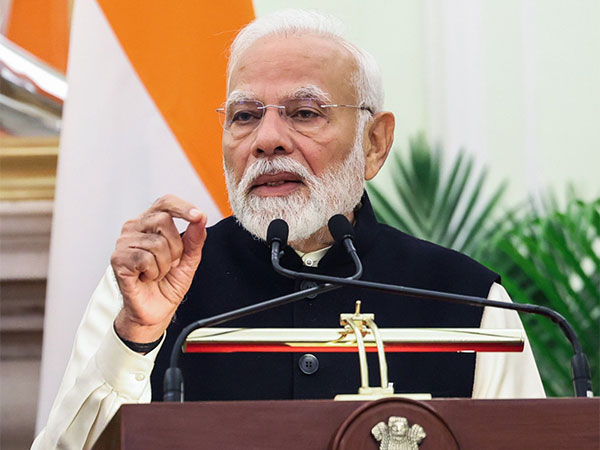
- At SRCC Centenary Celebrations on National Teachers’ Day PM Says “India’s Journey From Policy Paralysis To Dynamism Laudable”
“National Security Shift , Counter-Terrorism Operations Highly Commendable”
New Delhi|Sept, 5 : Prime Minister Narendra Modi on Saturday returned to Shri Ram College of Commerce (SRCC), 13 years after his much-discussed 2013 address at the institution, and said India had since made a decisive transition from “policy paralysis” to “policy dynamism”, emerging as a faster-growing economy with greater confidence on the global stage.
Addressing the centenary celebrations of SRCC in Delhi on Teachers’ Day, Modi drew a sharp comparison between the political, economic and security environment he had described during his February 2013 visit as Chief Minister of Gujarat and what he called India’s transformed position today.
Recalling the headlines of 2013, Modi said the country was then grappling with economic distress, scams, security concerns and a sense of pessimism. “There was a state of hopelessness,” he said, referring to what he described as a period when scams were at their peak, scamsters operated without fear and terrorism remained a persistent challenge.
He said India’s approach to national security had changed significantly. “Those spreading terrorism are hunted down now. If Pakistan indulges in a nefarious act, the Indian Army enters its home and strikes,” Modi said.
The Prime Minister also claimed that the “backbone” of Maoist and Naxal violence had been broken, citing the decline of left-wing extremism as another marker of the country’s transformation.
Turning to the economy, Modi said India had travelled a long distance from the “policy paralysis” of the past.
“From policy paralysis to policy dynamism… India has come a long way,” he said.
He pointed to India’s reported 7.8 per cent economic growth, saying it had come despite global uncertainty and the ongoing conflict in West Asia.
“India’s 7.8% growth amid global uncertainty reflects its economic strength,” Modi said.
He said India was now moving at a “new pace” and that developments which previously took decades were being achieved within a few years.
“What once took decades is now happening in just a few years,” he said.
Modi also referred to India’s upgraded credit rating and robust consumer demand, arguing that the indicators reflected an economy that was not only expanding but also creating new opportunities for employment and growth.
Taking aim at those who remain critical of the government’s economic record, the Prime Minister revived the metaphor from his 2013 SRCC speech.
“For the people for whom the glass was half empty in 2013 hold the same mindset even today. For them the glass will always remain half empty,” he said.
He also referred to the “Fragile Five” label used to describe vulnerable emerging-market economies during the economic turbulence of the early 2010s.
“Those responsible for pushing the country into ‘Fragile Five’ are now unable to digest India’s 7.8 per cent growth,” Modi said.
The Prime Minister called for greater confidence in Indian businesses and entrepreneurs, saying Indian talent had already demonstrated its ability to lead major global corporations.
“If Indians can lead the world’s top companies, Indian companies can lead the world too. It is all possible,” he said.
Modi said the country’s development journey ultimately depended on the collective efforts of its citizens.
“Together, 140 crore Indians will make India both Viksit and Aatmanirbhar,” he said, referring to the government’s objective of making India a developed and self-reliant nation.
The Prime Minister also reflected on the continuing political significance of his 2013 SRCC appearance, which took place more than a year before he became Prime Minister.
Recalling the response to that speech, he said, “My 2013 speech at SRCC had become a wave, and even today, 13-14 years later, the impact of that address remains intact.”
His return to the campus during his third term as Prime Minister gave the centenary event a symbolic dimension, allowing Modi to revisit an institution where he had addressed young people at a crucial point in his political journey.
The celebrations coincided with Teachers’ Day, observed on September 5 in memory of former President and eminent educationist Dr Sarvepalli Radhakrishnan.
The occasion brought together the centenary of one of India’s leading commerce institutions with a national day dedicated to acknowledging the role of teachers and educators in shaping generations.
In a separate post on X, Modi described SRCC as an institution distinguished by academic excellence, institution-building and its contribution to public and professional life.
“Delighted to join the centenary celebrations of Shri Ram College of Commerce. Over the years, this institution has given generations of students the opportunity to learn, grow and make a difference,” he said.
The Prime Minister said the college had played an important role in nurturing generations of leaders in business, public life and society.
Established in 1926, SRCC has built a reputation as one of India’s premier institutions for commerce and economics and has produced alumni who have made their mark across business, government, academia and public life.
Modi’s emphasis on economic transformation also came in the backdrop of the 12th anniversary of the Pradhan Mantri Jan Dhan Yojana, the financial-inclusion initiative launched in 2014 to expand access to banking and formal financial services.
The Prime Minister’s address therefore combined a celebration of SRCC’s hundred-year institutional journey with a political and economic assessment of India’s trajectory since his first appearance at the college.
Revisiting his 2013 “glass half-full” argument before a new generation of students, Modi sought to reinforce his contention that India had moved from pessimism and policy paralysis to faster growth, greater economic confidence and a more assertive role in the world.