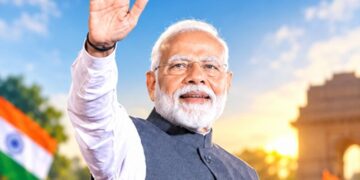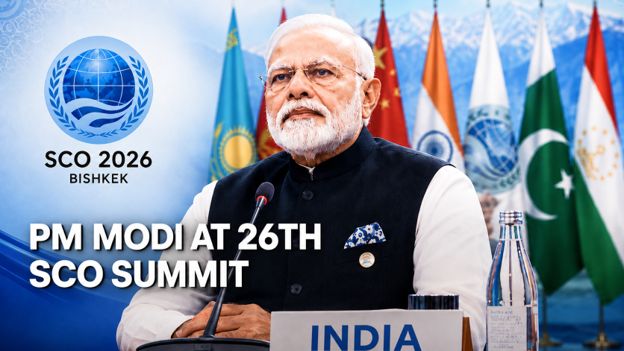
“PMModi called on SCO member states to speak with “one voice” against terrorism and reject double standards in dealing with terrorist organisations and those who provide them support….”
Mohammad Irfan
 This week Prime Minister Narendra Modi has called for a stronger and united international response to terrorism, asserting that the global fight against terror must move beyond an “action-reaction approach” and focus on dismantling the entire ecosystem that sustains terrorist organisations. Addressing the Shanghai Cooperation Organisation (SCO) summit in Bishkek, Modi placed security at the forefront of India’s vision for the grouping, describing peace and stability as the essential foundation for connectivity, development and opportunities for people across Eurasia. His intervention came against the backdrop of continuing global security uncertainties, with the Prime Minister arguing that terrorism remains a serious challenge not only for individual countries but for humanity as a whole. Prime Minister Modi called on SCO member states to speak with “one voice” against terrorism and reject double standards in dealing with terrorist organisations and those who provide them support. “The time has come to move these three pillars beyond vision and translate them into concrete outcomes. The first and foremost requirement for this is peace and security,” Modi said, referring to India’s vision for the SCO built around Security, Connectivity and Opportunity.
‘No place For Double Standards’: The Prime Minister’s strongest message was directed at the need for a comprehensive approach to counter-terrorism. Rather than limiting the response to individual attacks or terrorist incidents, Modi argued that countries must target the infrastructure and ecosystem that enables terrorism to survive. “We must dismantle the entire ecosystem of terrorist financing, recruitment, radicalisation, and safe havens,” he said. The formulation is significant because it broadens the counter-terrorism agenda from eliminating individual terrorists to addressing the systems that facilitate their emergence, financing and movement. Terrorist organisations require more than armed cadres to sustain themselves. They depend on financing networks, recruitment mechanisms, ideological radicalisation, logistical support and safe spaces. Disrupting these interconnected elements can therefore weaken terrorist networks in a more sustained manner. PM Modi’s call for a united response places collective international action at the centre of this strategy. “We must speak with one voice and make it clear that there can be no place for double standards on this serious issue,” he said. The Prime Minister also stressed that countries using terrorism as an instrument of policy and providing safe haven and support to terrorists must receive a clear message that terrorism cannot become a strategic asset.
From Reaction To Prevention: A key element of Modi’s address was his rejection of a purely reactive approach to terrorism. “In the fight against terrorism, we cannot remain confined to an action-reaction approach,” he said. The statement points towards a preventive model in which countries work together to identify terrorist networks, disrupt their financial resources, counter recruitment and radicalisation and prevent the creation of safe havens. Such an approach requires deeper intelligence cooperation, information sharing and coordinated action among security agencies. For the SCO, which brings together countries spanning a large part of Eurasia, the issue has particular significance. The grouping provides a platform for cooperation on security, organised crime, narcotics and information security. Prime Minister Modi emphasised the need to make the SCO’s existing mechanisms more effective and oriented towards practical outcomes.
Afghanistan Central To Regional Security: Prime Minister Modi also linked the security of Eurasia with peace and stability in Afghanistan. He said India has continued to contribute to Afghanistan’s development and provide humanitarian assistance to its people and would continue to do so. The Prime Minister’s reference to Afghanistan underscores its importance in the broader regional security architecture. For the countries of the SCO region, developments in Afghanistan have implications for terrorism, narcotics, organised crime, border security and regional connectivity. A stable and peaceful Afghanistan can contribute to greater regional cooperation, while prolonged instability can create space for extremist and criminal networks. India’s emphasis on humanitarian assistance and development also reflects its approach of supporting the Afghan people while advocating regional peace and stability.
Drug Trafficking As A Security Threat: Another important component of Modi’s security message was the issue of narcotics. He described drug trafficking as more than a conventional criminal activity, calling it a serious threat to the younger generation as well as regional security. The linkage between narcotics and security has gained increasing importance internationally because drug networks can intersect with organised crime, illicit financing and other forms of criminal activity. Prime Minister Modi welcomed the establishment of SCO Centres dealing with security threats, organised crime, information security and narcotics, but stressed that these mechanisms should become effective instruments of practical coordination and timely action. The emphasis is consistent with his broader argument that the SCO must move from dialogue towards concrete outcomes. If security mechanisms are backed by timely information exchange and coordinated action, they can strengthen the collective ability of member states to address transnational threats.
“Modi also drew attention to the wider consequences of conflicts, citing the crisis in West Asia as an example of how instability in one region can affect countries across the world…”
The Digital Security Enters The Strategic Agenda: Prime Minister Modi also pointed towards the changing nature of security in an interconnected world. The Prime Minister noted that the scope of security has become broader and that conflicts and instability in one part of the world can have consequences far beyond their immediate geographical boundaries. The experience of recent international crises, he said, demonstrates how instability can affect energy security, maritime trade and global supply chains. This has strengthened the case for countries to expand security cooperation beyond conventional military and counter-terrorism concerns. Information security and digital threats are increasingly becoming part of this landscape. The SCO’s focus on information security, which Modi referenced in his remarks, therefore assumes importance as countries confront an expanding range of cyber and digital challenges.
West Asia And The Wider Security Picture: Prime Minister Modi also drew attention to the wider consequences of conflicts, citing the crisis in West Asia as an example of how instability in one region can affect countries across the world. He pointed to consequences for energy security, maritime trade and supply chains, particularly noting that countries of the Global South can bear a disproportionate share of the impact. India, he said, has consistently advocated resolving tensions and conflicts through dialogue and diplomacy rather than on the battlefield. The message places India’s counter-terrorism position within a broader foreign-policy framework that combines firmness against terrorism with support for diplomatic solutions to interstate conflicts.
Security As The Foundation Of Connectivity : The Prime Minister’s emphasis on security was closely linked to the second pillar of India’s SCO vision—connectivity. Prime Minister Modi argued that economic connectivity and development can flourish only in an environment of peace and stability. India supports efforts that connect markets, facilitate trade and create new development opportunities, he said, while stressing that connectivity initiatives must respect the sovereignty and territorial integrity of all countries. The point reflects India’s position that regional connectivity should be based on principles of mutual respect and sovereignty. Prime Minister Modi also highlighted the need to modernise connectivity through measures such as simplified customs procedures, digital documentation and more efficient logistics networks. In this framework, security becomes an enabler of economic cooperation.A secure region allows trade routes to function, infrastructure projects to progress and businesses to operate with greater confidence.
Security, Connectivity, Opportunity: Prime Minister Modi’s address was built around three interconnected pillars—Security, Connectivity and Opportunity.
Security, in his formulation, is the foundation. Connectivity can create economic possibilities, while opportunity ensures that the benefits of cooperation reach ordinary people. The Prime Minister argued that the SCO’s next phase should focus on translating its existing vision into tangible outcomes. For India, this means strengthening cooperation in areas ranging from counter-terrorism and narcotics to trade, technology, infrastructure and people-to-people relations. The approach reflects an understanding that security and development are closely connected. Without security, development remains vulnerable. Without development and opportunity, social and economic vulnerabilities can potentially create conditions that hostile networks seek to exploit.
A Stronger Collective Response: Prime Minister Modi’s intervention at the SCO summit represents a renewed push for collective responsibility in the fight against terrorism. His call to dismantle financing, recruitment, radicalisation and safe havens effectively places responsibility not only on countries confronting terrorism directly but also on the wider international community. The message is particularly relevant for a region that has experienced the effects of terrorism, extremism and organised crime. A collective security framework can make it more difficult for terrorist networks to exploit differences between countries. Information sharing, coordinated action against financing, joint efforts to counter radicalisation and stronger mechanisms against narcotics can collectively strengthen regional security.
India’s Leadership Role Within The SCO: Prime Minister Modi’s remarks also reinforce India’s growing emphasis on shaping the SCO’s agenda around practical cooperation. Rather than treating the organisation simply as a platform for political dialogue, India has advocated initiatives focused on youth, entrepreneurship, science, culture and innovation alongside security cooperation. This broader approach is reflected in Modi’s reference to India’s SCO initiatives such as the Start-up Forum, Young Authors’ Conclave and Young Scientists’ Forum. However, the Prime Minister made clear that these opportunities can flourish only when the basic security environment remains stable. His message effectively establishes a hierarchy: security creates stability; stability enables connectivity; and connectivity creates opportunities.
A Clear Message Against The Use Of Terror As Policy: One of the most forceful elements of Modi’s address was his assertion that terrorism cannot be treated as a legitimate instrument of state policy. His call for countries that use terrorism as an instrument of policy or provide safe havens to understand that terrorism can never become a “strategic asset” is a direct articulation of India’s longstanding position. The argument is straightforward: the international community cannot effectively combat terrorism if there are inconsistencies in how terrorist groups and their supporters are treated. For India, consistent international standards are essential to building a credible global counter-terrorism framework. The Prime Minister’s appeal for “no double standards” therefore seeks to establish a common principle for the SCO: terrorism must be opposed regardless of its source, justification or political context.
Beyond The Battlefield: Another defining feature of Modi’s address was its recognition that modern security challenges extend well beyond conventional battlefields. Terrorist financing, recruitment, radicalisation, narcotics, organised crime, information security and supply-chain disruptions all form part of the contemporary security environment. This requires governments to build capabilities that span intelligence, law enforcement, diplomacy, technology and economic policy. The SCO, with its broad geographical reach, is well placed to facilitate such cooperation. Prime Minister Modi’s call to make the grouping’s security centres effective instruments of coordination reflects this larger objective.
Kashmir Horizon View: At the heart of PM Modi’s speech was a simple proposition: peace and security are prerequisites for regional prosperity. His vision for the SCO’s next 25 years is not limited to maintaining an existing institutional framework. It is focused on converting cooperation into practical outcomes that improve the lives of people across the region. But that transformation, the Prime Minister made clear, begins with security. A region threatened by terrorism, narcotics, organised crime and instability cannot fully realise its economic potential. Conversely, a secure Eurasia can unlock greater trade, investment, connectivity, technological cooperation and opportunities for its young population. Prime Minister Modi’s intervention therefore placed the fight against terrorism within a much larger vision of regional development. The emphasis on dismantling terrorist ecosystems, rejecting double standards, strengthening cooperation against narcotics and improving information security reflects an effort to make the SCO’s security pillar more action-oriented. His message from Bishkek was consequently both firm and forward-looking: terrorism must be confronted collectively, security must be strengthened proactively, and regional cooperation must deliver tangible benefits to people. As the SCO enters its next quarter-century, India’s approach seeks to place security at the centre of the organisation’s future—because, as Modi’s address underlined, without peace there can be no lasting connectivity, and without security there can be no sustainable opportunity.
(“Team Kashmir Horizon” is committed to continuous improvement and invites feedback and suggestions from readers and its followers on social media sites. Reader insights are considered vital for enhancing content quality and empowering the community. The team encourages open communication and values the thoughts and ideas of its audience, believing that such input will enable them to serve the public more effectively. The initiative aims to ensure that readers have the best possible experience with “Kashmir Horizon”. Interested individuals can reach out to us via email at [email protected].)