“US Congress passes Safeguard American Voter Eligibility-SAVE America Act”
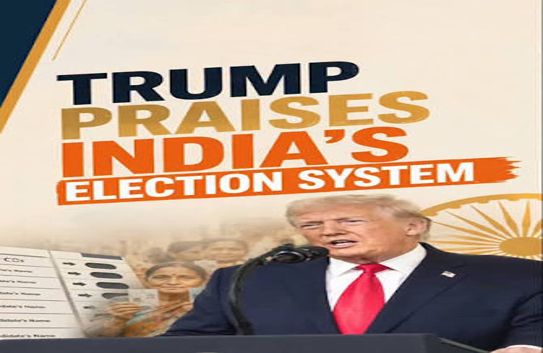
Srinagar: This week US President Donald Trump has praised India’s voter identification system and cited it as an example for stronger election-security measures in the United States, as his administration pushes for legislation requiring documentary proof of citizenship and government-issued photo identification for federal elections. In a social media post, Trump referred to a recent conversation with India’s Chief Election Commissioner Gyanesh Kumar, saying the Indian election official had questioned how elections could be conducted in the United States without mandatory valid photo identification. Trump used the reference to reiterate his demand that the US Congress pass the Safeguard American Voter Eligibility-SAVE America Act, which seeks to tighten voter registration and identification requirements for federal elections. The proposed legislation has become part of the broader American debate over election integrity, voter eligibility and access to the ballot. Trump and his supporters argue that stricter verification is necessary to ensure that only eligible US citizens participate in federal elections. Trump Points To India: Trump’s reference to India comes as his administration seeks to build political support for nationwide federal standards on voter identification. The US President highlighted the scale of India’s elections, noting that around 642 million people voted in the country’s most recent general election. He also pointed to India’s requirement that voters produce valid photo identification during polling. The comparison is significant because India conducts elections on a scale unmatched by most democracies. Hundreds of millions of voters participate across thousands of constituencies and polling stations, requiring extensive administrative and logistical arrangements.Voter identification is one component of this larger electoral framework. Trump’s argument is that the experience of a country with such a large electorate demonstrates that identification requirements can operate alongside mass participation.
What The SAVE America Act Proposes: The SAVE America Act was introduced in the US Congress on January 29 and seeks to establish stricter federal requirements concerning voter eligibility. Among its key provisions is a requirement for documentary proof of US citizenship when registering to vote in federal elections. The legislation also proposes requiring voters to present valid government-issued photo identification at polling stations. It includes provisions aimed at tightening rules governing absentee voting. The White House has described the legislation as a measure intended to ensure that only US citizens participate in American federal elections. Trump has made voter eligibility and election security recurring themes in his political agenda, and his latest reference to India has provided an international example for his argument.
India’s Voter Identification System: India’s electoral system requires voters to be registered on the electoral roll and to establish their identity at polling stations through prescribed identification documents. The Electoral Photo Identity Card, commonly known as the voter ID card, is the most recognisable form of voter identification. The Election Commission also permits other approved identity documents to be used by voters under specified circumstances. The purpose is to verify the identity of the person appearing at the polling station and prevent impersonation. The identification process operates alongside electoral rolls, polling procedures and other safeguards administered under the supervision of the Election Commission of India. India’s system has evolved over several decades as the country expanded its electoral infrastructure and introduced new technologies and administrative procedures.
A Comparison With The US: The US electoral system differs significantly from India’s. India has a central constitutional authority, the Election Commission of India, which oversees the conduct of elections across the country. The United States has a decentralised electoral system in which elections are administered largely by states and local authorities. As a result, voter registration, identification requirements, early voting, absentee voting and other procedures vary across American states. Some states already require voters to show identification at polling stations, while others have different mechanisms for establishing identity. Trump’s push is therefore aimed at creating stricter federal standards for elections to federal office.
Identity And Citizenship: The American proposal goes beyond simply requiring voters to show an identity document. The SAVE America Act seeks documentary proof of citizenship at the voter-registration stage. That distinction is central to the US debate. A photo identification document establishes who a person is, while documentary proof of citizenship is intended to establish whether that person is legally eligible to participate in federal elections. The White House has argued that stronger documentation would provide an additional safeguard against ineligible voting. Critics of stricter requirements, however, have raised concerns about the potential burden on eligible voters who may not possess the documents required under a new federal system. The issue has consequently become part of a wider American argument over election security and voting access.
India And Brazil Cited By Us Administration: The Trump administration has also compared American election procedures with those in India and Brazil. According to the administration, India and Brazil have stronger mechanisms for linking voter identification with biometric or identity databases, while the United States relies more heavily on self-attestation in determining citizenship during voter registration. The comparison is being used to support the argument that the US should strengthen its own voter-verification procedures. However, the electoral systems of the three countries operate under different legal and administrative frameworks. India’s election system, for instance, uses voter identification within a broader framework of electoral rolls and election administration. An identity database does not by itself determine voting eligibility.
Aadhaar Is Not Voter ID: India’s experience also highlights an important distinction between identity and electoral eligibility. Aadhaar is a major identity system in India, but it is not itself a voter identity card. The Election Commission maintains the electoral roll and has its own rules governing voter eligibility and identification. This distinction is important when India’s system is cited in international discussions. India’s electoral process involves multiple forms of identification and verification, but voting rights are ultimately governed by electoral law and inclusion in the electoral roll. The Indian model therefore cannot simply be reduced to the use of a single national identity database.
Trump Highlights Scale Of Indian Elections: Trump also drew attention to India’s electoral scale. Around 642 million people participated in India’s latest general election, according to the figure cited by the US President. Conducting elections for such a large electorate involves an enormous administrative exercise. Polling stations are established across urban and rural areas, election personnel are deployed, electronic voting machines are transported and security arrangements are made. Voter identification forms part of this system, allowing polling officials to verify voters against electoral records. Trump’s reference to India seeks to underline that a large electorate and voter identification can coexist.
Mail Voting Another Point Of Difference: Trump also highlighted the relatively small share of voting conducted through mail in India. He noted that voting by mail accounts for less than one per cent of the Indian electorate. The US has a significantly different system, with absentee and mail voting playing a larger role in several states. India primarily conducts voting through physical polling stations, while postal ballots are available to specified categories of voters under electoral rules. This difference is relevant to the debate because voter identification procedures for in-person voting are easier to compare than systems involving large-scale voting away from polling stations. The SAVE America Act’s provisions concerning absentee voting therefore form another part of the proposed tightening of the American system.
Election Security Versus Voting Access: At the centre of the US debate is a familiar tension between election security and ease of voting. Trump and supporters of the legislation argue that stricter identification and citizenship requirements can strengthen public confidence and reduce the possibility of ineligible voting. Opponents have argued that additional documentation requirements could create obstacles for some eligible voters. The debate is particularly significant because election administration in the US is decentralised, with states traditionally exercising substantial authority over voting procedures. Any federal legislation imposing nationwide standards would therefore represent a significant change in the regulatory framework.
Why India’s System Has Drawn Attention : India’s election machinery has long attracted international attention because of its scale. The country has demonstrated that elections involving hundreds of millions of people can be conducted through a structured system of electoral rolls, voter identification, polling stations, electronic voting and extensive administrative deployment. Trump’s remarks bring one specific aspect of that system—the use of voter identification—into the American political debate. For Washington, the comparison is being used to make the case for stronger federal voter-verification standards. For New Delhi, it is another indication of the growing international interest in India’s electoral experience.