• 14-km tunnel targeted for completion by 2028
• Project built at over 3,000 metres altitude amid harsh weather and complex terrain
• Centre says highway projects worth ₹1.35 lakh crore underway across J&K
• Travel time between Sonamarg &Minamarg reduced to 45 minutes
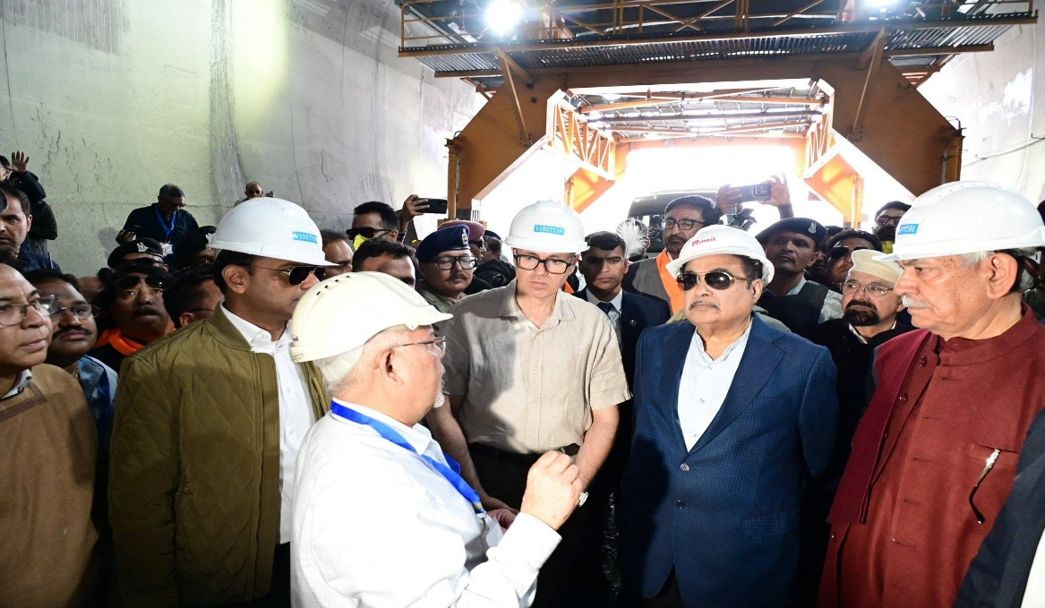
Minamarg (Kargil): Union Minister for Road Transport and Highways Nitin Gadkari on Tuesday witnessed the historic breakthrough of the Zojila Tunnel, marking a major milestone in one of India’s most ambitious mountain infrastructure projects and bringing all-weather connectivity between Kashmir and Ladakh significantly closer to reality.
The breakthrough of the main tunnel at the eastern portal near Minamarg in Kargil district marks the successful meeting of tunnel excavation works advancing from opposite ends, a critical stage in tunnel construction. The project is expected to provide uninterrupted connectivity between Sonamarg in Kashmir and Minamarg in Ladakh, a route that remains cut off for nearly six months every year due to heavy snowfall and extreme winter conditions.
Addressing the gathering after the breakthrough, Gadkari described the project as a lifeline for Ladakh and a landmark achievement in India’s infrastructure development journey.
“This tunnel is situated at almost 3,000 metres above sea level. Workers, engineers, contractors and the NHIDCL team have worked in temperatures touching minus four degrees Celsius and below. Nearly 80 per cent of the workforce belongs to this region. It has been built with world-class safety standards,” Gadkari said.
“For almost six months every year, connectivity remains disrupted. With this tunnel, Srinagar, Ganderbal, Sonamarg, Drass, Kargil and Ladakh will receive a major connectivity boost,” he added.
Constructed on the Sonamarg-Kargil section of National Highway-1, the nearly 14-km-long bi-directional tunnel is being developed by the National Highways & Infrastructure Development Corporation Limited (NHIDCL) under the Ministry of Road Transport and Highways at an estimated cost of around ₹6,800 crore.
The tunnel forms part of a larger 33-km project that also includes approach roads linking the Z-Morh Tunnel with the Zojila Tunnel. Built at altitudes ranging between 2,900 metres and 3,310 metres above sea level, the project is considered among the most challenging road infrastructure works undertaken in the country.
Officials said the tunnel is targeted for completion by February 2028.
Once operational, it will reduce travel time on the 38-km Sonamarg-Minamarg stretch from nearly 90 minutes to about 45 minutes while ensuring safe and reliable travel throughout the year. It will also substantially reduce disruptions caused by avalanches, landslides and heavy snowfall.
The project has progressed despite harsh weather conditions, difficult terrain and complex geological challenges. Engineers and workers continued excavation through severe winters, making the breakthrough one of the most significant achievements in Himalayan infrastructure construction.
The tunnel will be equipped with modern safety features including advanced ventilation systems, automatic fire detection mechanisms, CCTV surveillance, emergency communication facilities and pedestrian cross-passages. Avalanche protection structures, snow galleries, catch dams, bridges, culverts and extensive approach roads are also part of the project.
Gadkari said the tunnel would play a transformative role in improving tourism, trade and economic activity across the region while strengthening strategic connectivity to border areas.
From a defence perspective, year-round road connectivity is expected to facilitate faster movement of troops, equipment and essential supplies to Ladakh, which remains strategically important because of its proximity to sensitive border regions.
Highlighting the Centre’s broader infrastructure push, Gadkari said highway projects worth nearly ₹1.35 lakh crore — including completed, ongoing and proposed works — are currently underway across Jammu and Kashmir.
He said four major highway corridors are under development, including the Jammu-Udhampur-Srinagar corridor, Jammu-Chenani-Anantnag corridor, Srinagar-Baramulla-Uri corridor and Jammu-Akhnoor-Poonch corridor.
The Minister also highlighted strategic projects such as the Katra-Srinagar High-Speed Corridor, the Rafiabad-Kupwara-Chowkibal-Tangdhar road project and the Srinagar-Sonamarg-Gumri corridor.
Several tunnel projects are either under construction or in advanced planning stages, including the Digdol-Khooni Nala Tunnel, Sungal Tunnel and Bhimber Gali Tunnel. Proposed projects include the Singhpora-Vailoo (Sinthan Pass) Tunnel, Sudhmahadev Tunnel, Sadhna Pass Tunnel and Peer Ki Gali Tunnel.
According to officials, tunnel infrastructure has emerged as a key component of India’s strategy to ensure all-weather connectivity in mountainous regions. Between Jammu and Srinagar alone, 25 road tunnels have been approved, of which 20 have already been completed.
Across the country, 54 tunnels worth around ₹20,000 crore have been completed during the last 11 years, while work is underway on 128 tunnels involving investments exceeding ₹1.12 lakh crore.
For Ladakh, however, Tuesday’s breakthrough represents more than an engineering achievement. It marks a decisive step towards ending decades of winter isolation and creating a reliable, year-round road link through one of the most challenging mountain corridors in the Himalayas.