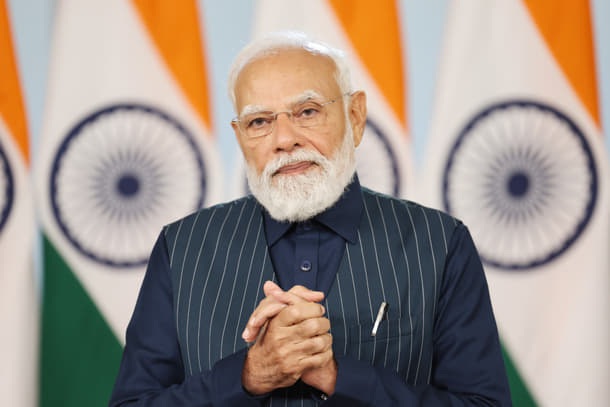
New Delhi, May 31 (UNI) Prime Minister Narendra Modi on Sunday used the 134th edition of his monthly radio programme Mann Ki Baat to showcase India’s growing sporting achievements, celebrate the preservation of its cultural heritage, promote scientific curiosity among youth, and highlight inspiring examples of citizens contributing to nation-building through grassroots initiatives.
Beginning the programme with a focus on India’s rising stature in athletics, the Prime Minister lauded athletes who created new national records at the National Senior Athletics Federation Competition held in Ranchi, Jharkhand.
The event, which featured nearly 800 participants from across the country, witnessed four national records being broken.
Modi paid special tribute to sprinters Gurindervir Singh and Animesh Kujur, whose performances in the men’s 100-metre race attracted national attention after the national record was shattered three times in just two days. During an interaction with the athletes, the Prime Minister described their rivalry as a “jugalbandi” that had pushed both competitors to achieve new heights.
“You both have achieved something remarkable. Together, you have created history,” Modi said, noting that healthy competition and mutual encouragement had become the driving force behind their success.
Gurindervir Singh, an officer in the Indian Navy and currently India’s fastest sprinter, recalled his journey from a middle-class family to becoming the first Indian to run the 100 metres in under 10.1 seconds. He said he was inspired by his father, a former volleyball player, to pursue sprinting despite widespread perceptions that Indians could not excel in the discipline.
“People used to tell me that the 100 metres was not an event for Indians. But my father and I decided we would prove them wrong,” Singh said.
Animesh Kujur, who hails from Chhattisgarh and now represents Odisha, spoke about his transition from football to athletics and his rise to international competition. He said recent performances had challenged long-standing assumptions about Indian sprinting.
“People often said Indians could not run below 10 seconds or even 10.1 seconds. But now we have shown that Indians can do it,” Kujur remarked.
Commending their camaraderie, Modi said the athletes exemplified the true spirit of sportsmanship by motivating one another while striving for excellence. “You challenge each other, help each other and move forward together. This is the true spirit of sportsmanship,” he said.
With several regions of the country experiencing severe heatwave conditions, the Prime Minister urged citizens to take precautions and prioritise their well-being. He advised people to remain hydrated, minimise exposure to the sun and follow official health advisories.
Highlighting India’s traditional wisdom in dealing with extreme summer temperatures, Modi spoke about a range of regional beverages including aam panna, lassi, chaas, sattu sherbet, kokum drinks, sol kadhi, panakam, neer mor and bel pana. He said these traditional refreshments reflected India’s rich cultural heritage and close connection with local agriculture.
The Prime Minister also celebrated the country’s love for mangoes, describing varieties such as Alphonso, Kesar, Dasheri, Langra, Chausa, Himsagar and Banganapalli as symbols of India’s diversity. He praised mango growers and noted that Indian mangoes were increasingly finding markets around the world.
Turning to cultural heritage, Modi recalled his recent visit to the Netherlands, where ancient Chola-era copper plates were formally returned to India. He described the occasion as a matter of immense national pride and said the artefacts offered valuable insights into the reign of Rajendra Chola I, the maritime achievements of the Chola Empire and its historical links with Southeast Asia.
“The rich history and culture of the Chola Empire are a matter of pride for every Indian,” he said.
The Prime Minister also referred to the discovery of rare copper plate inscriptions in Chhattisgarh under the Gyan Bharatam initiative, saying such findings help enrich understanding of India’s ancient governance systems, culture and religious traditions.
Encouraging young people to develop an interest in science, Modi highlighted the growing popularity of astronomy clubs across the country. Referring to initiatives in Bengaluru, Kerala, Rajkot and other regions, he said students were increasingly engaging in observation camps, telescope-building workshops and stargazing programmes.
“Night-time observation of the sky is an extraordinary experience,” he said, urging students to visit planetariums and participate in astronomy-related activities during their vacations.
Among the inspiring stories featured in the programme was the rescue of an endangered Gangetic dolphin in Uttar Pradesh. Modi praised the efforts of India’s first Ganga Dolphin Rescue Ambulance, which successfully saved the animal after a challenging operation that lasted nearly 13 hours.
“When we save a Ganga dolphin, we are not merely saving a species. We are protecting the biodiversity of the river and preserving a precious natural heritage for future generations,” he said.
The Prime Minister also highlighted the work of individuals making meaningful contributions to society at the grassroots level. He spoke about Saji Valasseril of Kerala, whose swimming initiative in Aluva has trained more than 15,000 people, including children with disabilities. The programme was inspired by a tragic boat accident that claimed the lives of several students.
“Service does not require vast resources. What is needed is a noble intention and sustained effort,” Modi observed.
He also praised Akash Gupta of Uttar Pradesh’s Basti district for spearheading efforts to clean the polluted Manorama River and raise awareness about environmental conservation. From Goa, he highlighted the work of retired teacher Balakrishna Aiya, who helped improve access to water through community participation and local initiatives.
Another story that drew attention was that of educationist Girija Amma from Tamil Nadu, who inspired students in her network of schools to contribute to the welfare of India’s armed forces. Motivated by a message of service conveyed through Mann Ki Baat, students donated one rupee each day and collectively raised nearly Rs 40 lakh for soldiers.
Modi said the initiative demonstrated how small acts of patriotism and collective participation could instil a strong spirit of national service among young people.
Wrapping up the programme, the Prime Minister said countless inspiring stories emerge daily from villages, towns and cities across the country, often without attracting public attention. He urged citizens to recognise and support such efforts, describing them as powerful examples of people-led development.
“Many of these initiatives may not receive widespread publicity, but they strengthen our faith that the nation is progressing through the power of its people. Learn from such individuals, appreciate them and, if possible, become part of some positive effort yourself,” he said. UNI