Blames PDP-era policy for spread of vends
Says “Ban feasible only with Central support”
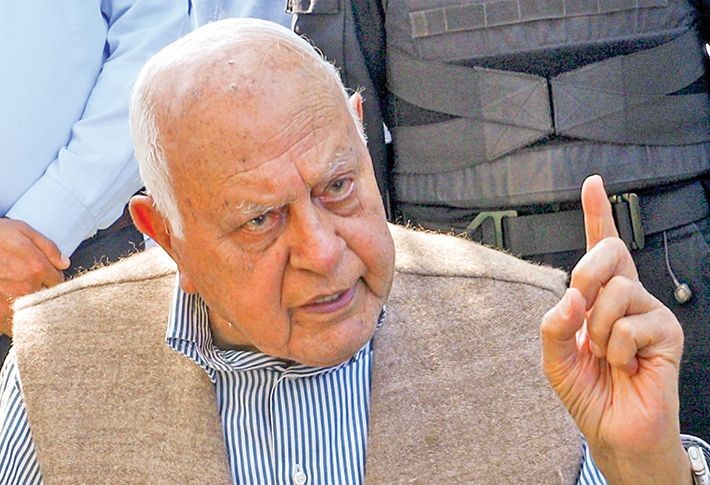
Srinagar : Amid a political slugfest over the demand for a liquor ban in Jammu and Kashmir, National Conference president Farooq Abdullah on Tuesday said prohibiting alcohol would not end its consumption, asserting that habitual drinkers would continue to source it from outside the Union Territory.
Speaking at the party’s Nawah-e-Subah headquarters in Srinagar, Abdullah said the region could be declared “dry” only if the Centre compensates for the loss of excise revenue.
“I don’t drink alcohol, but those who do will not give it up. If it is not available here, they will bring it from outside. What will we do?” he asked, questioning those advocating prohibition.
The remarks come amid renewed calls for a ban by the Peoples Democratic Party (PDP), which has accused the government led by Chief Minister Omar Abdullah of failing to curb liquor consumption. Hitting back, Abdullah blamed the previous PDP-BJP regime for expanding liquor vends into rural areas.
A day earlier, the National Conference had cited the 2017 excise policy framed under the PDP-BJP government, which allowed opening of outlets in previously “unserved” areas.
“We have not opened any new liquor shops since assuming office in 2024. Why was there no protest when outlets were being opened in villages?” he said, accusing rivals of indulging in “politically motivated criticism”.
He also invoked a 1977 exchange between former Prime Minister Morarji Desai and his father, former J&K Chief Minister Sheikh Mohammad Abdullah, to underline the revenue dilemma surrounding prohibition.
“My father told him that while he did not drink, the state depended on that revenue. If the Centre compensates for it even today, the ban can be implemented immediately,” Abdullah said.
The debate follows recent remarks by Chief Minister Omar Abdullah that liquor shops cater to those whose religion permits consumption and that no one is being forced to buy alcohol.
Separately, Abdullah flagged concerns over the economic situation, referring to Prime Minister Narendra Modi’s call for austerity amid global uncertainties. Warning of a potential fuel and gas crisis, he said any cost-cutting measures should not come at the expense of education.
“We cannot compromise on schooling. Poor families cannot afford online education. A balance has to be found,” he said.