“Clean Balance Sheet, Record Profits: Bank’s Comeback Turns Into Dominance”
Mohammad Irfan
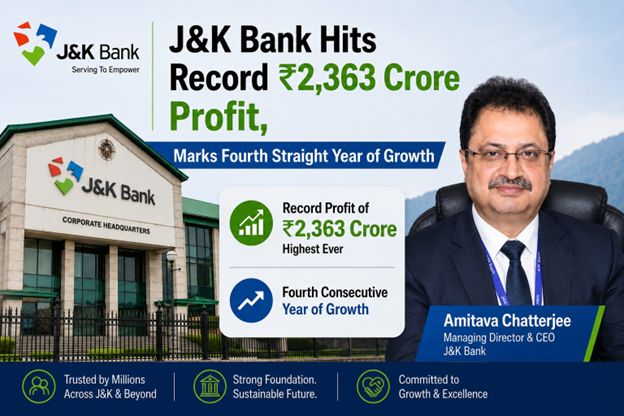
Srinagar: In a strong demonstration of financial resilience and strategic execution, Jammu & Kashmir Bank has reported its highest-ever annual profit of ₹2,363 crore for FY2025–26, marking the fourth consecutive year of record earnings. This milestone is not merely a reflection of improved profitability but a clear indicator of the bank’s structural transformation over recent years. Operating in a challenging macroeconomic environment—characterised by declining interest rates, rising competition for deposits, and regional economic pressures—the bank has managed to deliver consistent growth while strengthening its financial fundamentals. The significance of this achievement lies in its consistency. Sustaining record profitability over four consecutive years suggests that the bank’s performance is not cyclical but rooted in long-term strategic improvements. It reflects a shift from recovery mode to growth mode, underpinned by disciplined financial management and a focus on core banking strengths.
Strong Quarterly Momentum: The bank’s performance in the March quarter further reinforced its upward trajectory, with net profit nearing ₹800 crore compared to ₹584 crore in the same period last year. This sharp rise highlights the momentum built during the year and indicates strong operational efficiency across key segments. Importantly, this growth came despite the bank absorbing a one-time impairment provision related to its investment in J&K Grameen Bank. The ability to deliver strong quarterly results even after such adjustments underscores the robustness of its core income streams and operational resilience. Managing Director and CEO Amitava Chatterjee attributed this performance to “resilience and disciplined execution,” emphasising that the bank has been able to navigate headwinds without compromising on growth or stability.
Asset Quality|A Clear Turnaround Story: One of the most encouraging aspects of the bank’s performance is the sharp improvement in asset quality. The gross non-performing asset (GNPA) ratio declined significantly to 2.5%, reflecting a steady clean-up of the loan book. Net NPAs also reduced to low levels, indicating effective recovery mechanisms and prudent credit appraisal processes. The provision coverage ratio (PCR), which remains above 90%, further highlights the bank’s conservative approach to risk management. High provisioning not only safeguards the balance sheet against potential losses but also builds investor confidence in the bank’s financial health. This consistent improvement in asset quality marks a decisive turnaround from earlier years when asset stress was a key concern. It demonstrates that the bank has successfully embedded discipline in its lending practices and strengthened its risk management framework.
Operational Efficiency, Profitability Metrics: Alongside asset quality, operational efficiency has emerged as another pillar of the bank’s growth story. The cost-to-income ratio has declined for the fourth consecutive year, indicating better control over operating expenses and improved productivity. Profitability indicators also reflect this positive trend. The return on assets (RoA) and return on equity (RoE) have both strengthened, signalling higher earnings efficiency and better utilisation of capital. These metrics are crucial for assessing the bank’s ability to generate sustainable returns for stakeholders. While net interest income growth remained moderate due to lower policy rates, the bank managed to maintain stable net interest margins. This highlights its ability to effectively manage interest rate cycles and protect profitability even in a declining rate environment.
Business Growth Driven By Advances: J&K Bank’s overall business growth remained strong, with total business reaching ₹2.90 lakh crore. A key driver of this growth was the sharp increase in advances, which rose by 18% year-on-year. This indicates a proactive approach towards credit expansion and a growing appetite for lending across sectors. Deposit growth, while relatively moderate at around 11%, remained stable and was supported by a healthy CASA base. The improvement in CASA ratio provides the bank with a low-cost and stable funding source, which is critical for maintaining margins in a competitive environment. The faster growth in advances compared to deposits suggests a strategic push towards expanding the loan book, while maintaining a balanced approach to liquidity and funding.
Navigating Interest Rate Pressures: The operating environment during the fiscal year was marked by a reduction in policy rates by the Reserve Bank of India, which impacted lending yields across the banking sector. Additionally, intense competition for deposits led to increased funding costs, creating pressure on margins. Despite these challenges, J&K Bank managed to maintain stable profitability, reflecting effective asset-liability management. The bank’s ability to navigate these pressures without significant impact on its earnings highlights its operational strength and strategic flexibility.
Capital Strength, Future Preparedness: The bank’s capital adequacy ratio stood at over 16.5%, well above regulatory requirements, providing a strong cushion for future growth. This robust capital position allows the bank to expand its lending activities while maintaining financial stability. At the same time, the management has indicated that it may explore raising additional capital in the future, particularly in view of upcoming regulatory changes such as the expected credit loss (ECL) framework. This proactive approach reflects a forward-looking strategy aimed at strengthening the bank’s resilience against future risks.
Strategic Focus On Inclusive Growth: Looking ahead, J&K Bank plans to focus on key growth areas such as retail lending, MSME financing, and agriculture credit. These segments not only offer strong growth potential but also align with the bank’s role in supporting economic development and financial inclusion. The bank also aims to expand beyond its traditional markets while deepening its presence in Jammu & Kashmir and Ladakh. This dual strategy of consolidation and expansion is expected to enhance its market position and diversify its revenue streams.
Commitment To Social Responsibility: Beyond financial performance, the bank has also demonstrated a strong commitment to social responsibility. Its corporate social responsibility (CSR) initiatives, with spending approaching ₹100 crore over the past three years, have focused on key areas such as healthcare, education, environmental sustainability, and community development. These efforts reflect the bank’s broader vision of contributing to sustainable development and creating a positive social impact. In a region like Jammu & Kashmir, such initiatives play a crucial role in supporting community welfare and inclusive growth.
Conclusion| A Bank On Strong Footing: J&K Bank’s record profit for FY2025–26 is more than just a financial milestone—it is a reflection of a deeper transformation. The combination of improved asset quality, strong capital buffers, operational efficiency, and steady business growth indicates that the bank has built a solid foundation for the future. With a clear strategic direction and a focus on disciplined execution, the bank is well-positioned to navigate challenges and capitalise on emerging opportunities. As it enters the next financial year, J&K Bank stands as a resilient and forward-looking institution, ready to accelerate its growth journey while continuing to support the economic development of the region. In an increasingly competitive banking landscape, its performance sends a strong message—consistent strategy, prudent risk management, and operational discipline can deliver sustainable success even in challenging times.