Urges end to political violence, calls for peace in Bengal
BJP secures historic victory, reshapes state’s political landscape
NDA retains Assam, returns to power in Puducherry
Women voters play key role in BJP’s electoral surge
New Delhi: In a landmark political moment, the Bharatiya Janata Party (BJP) secured a sweeping victory in the West Bengal Assembly elections for the first time, marking a dramatic shift in the state’s political landscape.
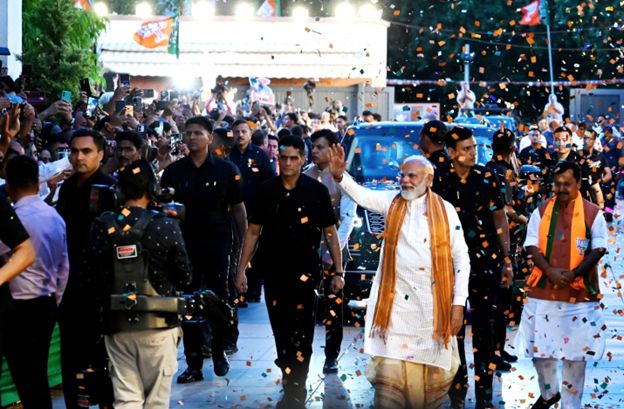
Addressing jubilant party workers at the BJP headquarters in the national capital on Monday evening, Prime Minister Narendra Modi struck a conciliatory tone, calling for “change, not revenge” and urging all political stakeholders in the state to move beyond a legacy of violence and fear.
West Bengal
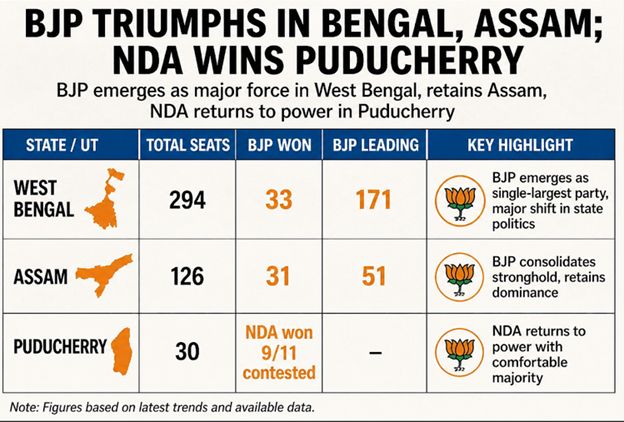
BJP scripts history by emerging as the dominant force, crossing the halfway mark in leads and wins. The result marks a major shift from years of TMC dominance, with several high-margin victories reflecting strong voter support.
Assam
BJP-led NDA retains power for the third consecutive term with a massive mandate. The alliance secures over 100 seats, reinforcing its stronghold and endorsing its governance model in the state.
Puducherry
NDA returns to power with a comfortable majority, winning 9 out of 11 contested seats. The victory strengthens BJP’s footprint in southern India through alliance politics.
In a nearly 50-minute address delivered amid loud cheers and celebrations, Modi described the outcome as not just an electoral win, but a turning point for West Bengal and Indian democracy. He emphasized that the verdict reflected the people’s aspiration for a new political culture—one rooted in peace, development, and accountability.
“Today, when BJP has won, there should be talk of change, not revenge; of the future, not fear,” PM Modi said, appealing to political parties in the state to abandon the cycle of violence that has historically marred elections in Bengal. He noted that, unlike previous polls, this election cycle witnessed peaceful voting with no reported loss of life, calling it a significant achievement for democracy.
The BJP’s performance in West Bengal signals a major political realignment, as the party has managed to penetrate a state long dominated by regional forces. Modi said the results demonstrated “trust in democracy, trust in performance-based politics, and trust in stability,” adding that the people had chosen governance over fear.
He also linked the party’s success to broader national sentiments, stating that the victory represented the spirit of “Ek Bharat, Shreshtha Bharat.” Referring to the geographical spread of BJP’s influence, Modi used the symbolic imagery of the Ganga river, saying the “lotus has bloomed from Gangotri to Ganga Sagar,” indicating BJP’s growing dominance across states along the river’s course.
While the Bengal victory remained the centerpiece of his speech, Modi also highlighted the party’s strong performance in Assam and Puducherry. In Assam, the BJP-led National Democratic Alliance (NDA) returned to power for a third consecutive term with a commanding majority, securing over 100 seats in the 126-member Assembly. The result reaffirmed the party’s stronghold in the northeastern state under Chief Minister HimantaBiswaSarma.
Describing the Assam verdict as a reflection of sustained public trust, Modi said the people had endorsed the NDA’s development-oriented governance model. The scale of the victory—amounting to a three-fourths majority—underscored the consolidation of BJP’s political base in the region.
In Puducherry, the NDA also retained power, further extending BJP’s footprint in southern India. Modi said the alliance’s return to office was a testament to the credibility of its vision for development and inclusive governance. He assured the youth and key sectors, including fishermen, that the government would continue to prioritize their welfare and economic growth.
The Prime Minister’s address also touched upon broader political narratives, including the role of women voters in shaping electoral outcomes. He noted that women’s participation in the elections had been exceptionally high, calling it one of the most encouraging aspects of Indian democracy. According to him, this growing political engagement of women is a decisive force in shaping the country’s future.
Modi took aim at opposition parties, alleging that they had faced electoral setbacks due to their opposition to the women’s reservation bill. He argued that women voters had “punished” parties that attempted to block measures aimed at empowering them, suggesting that this trend would continue in future elections.
Despite the sharp political messaging, the Prime Minister repeatedly returned to the theme of reconciliation in Bengal. He stressed that the electoral victory should not lead to political vendetta, but instead serve as an opportunity to rebuild trust and foster inclusive governance.
“As Bengal enters a new phase, it is essential that political parties rise above past rivalries and work together for the state’s development,” he said, adding that the mandate should be seen as a call for transformation rather than confrontation.
The speech also carried symbolic undertones, as Modi referenced Syama Prasad Mookerjee, the founder of the Bharatiya Jana Sangh, BJP’s ideological predecessor. He said the Bengal victory would bring peace to Mookerjee’s soul, given his deep connection to the state and his vision for national integration.
The Prime Minister further lauded the role of election authorities, security personnel, and polling staff in ensuring the smooth conduct of elections across multiple states. He said their efforts had upheld the dignity of India’s democratic institutions and processes.
The results from West Bengal, Assam, and Puducherry collectively underscore BJP’s expanding political footprint across diverse regions. In Bengal, the party’s emergence as the dominant force marks a significant challenge to entrenched regional politics. In Assam, the consolidation of power reflects continuity and voter confidence, while in Puducherry, the victory highlights the effectiveness of alliance politics.
Political analysts view these outcomes as indicative of a broader shift in voter behavior, with increasing emphasis on governance, stability, and national leadership. The BJP’s ability to secure mandates across geographically and culturally distinct regions suggests a widening appeal that transcends traditional political boundaries.
However, the call for “change, not revenge” also underscores the challenges ahead, particularly in West Bengal, where political polarization has historically been intense. Ensuring a peaceful transition and fostering cooperative governance will be critical in translating electoral success into long-term stability.
As celebrations continue within party ranks, the focus now shifts to governance and implementation. The scale of the mandate, particularly in Bengal and Assam, brings with it heightened expectations from the electorate. Issues such as economic development, employment, infrastructure, and social harmony are likely to dominate the political agenda in the coming months.
For the BJP, the victories mark not just an electoral triumph but a strategic milestone in its national expansion. For the opposition, the results signal the need for introspection and recalibration.
In his concluding remarks, Modi congratulated party workers across the country, crediting them for the “historic victory” and their relentless efforts at the grassroots level. He said their dedication had once again ensured that the “lotus blooms,” creating what he described as a new chapter in India’s political journey.