
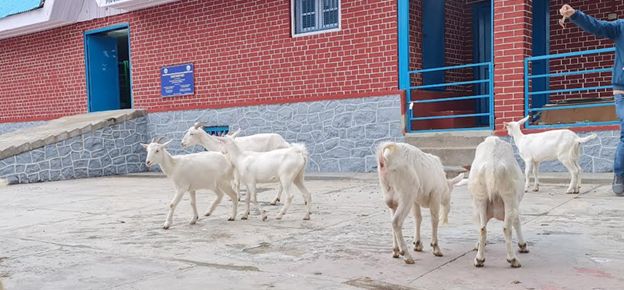
24 imported Saanen goats under study; focus on yield, breeding, and adaptability
Irfan Yattoo
Srinagar: Sher-e-Kashmir University of Agricultural Sciences and Technology-Kashmir (SKUAST-K) has introduced high-yielding Saanen goats, often referred to as the “Milk Queen”, at its Mountain Research Centre for Sheep and Goat (MRCS&G) in Shuhama as part of an initiative to enhance milk production and promote small-scale dairy units in the Valley.
Dr Parvaiz Ahmad Reshi, Senior Scientist & Head of MRCS&G, told Kashmir Horizon that for the first time, they have introduced ‘Milk Queen’ in Kashmir.
“We have procured 24 Saanen goats, including 20 females and 4 males, from Switzerland. They were initially quarantined in Pune before being transported to Kashmir. We will study their performance to assess how well they adapt to the region’s climatic conditions and environment,” he said.
Dr Reshi said the project aims to popularise an “urban goat” model, positioning goats as a viable alternative to cattle rearing in cities, given their lower maintenance requirements and efficient milk yield.
“Unlike cows, which can weigh up to 500–600 kg and require substantial feed and space, these goats weigh around 50–60 kg and can produce an average of 3–4 litres of milk daily, with potential yields of up to 7 litres under optimal conditions,” he said.
Dr Reshi said the objective is to develop a complete package of practices and take it to the field. These goats are easier to manage, require less feed, and are suitable for urban households.
“The animals are currently being studied for feeding patterns, disease resistance, reproductive cycles, and overall adaptability to local climatic conditions,” he added.
According to Dr Reshi, each goat consumes about 1–2 kg of dry fodder along with 500–600 grams of customised feed daily, making the model more economical for households.
“Younger animals have been introduced in the initial phase to assess breeding cycles, birth weight of offspring, and milk utilisation patterns,” he added.
Meanwhile, the initiative also focuses on improving local goat breeds through scientific cross-breeding to enhance both milk yield and growth potential.
“We are looking at upgrading local breeds so that their productivity improves while retaining their adaptability to Kashmir’s conditions,” he said.
Apart from quantity, the quality of milk is also being highlighted. Dr Reshi Saanen goats produce A2-type milk, which is considered easier to digest and suitable for children, elderly people, and patients.
“Goat milk has medicinal value, is non-allergenic and does not have the strong odour often associated with it,” he added.
Describing the breed as docile and suitable for confined rearing, officials said it can be raised in small enclosures, including cage systems, making it ideal for urban settings.
“This is a low-investment, manageable model that can ensure regular milk supply for families,” he said.
Dr Reshi further said that the university is also positioning the initiative as a livelihood opportunity for youth.
“Dairy goat farming remains largely untapped in Kashmir. With proper training and guidance, young entrepreneurs can establish units and generate income,” he said, adding that SKUAST-K plans to offer training programmes and technical support to interested farmers.
Dr Reshi said that the move is expected to open up new avenues in urban dairy farming while reducing dependence on external milk supply and strengthening local production systems.