- A New Grid Order: Subsidies for the Poor, Solar for the Rest
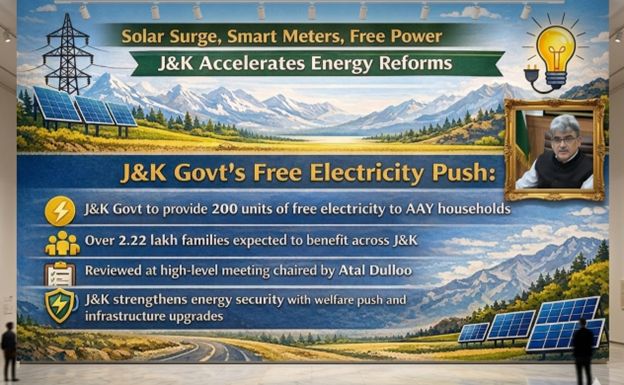
Srinagar: In a significant policy push combining welfare with long-term reform, the Government of Jammu and Kashmir has initiated the identification of beneficiaries under the Antyodaya Anna Yojana (AAY) category for providing 200 units of free electricity. The move is aimed at extending targeted relief to economically weaker households while simultaneously accelerating structural changes in the power sector. The initiative, which is expected to benefit over 2.22 lakh households across the Union Territory, was reviewed at a high-level meeting chaired by Atal Dulloo. The review highlighted a broader strategy that blends immediate financial support with systemic improvements in electricity distribution, efficiency, and sustainability.
Targeted Welfare|Free Electricity For The Most Vulnerable:bThe rollout of free electricity for AAY households represents a focused attempt to ease the financial burden on the poorest segments of society. With rising living costs and energy needs, access to affordable electricity has become central to improving quality of life, particularly in rural and remote areas. Officials indicated that the identification process is being carried out in coordination with district administrations, with special attention to ensuring near-universal coverage across districts. Many of the targeted beneficiaries reside in far-flung and mountainous regions, making the exercise both critical and challenging. The Government has emphasized that only genuine beneficiaries will be included. Extensive field verification and data validation exercises are underway to ensure accuracy. Authorities are working to resolve discrepancies between ration card records and electricity consumer databases, as well as addressing issues such as migration, locked households, and reluctance among some eligible families. The focus on inclusion, particularly in remote areas with scattered habitations and difficult terrain, underscores the administration’s effort to ensure that the benefits reach those who need them the most.
Administrative Challenges, Ground-Level Realities: While the policy intent is clear, the implementation process has revealed several operational challenges. One of the key issues has been aligning data across multiple databases, including food distribution and power consumption records. In addition, logistical constraints in mountainous regions, where electricity networks are spread over long distances, complicate both verification and service delivery. Field teams are required to physically access remote households, often in areas with limited connectivity. Despite these challenges, officials remain confident that the coordinated approach involving district administrations will ensure timely completion of the identification process. The emphasis remains on transparency, accuracy, and inclusiveness.
Solar Push Gains Momentum Across The UT: Parallel to the welfare initiative, Jammu and Kashmir has recorded significant progress under the rooftop solar programme being implemented through the PM Surya Ghar: Muft Bijli Yojana. The scheme is designed to promote clean energy adoption while reducing dependence on conventional power sources. It offers consumer-friendly financing options, including access to bank loans at competitive interest rates, making solar installations more accessible to households. In Jammu Division, more than 28,600 applications have been received, with over 11,000 installations completed. In Kashmir Division, the response has been even stronger, with over 73,000 applications and more than 17,700 installations completed, with several districts exceeding their targets. The growing adoption of rooftop solar reflects increasing public awareness and acceptance of renewable energy solutions. It also indicates a shift toward decentralized power generation, which can help reduce transmission losses and improve reliability.
RESCO Model | Expanding Access Without Upfront Costs: A notable feature of the solar programme is its implementation under the Renewable Energy Service Company (RESCO) model. Under this arrangement, private developers undertake the installation and maintenance of solar systems, eliminating the need for upfront investment by consumers. This model has significantly lowered entry barriers, particularly for middle- and low-income households, and has played a key role in accelerating adoption. By shifting the financial burden away from consumers, the RESCO model ensures that the benefits of solar energy are more widely distributed. The approach also aligns with broader policy goals of promoting public-private partnerships and leveraging private sector efficiency in delivering public services.
RDSS| Strengthening The Backbone Of Power Distribution: The meeting also reviewed progress under the Revamped Distribution Sector Scheme (RDSS), a flagship initiative aimed at modernizing power distribution infrastructure and improving operational efficiency. Under RDSS, projects worth ₹5,762 crore are being executed across the Union Territory. These include ₹1,053 crore allocated for smart metering and ₹4,709 crore for measures aimed at reducing technical and commercial losses. Smart metering has emerged as a key component of the reform agenda. Over 7.10 lakh smart meters have been installed so far, including nearly 3 lakh in the past six months. These meters enable real-time monitoring of consumption, improve billing accuracy, and enhance transparency.
Other interventions under RDSS include feeder segregation, infrastructure upgrades, and energy accounting systems. Together, these measures are aimed at creating a more efficient and reliable power distribution network.
Improving Efficiency, Reducing Losses: The reforms under RDSS have already begun to yield measurable results. Officials reported a reduction in the gap between Average Cost of Supply (ACS) and Average Revenue Realised (ARR) to 0.3 by the financial year 2025-26. Billing efficiency has improved to 77 percent, while collection efficiency has reached 94 percent. Aggregate Technical and Commercial (AT&C) losses have been reduced to 30 percent, indicating progress in curbing leakages and improving revenue realization. These improvements are critical for the financial sustainability of the power sector. Reducing losses and enhancing efficiency not only strengthens the sector’s viability but also creates room for further investments in infrastructure and services.
Integrated Approach| Welfare Meets Reform: The government’s strategy reflects an integrated approach that combines short-term relief with long-term structural changes. The provision of free electricity addresses immediate concerns of affordability, while investments in solar energy and infrastructure upgrades aim to ensure sustainability and reliability. Chief Secretary Atal Dulloo emphasized that this dual approach is essential for achieving balanced development. By aligning welfare measures with systemic reforms, the administration aims to create a resilient and inclusive energy ecosystem. This approach also recognizes that addressing energy challenges requires both demand-side and supply-side interventions. While subsidies provide relief, efficiency and innovation are necessary for long-term stability.
Implications for Inclusive Growth, Energy Security: The combined impact of these initiatives is expected to extend beyond the power sector. Access to reliable and affordable electricity is closely linked to economic development, education, healthcare, and overall quality of life. For rural and remote areas, improved electricity access can enable better connectivity, support small businesses, and enhance access to essential services. The adoption of solar energy further contributes to environmental sustainability and reduces dependence on fossil fuels. At a broader level, these measures are aligned with national goals of energy security, climate action, and inclusive growth. By focusing on both equity and efficiency, the government is attempting to address multiple objectives simultaneously.
A Transformative Phase For J&K’s Power Sector: The ongoing initiatives in Jammu and Kashmir mark a transformative phase for the region’s power sector. The identification of AAY beneficiaries for free electricity, combined with progress in solar adoption and infrastructure reforms, reflects a comprehensive and forward-looking policy framework. While challenges remain in implementation, the emphasis on coordination, transparency, and inclusiveness provides a strong foundation for success. If executed effectively, these measures have the potential to significantly improve power reliability, reduce financial stress on vulnerable households, and accelerate the transition to clean energy. As the Union Territory moves forward with this integrated strategy, the focus will remain on ensuring that the benefits reach every household while building a sustainable and efficient energy system for the future.