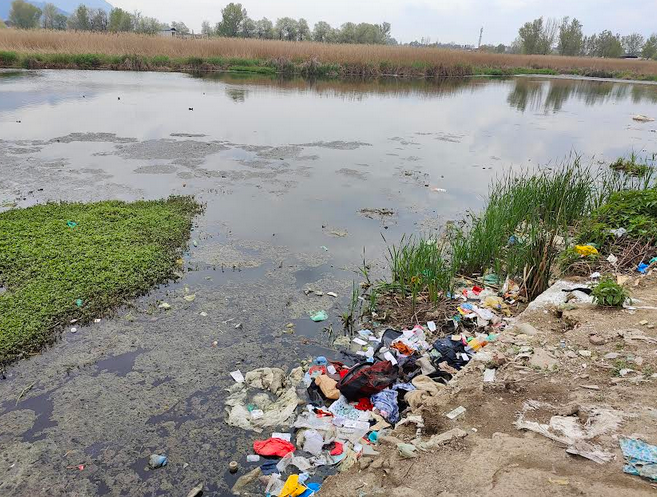
Srinagar : Once a source of life and pride for Srinagar’s residents, Brari Nambal today stands as a dying reminder of environmental neglect, with polluted waters, unbearable stench, and unchecked waste slowly erasing its identity.
Tucked behind the densely populated locality of Bab Demb, the lagoon, historically connected to Dal Lake, has witnessed a dramatic transformation over the decades. What was once a clean, flowing freshwater body has now turned into a stagnant pool filled with plastic waste and sewage from surrounding households.
Elderly residents remember a completely different Brari Nambal.
“There was a time when this water was so clean that we used to drink it without any hesitation,” said Mohd Shafi (74), a resident of Chinkari Mohalla, Bab Demb. “People would fish here, bathe here, and spend hours by its side. It was not just water, it was part of our daily life.”
That connection now lies broken.
Today, drainage outlets from nearby homes flow directly into the lake, contaminating the water and accelerating its decay. The situation worsens during summers, when rising temperatures intensify the already unbearable smell.
“In the heat, the smell becomes suffocating,” said Ghulam Qadir (64), a resident of Bab Demb. “You cannot stand here for long. It feels like the lake is crying for help, but no one is listening.”
Locals say the problem is not recent but the result of years of neglect, lack of proper waste management, and the disruption of the lake’s natural drainage system. With no clear outflow, the water has turned stagnant, leading to the growth of weeds and the disappearance of aquatic life.
For many, the transformation is difficult to accept.
“We grew up hearing that people once depended on this lake for their daily needs,” said Suhail Ahmad, a shopkeeper in the area. “Now it has become a dumping site. Plastic, sewage, everything ends up here. This is not how a place like this should be treated.”
Residents believe the condition of Brari Nambal reflects a larger environmental crisis.
“We are destroying what once sustained us,” Suhail added. “Then we talk about climate change, water shortages, and rising diseases. The truth is, we are responsible for it. We are ruining our future with our own hands.”
Despite the grim reality, there is a growing demand among locals for urgent intervention. Residents are calling for scientific cleaning, proper waste disposal systems, and restoration of the lake’s natural water flow to prevent further damage.
“This lake is part of our heritage,” said Mohd Shafi. “If it disappears, it will not come back. What we lose here is not just water, but a part of who we are.”
As Brari Nambal continues to shrink and suffer in silence, its condition serves as a stark warning of what happens when nature is ignored, and of what could be lost if action is not taken in time.