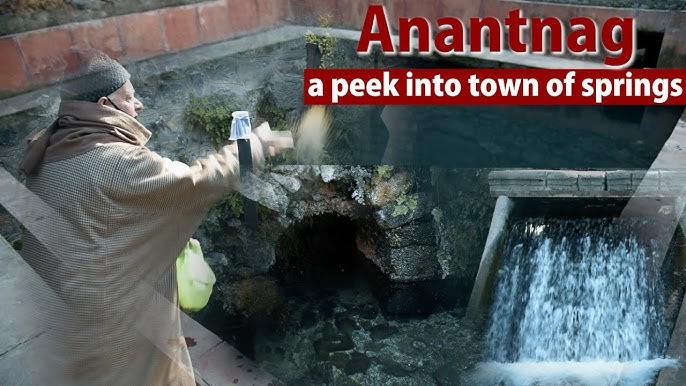
Anantnag : Anantnag, once celebrated as the “land of springs,” is facing a growing environmental crisis as many of its historic freshwater sources shrink, dry up or fall into neglect, raising concerns among residents about the district’s future water security and ecological balance.
The name Anantnag itself is derived from the Kashmiri words Anant (countless) and Nag (springs), reflecting a time when natural springs flowed abundantly across the region. For generations, these freshwater sources served as the primary supply of drinking water, supported agriculture and sustained aquatic life. Elderly residents recall that the springs once flowed with such force and clarity that people drank directly from them.
Today, many of these once-youthful springs have either weakened or completely dried up, turning what were once vibrant water sources into stagnant pools or dry beds.
The crisis became particularly evident last year when the historic Achabal Spring witnessed an unprecedented dry spell. The spring, known for its steady flow for centuries, saw a sharp decline in discharge, forcing many households in the area to seek alternative water sources.
“We had never seen the spring like that before,” said Bashir Ahmad, a resident of Achabal. “Even in the driest years, Achabal always had enough water. Last year was different.”
In Dooru, the situation has become even more alarming. The historic Shehlinag Spring dried up for the first time in living memory, leaving scores of fish dead and raising fears of long-term ecological damage. The sudden disappearance of water shocked residents who had depended on the spring for decades.
Locals blamed the recent drilling of a borewell nearby by the Public Health Engineering (PHE) Department, alleging that it disturbed the underground water channels feeding the spring. Officials, however, attributed the drying of the spring to a prolonged dry spell and pollution in the area.
“This spring had never dried before,” said a resident of Dooru. “After the borewell was drilled, the water started decreasing until nothing was left. Now even the fish are gone.”
Environmental stress has also become visible at Shairbagh Spring in the heart of Anantnag town, where the recent death of several fish alarmed residents. The spring, located near the historic Andernag area, has long supported indigenous fish species and served as an important ecological and cultural site.
Locals blamed the fish deaths on reduced water flow, pollution and lack of maintenance.
“The water level has gone down and the condition is getting worse,” said a shopkeeper near Shairbagh. “Earlier the fish survived easily here, but now even they cannot live in this water.”
Apart from major springs, several smaller springs across the district have already dried up or are on the verge of extinction. In areas such as Dialgam, Khanabal, Monghall and parts of Sherbagh, residents say springs that once supplied drinking water to entire neighborhoods have either turned seasonal or disappeared completely. Some have been reduced to muddy pits, while others have been filled with silt or affected by nearby construction.
Even prominent springs such as Kokernag Spring and Verinag Spring have shown fluctuations in discharge in recent years, according to locals, raising fears about the long-term sustainability of spring-fed water systems in the district.
Residents and environmental observers attribute the decline to a combination of factors, including prolonged dry spells, reduced snowfall and rising temperatures. These changing weather patterns have affected groundwater recharge, which is essential for sustaining springs.
Unplanned construction and human interference have further worsened the situation by disturbing natural recharge zones. Excavation, road construction and urban expansion have disrupted underground water channels that feed the springs.
Locals also blame official negligence, saying many springs remain clogged with waste and overgrown vegetation without any regular maintenance or conservation measures.
“There is no proper protection,” said a resident of Khanabal. “Some springs have turned into dumping sites. If nothing is done, the remaining ones will also disappear.”
Over the years, several government initiatives were announced to protect and revive springs, but residents say most of them failed to deliver results on the ground. Cleaning drives and minor beautification works were carried out at some locations, but no long-term conservation or recharge measures were implemented.
Under rural development and municipal programs, desilting and fencing of a few springs were proposed, while awareness campaigns were occasionally conducted. However, locals say these efforts remained temporary and lacked scientific planning.
“Officials come, take photos and leave,” said a local resident from Dialgam. “After that, no one returns to see whether the spring is alive or dead.”
The drying of springs has had a direct impact on daily life. Many families who once depended on spring water are now forced to rely on tap supplies or tanker water, especially during dry months. Farmers say reduced water availability has also made irrigation more difficult.
The ecological impact has also been significant. Reduced water flow has affected aquatic life and vegetation in spring-fed ecosystems, as seen in the fish deaths at Shairbagh and Shehlinag. Springs that once supported thriving biodiversity are now showing signs of ecological stress.
Beyond the environmental damage, residents say the disappearance of springs threatens the cultural identity of Anantnag itself.“These springs are the reason this place is called Anantnag,” said an elderly resident. “If the springs disappear, the identity of this town will disappear with them.”
Residents have urged authorities to take immediate steps to restore and protect the remaining springs, including scientific conservation, protection of recharge zones and regulation of activities near water sources. Without timely intervention, locals fear that more of Anantnag’s historic water sources could vanish — turning the once water-rich district into a region struggling for one of its most basic resources.