Aqzar raheel
Srinagar: In a development being described as a landmark in mountain infrastructure management, the 122 Road Construction Company (RCC) of the Border Roads Organisation has successfully maintained continuous vehicular movement across the strategic Zojila Pass during peak winter months a rare accomplishment for one of the most challenging high-altitude routes in the Himalayas. For decades, the pass has symbolised winter isolation, frequently shutting down under layers of heavy snowfall, avalanches, and extreme sub-zero temperatures. This season’s uninterrupted accessibility, however, marks a significant operational breakthrough and signals a shift in how high-altitude roads are maintained and managed in extreme climatic conditions.
Lifeline Corridor in the Himalayas: The pass forms a crucial segment of the Srinagar–Leh Highway, the only surface transport corridor linking the Union Territories of Jammu and Kashmir and Ladakh. The road serves as a vital artery for civilian travel, trade, tourism, emergency services, and supply distribution to remote and high-altitude regions. Each winter, the route faces closure as snow accumulation often rises several feet high, making travel impossible and forcing reliance on air transport for essential supplies. The ability to keep the road open during this period significantly reduces logistical strain and enhances regional accessibility. Officials said that maintaining the route this winter required sustained effort, advanced snow-clearance planning, and real-time monitoring of weather and terrain conditions. The success reflects not only manpower dedication but also improvements in equipment, coordination systems, and operational strategy.
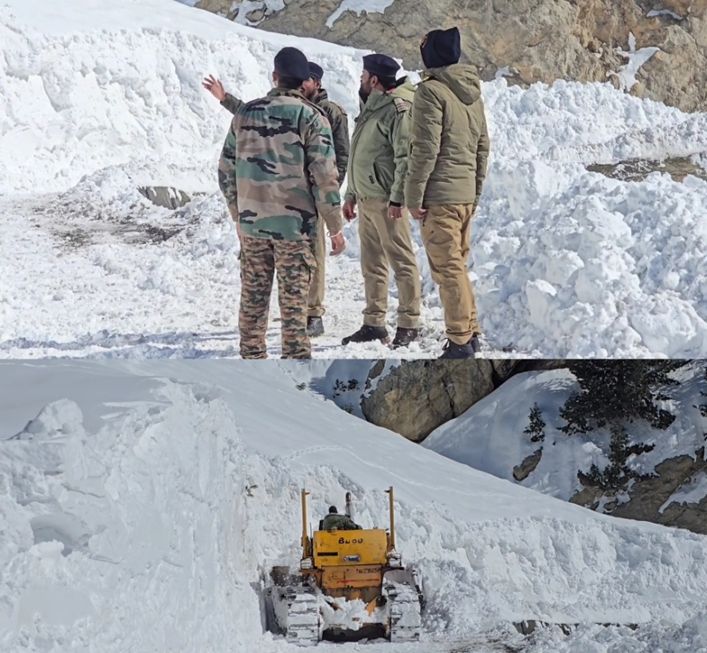
Battling Nature at 11,500 Feet: Situated at an elevation of more than 11,500 feet above sea level, Zojila is widely regarded as one of the toughest mountain passes in South Asia. Snowstorms can arise suddenly, visibility often drops to near zero, and icy winds pose constant hazards for road crews. BRO personnel deployed specialised machinery capable of cutting through thick snow walls, while ground teams worked in rotating shifts to ensure the route remained motorable. Officials said the operation required precision timing, as even brief pauses in clearance could allow fresh snowfall to block the route again. Field teams also had to monitor avalanche prone stretches, stabilise vulnerable sections, and coordinate with local authorities to regulate traffic flow for safety. Continuous patrolling was undertaken to identify icy patches and landslide risks, ensuring vehicles could travel without incident. According to officials, such round-the-clock winter operations demand both technical expertise and physical endurance. Workers often function in oxygen-thin air and freezing conditions that test human limits, yet they remain stationed for extended periods to maintain road connectivity.
Relief for Residents, Transporters: The uninterrupted winter opening of the pass has brought relief to thousands of residents, traders, drivers, and travellers who depend on the highway. For remote communities, road access determines the availability of food supplies, medicines, fuel, and other essential commodities. Transporters said continuous connectivity prevents price spikes and shortages that commonly occur when routes close. Traders noted that winter access allows business activity to continue instead of halting for months, improving economic stability in high-altitude districts. Commuters travelling for education, employment, or medical treatment have also benefited from the development. In previous years, long winter closures often forced residents to postpone travel plans or rely on costly alternatives. This season, however, vehicular movement has continued, allowing routine mobility even during severe weather. Officials described the achievement as a major relief for the public, adding that reliable road access enhances not only convenience but also safety by ensuring faster emergency response and evacuation if needed.
Strategic and Administrative Significance: Beyond civilian benefits, the route holds major logistical importance. Reliable winter connectivity ensures steady transportation of equipment, materials, and supplies needed for administration and development activities in high-altitude regions. Experts say the ability to maintain the pass open demonstrates improved preparedness and planning capabilities. Over the years, authorities have invested in better forecasting tools, stronger machinery, and refined snow-management techniques. This combination has made it possible to sustain operations in conditions that previously forced closures. Officials emphasised that such achievements are not accidental but result from long-term institutional learning. Each winter season provides data on snowfall patterns, terrain behaviour, and equipment performance. That information is analysed and used to improve strategies for subsequent operations, gradually strengthening the system’s resilience.
Engineering Progress in Extreme Terrain: Infrastructure specialists view the development as evidence of evolving engineering capability in high-altitude road maintenance. Modern snow cutters, avalanche-control methods, satellite monitoring, and improved communication systems now enable teams to respond faster and operate more efficiently. Road engineers explained that keeping a pass open is far more complex than clearing snow once. It requires continuous monitoring, preventive maintenance, and rapid intervention whenever conditions change. A single snowstorm can undo hours of work, making persistence essential. They added that winter operations also demand careful planning of fuel supply, machinery maintenance, worker rotation schedules, and safety protocols. Every element must function smoothly to sustain uninterrupted connectivity.
Boost for Tourism, Economy: The pass also serves as a gateway to several scenic and tourist destinations. Improved winter accessibility could encourage more off-season travel and winter tourism in the region, benefiting local businesses such as hotels, transport services, and small traders. Tourism stakeholders believe that reliable winter road connectivity has the potential to transform seasonal economies by extending visitor activity beyond the traditional summer months. Although tourism during peak winter remains limited due to weather risks, better road access is expected to gradually boost confidence among travellers. Local entrepreneurs say that consistent accessibility improves planning certainty, enabling them to manage supplies and services more efficiently. This stability, they argue, is essential for sustainable development in mountainous regions where economic opportunities are often constrained by geography.
Human Effort Behind the Achievement: Officials repeatedly highlighted the dedication of personnel deployed on the ground, noting that winter road maintenance at such altitude requires discipline, resilience, and teamwork. Workers often remain stationed in remote camps for extended periods, separated from families, to ensure the route remains open. They operate in conditions where temperatures can plunge far below freezing, machinery can freeze overnight, and sudden storms can disrupt visibility. Despite these challenges, teams continue their duties, driven by the understanding that thousands depend on the road’s accessibility. Authorities commended the field units for their commitment, saying their work exemplifies professional excellence and public service. They added that such achievements underscore the importance of investing in infrastructure agencies capable of operating effectively in difficult environments.
A Shift in Winter Connectivity Narrative: Historically, Zojila’s closure symbolised the seasonal isolation of high-altitude regions. Winter months often meant restricted mobility, limited trade, and logistical challenges. This year’s sustained opening suggests that such isolation may gradually become less common as operational capabilities improve. Analysts say that if similar performance is maintained in coming winters, it could redefine expectations for mountain connectivity. Reliable winter access would strengthen economic integration, support development initiatives, and improve quality of life for residents in remote districts. They caution, however, that such operations remain highly dependent on weather conditions, which can vary unpredictably. Continued success will require sustained investment in equipment, training, and planning.
Milestone in Mountain Infrastructure: Officials described the season’s achievement as a milestone in high-altitude road maintenance history. They said it demonstrates the growing efficiency of agencies tasked with maintaining critical routes in challenging terrain and reflects the impact of improved planning, technology, and field experience. Infrastructure experts agree that the development highlights a broader trend the steady strengthening of logistical networks in mountainous regions. Such progress is considered essential for regional development, disaster preparedness, and economic growth.
Looking Ahead: As winter continues, authorities remain vigilant, monitoring weather patterns and maintaining readiness to respond to snowfall or avalanches. Teams remain deployed along the route, prepared to clear fresh snow and ensure safe passage for vehicles. Officials said their objective is not only to keep the road open but also to maintain safety standards, emphasising that traffic regulation and real-time advisories are critical components of winter operations.
They added that lessons learned from this season will guide planning for future winters, potentially setting new benchmarks for high-altitude road management.
With the successful maintenance of continuous winter traffic across Zojila, a route once synonymous with seasonal closure is steadily transforming into a symbol of resilience, technical capability, and year-round connectivity a development that could reshape mobility, trade, and daily life across the Himalayan region