Decades of Internal Security Transformation In J&K : From Aug 5, 2019 to 2029
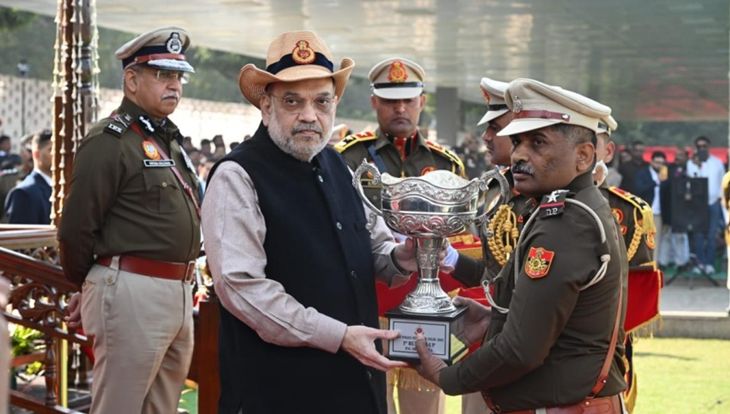
Srinagar: Union Home Minister Amit Shah this week laid out an ambitious internal security roadmap, declaring that terrorism and insurgency in Jammu & Kashmir and the North-East would be completely eradicated by 2029, while Maoist violence across the country would be eliminated by March 31, 2026. Speaking at the 79th foundation day celebrations of the Delhi Police in the national capital, Shah framed the announcement as the culmination of what he described as a decade-long transformation of India’s internal security architecture since 2014.
A Time-Bound Security Roadmap: Shah laid out an ambitious internal security roadmap, declaring that terrorism and insurgency in Jammu & Kashmir and the North-East would be completely eradicated by 2029, while Maoist violence across the country would be eliminated by March 31, 2026. Shah framed the announcement as the culmination of what he described as a decade-long transformation of India’s internal security architecture since 2014.
J&K At The Centre Of National Security Narrative: While the event centred on policing reforms and the launch of new initiatives in Delhi, the political message was unmistakably national — and for Jammu & Kashmir, pointedly specific. Shah asserted that the security situation in the Union Territory has been “gradually improving” following the abrogation of Article 370 in August 2019, which ended the erstwhile state’s special status. “I can assure the countrymen that J&K and the North-East would be free of violence by 2029,” he said, placing a definitive timeline on a region long associated with terrorism and cross-border infiltration.
Post-Article 370 | Consolidation Phase: For Jammu & Kashmir, the announcement carries both symbolic and strategic weight. Since 2019, the Centre has maintained that the withdrawal of special status was intended to integrate the region more fully with the rest of India and create conditions for lasting peace and development. Shah’s remarks suggest the government believes it has entered a consolidation phase — where sporadic incidents are seen as residual rather than systemic threats.
80% Challenges “Under Control”: He argued that before 2014, India’s internal security faced serious challenges in three major theatres: Jammu & Kashmir, the North-East, and Maoist-affected districts. “Around 80 percent of these issues have now been brought under control,” Shah said, citing peace accords in the North-East and a steady decline in Maoist violence. Nearly 20 peace agreements have been signed with insurgent groups in the North-East, he noted, and more than 10,000 youth have laid down arms and joined the mainstream.
Border Security, Zero Infiltration Goal: In Jammu & Kashmir, the Centre has emphasised a multi-pronged strategy — combining security operations, intelligence-led counter-terror measures, border infrastructure, and development initiatives. Shah highlighted the government’s resolve to build a security system “so strong that not even a single infiltrator can cross the borders.” The statement reflects continued focus on strengthening surveillance and anti-infiltration grids along the Line of Control and international border.
Criminal Law Reforms, Conviction Rates: The Home Minister’s remarks also linked security directly with governance reforms and legal restructuring. Referring to the newly introduced criminal codes — the three Nyay Samhitas Shah said the objective was to modernise India’s criminal justice system and raise the national conviction rate to 75–80 percent. He pointed out that states such as Assam, Haryana and Gujarat have already recorded conviction rate increases of over 20 percent under reformed systems. The implication for Jammu & Kashmir is significant, where effective prosecution has historically been a challenge in terror-related cases.
Safe City Model| Tech-Driven Policing: At the Delhi Police event, Shah unveiled ten new initiatives, including the Safe City project for the national capital. The project will see the deployment of around 2,100 AI-enabled cameras as part of a larger network of 10,000 cameras, in addition to 15,000 already installed across the city. He later inaugurated the first phase of the project, which includes a modern command and control centre integrating 21,000 CCTV cameras, of which 10,000 have gone live.
Expanding Surveillance Infrastructure Nationwide: While Delhi’s surveillance expansion is city-specific, Shah indicated that the Ministry of Home Affairs intends to “weave a network of CCTV cameras across the country” to create a technologically advanced security ecosystem. Such technological integration has direct relevance for conflict-prone regions like Jammu & Kashmir, where intelligence, monitoring, and rapid response capabilities are central to counter-terror strategy.
The “Golden Era” Claim: Shah described the period since 2014 under Prime Minister Narendra Modi as a “golden era” in India’s internal security history. The claim rests on measurable indicators a decline in large-scale terror attacks, reduced Maoist activity across central India, and a stabilising North-East marked by negotiated settlements rather than prolonged insurgency. For Jammu & Kashmir, however, the narrative remains closely tied to political developments, including grassroots democratic processes and investment outreach initiatives.
Beyond Terrorism| Drugs, Cyber Threats, Organised Crime: Beyond terrorism and insurgency, Shah outlined broader priorities: building a “drug-free India,” eliminating cyber-terrorism, and dismantling organised crime networks. He revealed that nine gangsters were killed in encounters in 2025 and that the Delhi Police Special Cell, with support from central agencies, is monitoring 32 gangsters who have fled abroad. Though primarily referencing metropolitan crime, the agenda overlaps with concerns in Jammu & Kashmir, where narco-terror financing and online radicalisation remain security challenges.
A Benchmark For 2029: The Home Minister’s confidence about a terror-free Jammu & Kashmir by 2029 sets a clear benchmark against which future developments will be measured. It reflects the Centre’s assessment that structural shifts — from intelligence coordination to border fencing, from financial crackdowns to administrative reorganisation — have altered the trajectory of violence in the Union Territory.
From Assurance To Accountability : In setting firm deadlines — March 2026 for Maoist violence and 2029 for terror and insurgency in Jammu & Kashmir and the North-East — Shah has translated a political objective into a time-bound national commitment. For Jammu & Kashmir, the declaration is both assurance and assertion an assurance that stability is within reach, and an assertion that the Centre remains committed to transforming security gains into lasting peace. The coming years will determine how firmly that vision takes root on the ground.