PM Modi Finalizes Strategic Trade Realignment
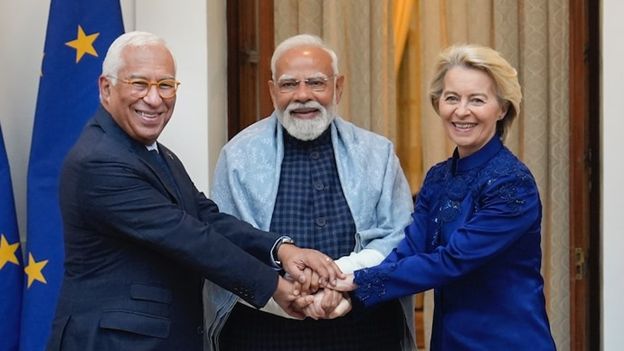
New Delhi: India and the European Union (EU) have announced the conclusion of negotiations for a Free Trade Agreement (FTA), marking a major development in bilateral trade and economic relations. The agreement establishes a modern, rules-based framework aimed at deepening market integration between the world’s fourth-largest economy and the second-largest economic bloc. Officials described the FTA as one of the most comprehensive trade agreements negotiated by India, covering goods, services, investment facilitation, regulatory cooperation and non-tariff barriers. The agreement is expected to significantly expand export opportunities for Indian industries, particularly labour-intensive sectors such as textiles, apparel, handicrafts and furniture.The conclusion of negotiations comes as India continues to expand its global trade engagement under the leadership of Prime Minister Narendra Modi, with a focus on improving market access, diversifying exports and strengthening India’s integration into global value chains.
Strategic Importance of the India–EU Trade Partnership: The European Union remains one of India’s most important trading partners. The EU is currently India’s second-largest export destination for textiles and apparel after the United States, highlighting the strategic importance of the European market for Indian manufacturers and exporters. The agreement is being finalised at a time when global trade patterns are undergoing adjustment. During the presidency of former US President Donald Trump, changes in US trade policy, including tariff restructuring and bilateral negotiations, contributed to shifts in global supply chains. These developments reinforced the importance for countries such as India to diversify export markets and strengthen trade ties with multiple major economies, including the EU. Officials said the India–EU FTA is intended to provide long-term stability, predictability and transparency for businesses on both sides, while responding to evolving global economic conditions.
Scale of the European Textile, Apparel Market: According to official data, the European Union’s total global imports of textiles and apparel stood at USD 263.5 billion in 2024, underlining the size and long-term potential of the European market. India’s textile and apparel exports to the EU have shown consistent positive growth over the past five years. India’s current global textile and apparel exports are valued at approximately INR 3.19 lakh crore (USD 36.7 billion), of which INR 62.7 thousand crore (USD 7.2 billion) is exported to the EU. With the implementation of the FTA, officials expect these figures to increase substantially due to improved price competitiveness and expanded market access.
Zero-Duty Access for Textiles, Apparel: One of the key outcomes of the FTA is the proposed zero-duty access for textiles and clothing across all tariff lines, with tariff reductions of up to 12 per cent. This provision is expected to open the EU’s textile and apparel import market, valued at around INR 22.9 lakh crore (USD 263.5 billion), to Indian exporters on preferential terms. Officials said the removal of tariffs would significantly benefit Indian exporters across multiple segments, including cotton yarn, man-made fibre apparel, ready-made garments, men’s and women’s clothing and home textiles. The agreement addresses a long-standing tariff disadvantage faced by Indian exporters compared to competitors such as Bangladesh, Pakistan and Turkey, which currently enjoy preferential access to the EU market under various trade arrangements.
Export Composition, Labour-Intensive Segments: India’s textile exports to the EU are diversified across several value-added and labour-intensive categories. Ready-made garments account for approximately 60 per cent of total textile exports to the EU, followed by cotton textiles at around 17 per cent and man-made fibre and MMF textiles at about 12 per cent. Other important segments include handicrafts and carpets, each contributing around 4 per cent. Jute products account for approximately 1.5 per cent, while woollen textiles, handlooms and silk products together make up smaller but significant shares. Officials noted that the export basket reflects the MSME-driven and artisanal nature of India’s textile trade with the European market, with strong linkages to rural and semi-urban employment.
Employment Impact , MSME Participation: The textile sector employs around 45 million people directly in India, making it one of the country’s largest employment-generating industries. Improved access to the EU market is expected to support higher production levels, improved capacity utilisation and employment generation across textile and apparel manufacturing clusters. Micro, small and medium enterprises (MSMEs) are expected to be key beneficiaries of the agreement, particularly in labour-intensive segments such as garments, home textiles, handicrafts and carpets. Officials said the FTA is also expected to encourage investment and technology transfer, including upgrades in manufacturing processes aligned with EU sustainability and quality standards.
Market Access for Home Décor, Wooden Crafts & Furniture: Beyond textiles and apparel, the FTA provides enhanced market access for home décor, wooden crafts and furniture. Tariff reductions of up to 10.5 per cent are expected to improve competitiveness for Indian wooden, bamboo and handcrafted furniture products in the European market. The agreement is expected to support growth in high-value, design-oriented segments and strengthen India’s participation in global furniture and home décor supply chains.
District-Level,d Cluster-Based Impact: India’s textile and apparel exports to the EU originate from a geographically dispersed manufacturing base, covering 342 districts across the country. Officials said this reflects broad-based participation and regional inclusiveness in India’s export ecosystem.
Major ready-made garment clusters include Tiruppur, Bengaluru and the Gurugram–Faridabad region, which support large-scale employment, particularly among women workers. Cotton textiles and home furnishings are produced in clusters such as Karur, Panipat and Ahmedabad. Man-made fibre and synthetic textiles are concentrated in Surat, Dadra and Nagar Haveli and Mumbai, strengthening India’s presence in blended and MMF product categories. Traditional and value-added segments include handicrafts from Moradabad, Jaipur and Jodhpur; handlooms from Kanchipuram, Karur and Kolkata; carpets from Bhadohi, Mirzapur and Varanasi; jute products from Howrah and the North and South 24 Parganas; and silk and woollen textiles from Bengaluru, Mysuru and Bhagalpur.
Addressing Non-Tariff Barriers: In addition to tariff liberalisation, the India–EU FTA includes provisions aimed at addressing non-tariff barriers. These include enhanced regulatory cooperation, customs facilitation measures, transparency requirements and predictable trade-related rules. Officials said these provisions are intended to reduce transaction costs, improve ease of doing business and provide exporters with greater certainty and clarity in accessing the European market.
Integration with India’s Broader Trade Strategy: The India–EU FTA complements India’s broader trade engagement with Europe and other major economies. India has recently concluded trade agreements with the United Kingdom and the European Free Trade Association (EFTA), expanding access to European markets. Together, these agreements are expected to support export diversification and reduce dependence on a limited number of markets. Officials said the FTA aligns with India’s long-term development objectives and supports its efforts to strengthen manufacturing and exports. The conclusion of the India–EU Free Trade Agreement marks a significant step in bilateral economic relations. Once implemented, the agreement is expected to expand trade flows, support employment generation and facilitate deeper integration of Indian industries into global value chains. Officials said further details regarding timelines for implementation and sector-specific commitments will be announced following legal vetting and ratification procedures on both sides.